Azil system: calculated astronomical model
October 26, 2026. A numerical implementation of the Game Master’s direction. Physical values are model choices, not recovered observations. The origin “Year 0 Day 0” is computational and establishes no historical era.
Parameters
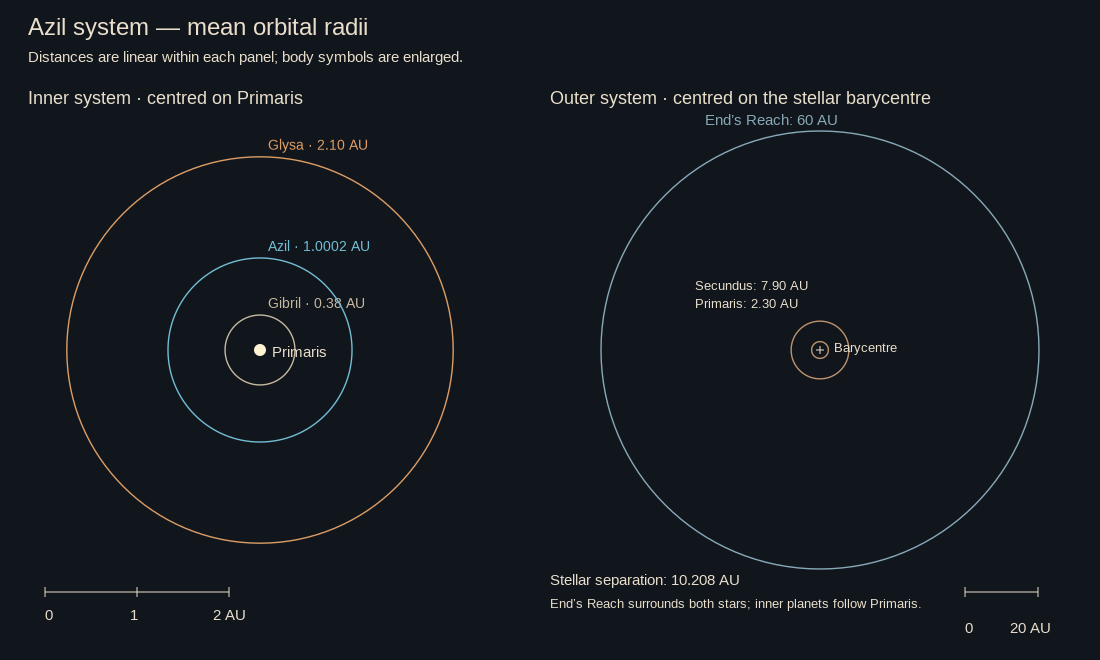
| Body | Orbit (AU) | Period (days) | Radius (km) | Temperature (K) |
|---|---|---|---|---|
| Solaris Primaris | 2.302530 | 10329.23077 | 723528 | 5822.56 |
| Gibril | 0.380000 | 84.30376 | 3313 | 449.86 |
| Azil | 1.000202 | 360.00000 | 6371 | 294.15 |
| Glysa | 2.100000 | 1090.17780 | 73407 | 452.69 |
| Solaris Secundus | 7.905354 | 10329.23077 | 208710 | 3400.00 |
| End’s Reach | 60.000000 | 147157.43493 | 62920 | 61.27 |
Primaris: G1 V, 1.03 solar masses, 1.04 solar radii, 1.12 solar luminosities, 5822.56 K; 0.8 billion years, solar metallicity, ten-day rotation and 0.05% rotational variability semi-amplitude. Secundus: M3 V, 0.30 solar masses/radii, 3400 K, 0.01084 solar luminosities, 72-hour rotation and irregular magnetic flares. The constant relative stellar separation is 10.207884 AU; individual stellar orbits above are barycentric.
Azil: one Earth mass/radius, 24-hour solar day, 23.933518-hour sidereal rotation, 3° tilt, 1.11955 Earth insolation, Bond albedo 0.30, 261.87 K equilibrium temperature, 32.28 K greenhouse difference and 294.15 K (21 °C) surface mean. The model assumes 71% oceans and a nitrogen–oxygen/water-vapour atmosphere. This energy balance is not a full climate simulation.
Gibril: 0.12 Earth masses, Bond albedo 0.12, negligible mineral exosphere, 1400-hour rotation and 1° spin tilt. Glysa: 10 Jupiter masses, 1.05 Jupiter radii, 450 K intrinsic temperature and 177.41 K irradiation temperature combine to about 452.69 K. Residual formation heat at the chosen young age explains its hot hydrogen–helium atmosphere; no exact cooling-grid interpolation is claimed. End’s Reach: 0.70 Jupiter masses, 0.90 Jupiter radii, Bond albedo 0.40, intrinsic 60 K plus irradiative 32.61 K give a combined 61.27 K cold hydrogen–helium atmosphere. A faint icy ring is a generic model assumption. No satellites are newly named or counted.
Dynamical stability
Using Holman & Wiegert’s empirical coplanar prograde criteria at mass ratio 0.22556391 and zero binary eccentricity, the circumprimary boundary is 3.8614966 AU and the circumbinary boundary 23.1754568 AU. Glysa’s apocentre is 2.142 AU, leaving 1.7195 AU inside the inner boundary. End’s Reach’s pericentre is 58.8 AU, leaving 35.6245 AU outside the outer boundary. Gibril and Azil are farther inside. Azil/Glysa are separated by 4.871 mutual Hill radii. These screens do not replace a long-term multi-body integration. Azil’s 360-day Kepler relation uses Primaris plus Azil’s mass, not the combined binary mass; stellar tides are a small perturbation.
Visibility
Primaris spans 0.554° from Azil. Secundus spans 0.01426–0.01736°, at 11.208–9.208 AU between conjunction and opposition, with mean distance 10.232 AU. Integrating blackbody spectra against CIE’s photopic efficiency gives 92.4476 and 33.9285 lm/W. Primaris supplies about 140,900 lux above the atmosphere (105,700 lux on a clear horizontal surface at zenith). Secundus supplies 3.98–5.90 lux normal to its rays before atmospheric loss; clear-air zenith values are 2.99–4.43 lux. A low star gives less, and Primaris hides Secundus at exact conjunction. Full moonlight on Earth is roughly 0.1–0.3 lux, an order-of-magnitude comparison only. Red-orange night light is consistent with the Red Nights; the paintings’ saturated red skies remain artistic interpretation.
True-dark nights and festival timing
The Festival of the Eclipse officially starts on the first night of true darkness. At the model’s 45° north reference, one whole sunset-to-sunrise true-dark night occurs every 373 days (1.036111 years). The reference is not a measured latitude for Vesper Court. Both stellar upper limbs are checked against a level geometric horizon throughout the night. Primaris’s approximately 0.277° angular radius, compared with Secundus’s approximately 0.007° radius, makes the narrow window possible. A broad arbitrary conjunction window or a replacement of the whole night by astronomical twilight would give a different answer.
The first begins at sunset, absolute day 19.742738714 (Year 0 Day 19), and ends at day 20.257265685: 12.348647 hours. Secundus’s upper limb stays at least 0.107898° below the horizon. Both adjacent nights fail. Across 360 checked cycles the night duration varies from 11.54757 to 12.34867 hours, with one qualifying night each cycle. Night labels advance by 373 days, shifting the calendar date by 13 days; exact sunset times vary slightly. Mean opposition, the Red Nights peak geometry, follows mean conjunction by 186.5 days. The complete mean-element pattern repeats in 134,280 days (373 Azil years). The epoch is computational; no festival length, new rites or historical date is assigned.
True darkness here means no direct starlight. Twilight, moonlight and artificial light are not removed. No lunar phases, distances or periods are asserted by this article model. The existing hierarchy remains Azil → Father → Song. A later sky implementation must recalculate for its actual latitude and orbital perturbations before treating these model dates as an observed almanac.
Scientific method references
- Holman & Wiegert (1999), Long-Term Stability of Planets in Binary Systems, empirical S/P critical radii.
- Baraffe et al. (2003), evolutionary models for cool brown dwarfs and extrasolar giant planets, physical context for residual cooling.
- CIE (2019), spectral luminous efficiency for photopic vision, DOI 10.25039/CIE.DS.dktna2s3; blackbody-weighted efficacy calculation, not maximum monochromatic efficacy.
- US Naval Observatory, Rise, Set and Twilight Definitions, distinction between stellar limb visibility and astronomical twilight.