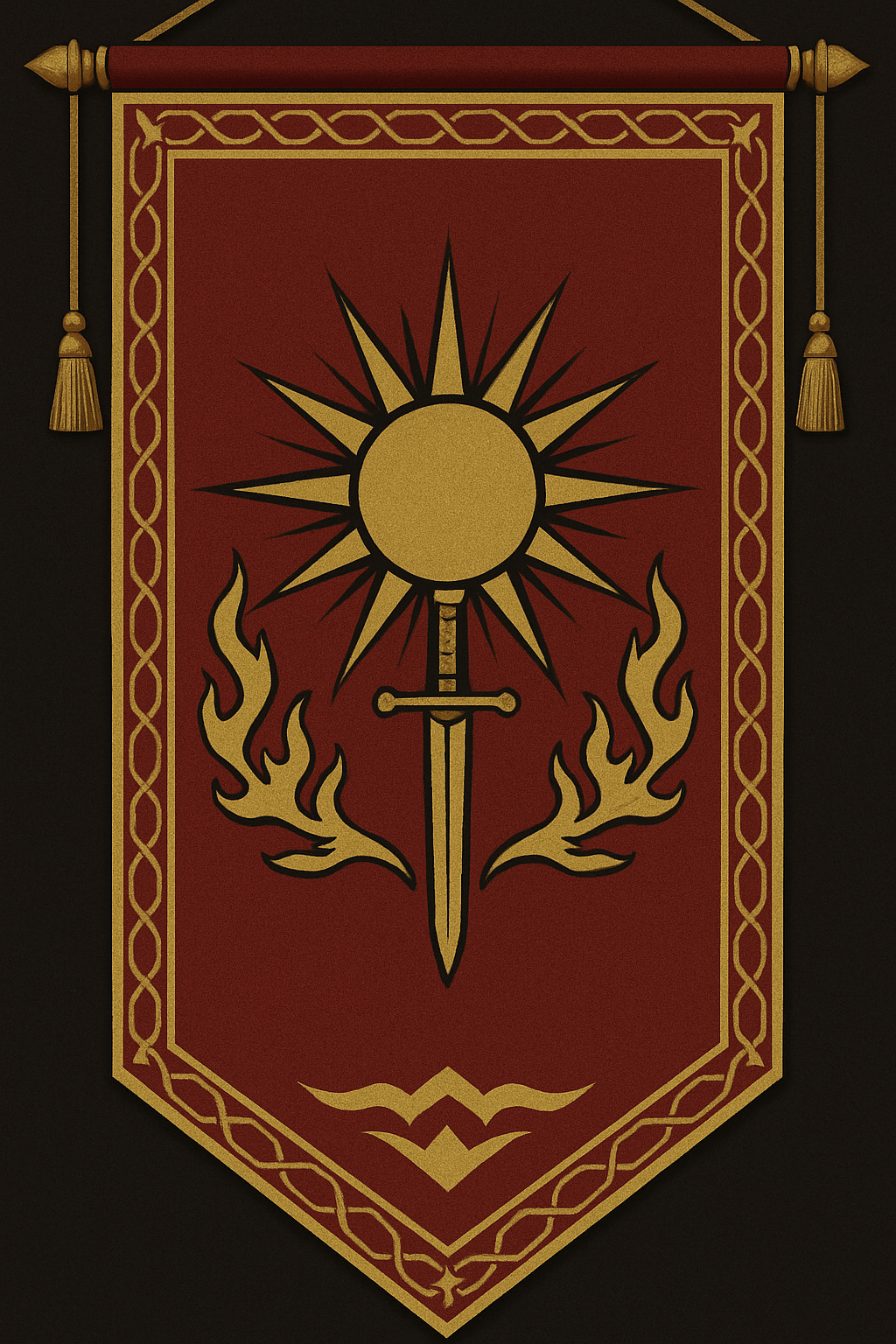
Pronunciation (approximate): IPA /ˈkɪŋdəm əv ði ɪˈtɝnəl sʌn/ · English: KING-dum uv thee ih-TUR-nuhl SUN
Overview
The Kingdom of the Eternal Sun, often shortened in notes to KotES or the Eternal Sun Kingdom, is remembered as one of the great mortal powers of Azil. Its name carries a promise as much as a claim: that civilization may endure beneath an unsetting light, even when night belongs to ghouls, vampires, and the dead. Current campaign notes place the kingdom in the same historical orbit as the Great War, vampire-lord dominion, and the hard doctrine of survival that shapes modern Midnightian lands.
The kingdom is most closely associated with King Rashkhan, whose quoted words are severe rather than affectionate: he does not promise love, only survival. This frames KotES as a polity built around protection through discipline, fortification, and sacrifice. Its mercy is pragmatic, often harsh, and directed toward keeping the living world from being consumed.
Identity and Mandate
KotES should be treated as a survival state: a realm whose institutions are judged by whether they keep people alive. Law, military service, rationing, sanctuary, and punishment likely all flow from this first principle. The kingdom's ideology does not appear gentle, but it is not merely cruel; it is a system that has decided the alternative to order is predation.
The phrase Eternal Sun suggests a political myth of daylight extended into law. In a world where darkness empowers the undead, the kingdom's image of an unending sun becomes both religious metaphor and military doctrine. Its walls, patrols, and internal strictures are not ornamental; they are the machinery by which dawn is made repeatable.
Rashkhan and Kingship
King Rashkhan's recorded voice is blunt, unsentimental, and protective by force of will. He speaks as a ruler who expects resentment, perhaps even hatred, but measures success by survival rather than affection. Future lore should clarify whether Rashkhan is founder, reformer, war king, or inheritor of a desperate throne.
His rule appears to rest on three assumptions: the dead will not relent, ordinary mercy can become weakness, and citizens may need to endure hardship so the whole realm does not fall. That makes him a useful lens for writing KotES material: every policy should answer the question, what does this cost, and who survives because of it?
Military Structure
The most visible military expression of KotES is the Dread Horde, a force described as expendable by outsiders and necessary by Rashkhan. If the kingdom's regular armies are its shield, the Dread Horde is its grinder: a formation sent into conditions too costly, diseased, or monstrous for conventional soldiers to endure cleanly.
Campaign notes also mention the Great War and conflict with vampire powers. KotES military records should eventually distinguish between border garrisons, city defense, field armies, scouts, inquisitors, and sacrificial formations such as the Dread Horde. Until more notes confirm details, the safest reading is that the kingdom survived because it was willing to organize violence at scale.
Faith and Midnightian Context
The Kingdom of the Eternal Sun is not yet fully mapped against Midnight's faith. It may revere her, oppose aspects of her hierarchy, or operate as a secular survival kingdom under the shadow of her mandate. Its hostility toward vampires is compatible with Midnightian doctrine, but compatibility is not the same as obedience.
If KotES predates parts of modern Midnightian order, its sun imagery may represent an older mortal tradition that was later absorbed, reinterpreted, or contested by the Temple and Coven. This should remain open until campaign canon confirms the relationship.
Known Campaign References
Fenris's early notes reference the Great War and the Eternal Sun Kingdom.
Article descriptions attribute hard survival doctrine to King Rashkhan.
The Dread Horde is explicitly tied to KotES and to anti-monster warfare.
Petorin's backstory, while not confirmed as KotES-based, includes inquisitorial training and vampire warfare themes that fit the kingdom's broader survival culture.
Open Questions
Where is the kingdom located relative to the party's current route, the black slab, and the ruins below Azil?
What are the dates of Rashkhan’s accession and the earlier phases of his reign? The party has met him in the present campaign.
Does KotES serve Midnight directly, cooperate with her institutions, or preserve an older solar tradition?
What caused the Great War, and what role did KotES play in its beginning and end?
Recorded Royal Encounters
The party has met King Rashkhan in the Eternal City. In Petorin's sixth adventure, the king wrestles Kor despite missing his right arm, equips the party from his armory, and brings them to the barrier above the Vaults of Eternity. Melody identifies the battle Petorin experienced through their link as the Siege of Tambleton; Petorin associates Rashkhan's lost arm with that memory.
This cooperation does not establish royal command over every religious undertaking. After the descent, two Daughters of the Eclipse tell Rashkhan he is not destined to know the party's next destination.
On October 10, Rashkhan gives Petorin a crossbow and an old inquisitors' book as wedding gifts, but refuses to waive Vesper Court's taxes. He says a year of back taxes is due and directs Petorin to the records office. When Petorin proposes transferring the property to Melody for religious purposes, the king says ownership must be male. These are the rulings recorded in this specific transaction; the notes do not supply a complete code of kingdom law.
Eternal City
For the party’s encounters with the city’s districts, lifts, and access documents, see Eternal City and Eternal City Transit Papers.