Pronunciation (approximate): IPA /ˈruɪnz əv ði oʊld/ · English: ROO-inz uv thee OHLD
Overview
The Ruins of the Old are remnants of an earlier civilization or technological age on Azil. They are marked by stonework, mechanisms, heat, constructs, and materials that exceed what living craftsmen can easily reproduce. The quoted historian is explicit: no living chisel or forge is believed capable of matching the work.
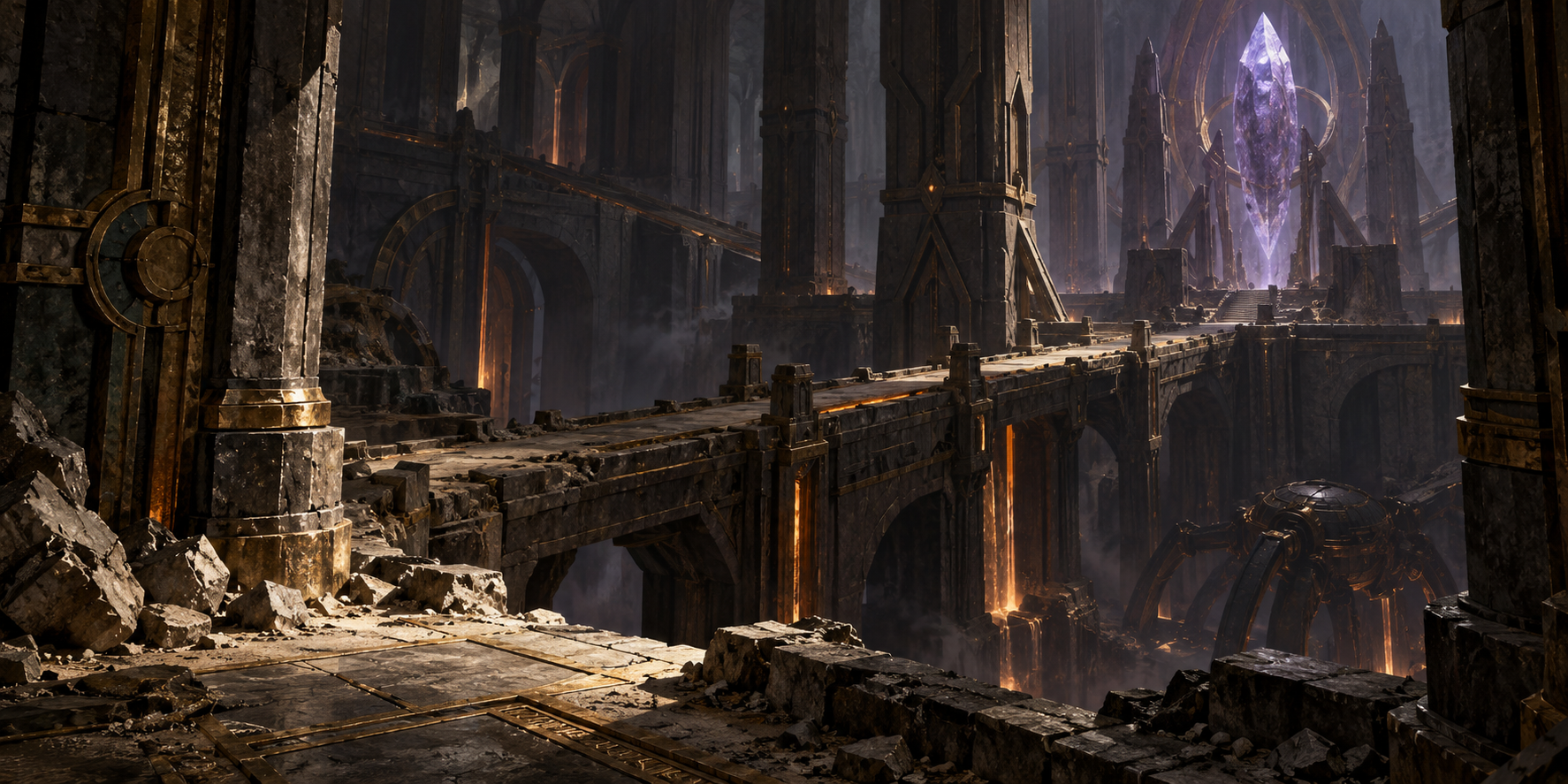
Recent quest-log material gives the party direct contact with this category of site. Beneath the black slab, the company entered a ruin of metallic guardians, ancient command protocols, elevated crossings, glowing runes, and a purple crystal that reacted to Petorin's key. That site should be treated as a living example of the Old rather than an isolated dungeon.
Material Character
The Old ruins are not merely broken castles. They contain worked stone, metal, and arcane or mechanical systems that retain function long after their makers vanished. Doors respond to authority tokens. Constructs parse language, count bodies, assign roles, and enforce commands. Heat, flowing metal, or forge-like channels may remain active where ordinary infrastructure would have gone cold centuries ago.
This suggests the Old combined architecture, law, and machine into one system. A door is not only a door; it is a checkpoint. A statue is not only a statue; it is an administrator of violence. A crystal is not only a relic; it is an archive or engine of memory.
Authority and Language
The party's exploration of the lower ruin shows that Old systems still recognize hierarchy. The spider-like guardian asked for an architect, rejected Petorin despite the black slab, called the party slaves, and temporarily assigned Shiel an authority role. These are not neutral terms. They imply a society built around command, labor classification, and enforced compliance.
The words activate, present, Heaven, providence, architect, and liquidation should be treated as important vocabulary until translated more fully. They may be literal, mistranslated, religious, administrative, or all of those at once.
Known Features
Black slabs: Key-like objects that grant access or identify authorization, though possession does not necessarily make the bearer the true authority.
Metallic guardians: Statues and spider-like constructs that react to noise, issue commands, count entrants, and threaten liquidation.
Mimic hazards: Not every threat is part of the original system; some monsters may infest Old sites after abandonment.
Runic instructions: Wall text that can activate ancient mechanisms when spoken correctly.
Purple crystal archive: A large crystal that accepted Petorin's slab and delivered visions of ruined buildings and a place Dina named Avargus.
Avargus and Lost Cities
Petorin's vision in the command center pointed toward destroyed buildings and a place Dina identified as Avargus: a mythical city known for killing and hiding from vampires, possibly destroyed and laid beneath water. If accurate, Avargus may be one of the clearest bridges between the ruins of the Old and later mortal resistance against vampire powers.
At present, it is unknown whether Avargus built the ruins, inherited them, hid within them, or merely learned how to use Old systems. Future discoveries should separate three possibilities: the Old as original makers, Avargus as later users, and modern factions as scavengers of both.
Dangers
Old ruins are dangerous because they still obey dead instructions. The party survived not by conquering the system but by giving it answers close enough to pass. This is a key rule for future writing: the Old does not need malice to kill. It only needs an obsolete command that still has power.
Other dangers include misread language, false authority, automated defenses, unstable magic, predatory creatures nesting in abandoned rooms, and political consequences if a modern faction learns how to control what remains below.
Open Questions
Who were the Old: ancestors of modern peoples, a vanished empire, servants of gods, or something stranger?
What is the exact relationship between the Old ruins, Avargus, and vampire resistance?
Why do the constructs call living visitors slaves, and what did architect mean in their society?
What does liquidation mean in the ruin's original command structure?
Why did Melody need the item or knowledge beneath the black slab, and how much did she already understand?
The Guardian's Reckoning
In Shiel's account of the June 27 exploration, the spider-like guardian rejects the date she supplies because it would mean more than thirty-five hundred years have passed. This is the construct's own reckoning; the party has not independently dated the ruin.
Black Slabs Beyond the Ruin
The slabs later provide a concrete connection to the machinery beneath Rashkhan's palace. In the August 1 descent, Leashira reminds Dina that Brax took two black slabs from skeletons in the earlier temple with the great crystal. Dina uses one at the central pillar, and the platform descends as her eyes and Petorin's turn white. Leashira's full account records the recovered objects being used in a second site; it does not establish that the two complexes share a builder.
Reference Painting
An immense underground stone-and-metal hall frames a raised crossing, ancient mechanisms, a purple crystal and a dormant spider-like guardian. It interprets features of the recorded Old ruin; it identifies neither Mount Celestia nor Avargus nor a shared builder with Rashkhan's vault.