Pronunciation (approximate): IPA /ˈsɪməlkrɑn/ · English: SIM-uhl-krahn
Overview
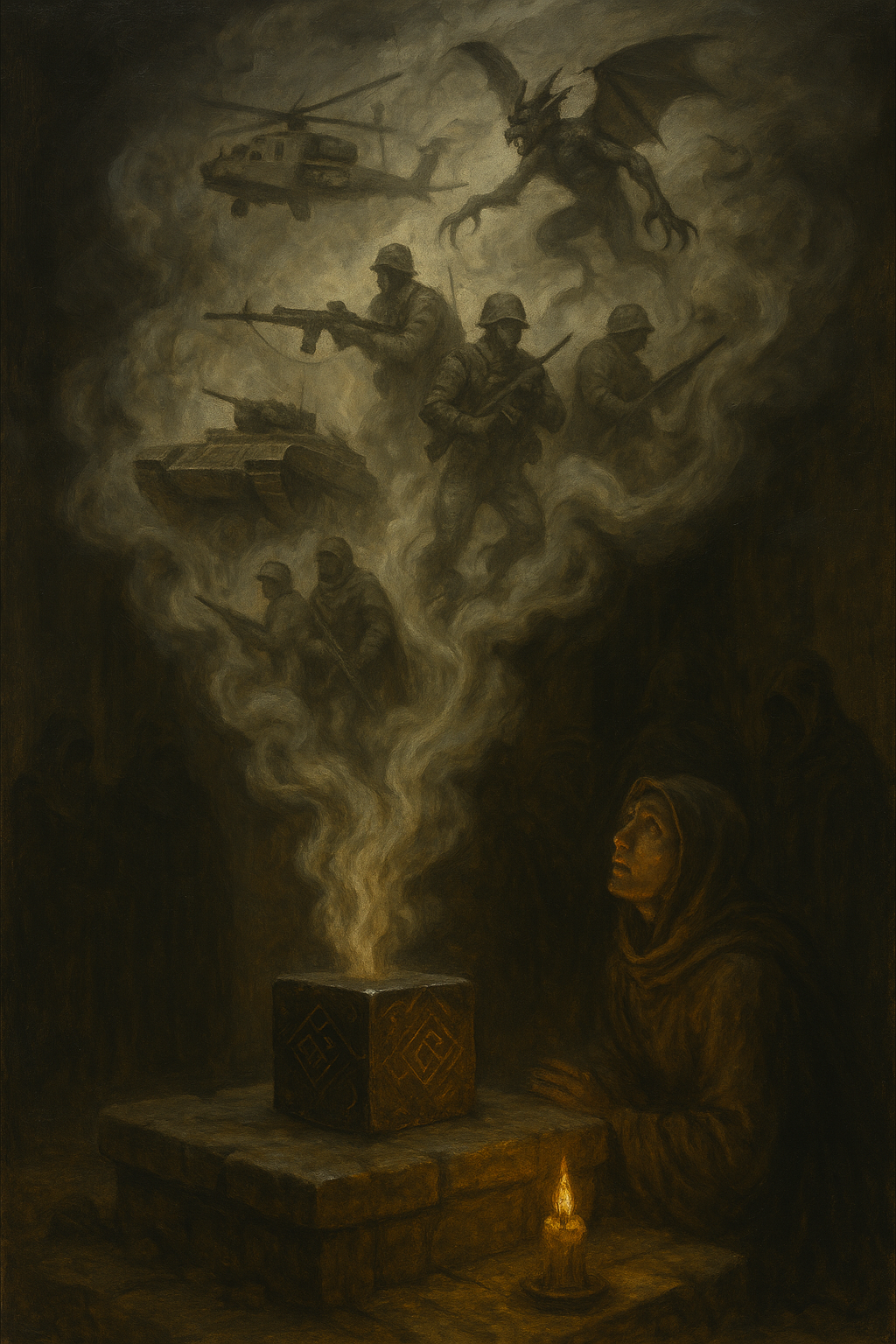
The Simulcron is a relic of enigmatic provenance, a vessel of memory whose purpose remains obscured by the collapse of the age that birthed it. In the present day it appears as a small and inert object, most often a cube wrought of some blackened alloy or stone, marked with angular etchings that defy contemporary craft. Yet when awakened by rare arcana or the rare devices preserved from antiquity, it yields visions: fragments of the final era before the cleansing wrought by Vampire King Arthur. These visions are not consistent, nor are they coherent narratives, but shards of experience preserved without context. The vast majority reveal the brutal theater of war—armies in modern array, wielding strange rifles and iron engines against the vampiric host—while a rare few expose glimpses of science, lore, or fragile mortal intimacy amidst ruin.
Scholars of Temple, Coven, and Daughter alike contend fiercely over the meaning of these artifacts. To some, they are sacred warnings, preserved by divine will to demonstrate the futility of pride against the abyssal foe; to others, they are poison, designed to break the spirit of those who watch. Still others argue they are merely accidental survivals, nothing more than the bureaucratic residue of a dying civilization, robbed of their original intent yet elevated now into relics by scarcity. What is beyond dispute, however, is their value: a single Simulcron, however banal or horrific its contents, is pursued with fevered desperation. For within its smoke and shadow may lie the smallest fragment of insight into the vampire’s nature, and that sliver alone could alter the fate of wars yet to come.
Origins and Nature
The true origin of the Simulcron remains a matter of contention, for none alive can claim certain knowledge of the age that produced them. The prevailing theories are as numerous as the sects that covet the relics. Temple scholars assert that the Simulcrons are deliberate providences, fragments of divine revelation preserved by the will of the One so that future generations might learn humility in the face of eternal war. To them, the overwhelming prevalence of martial visions is proof that conflict against the vampire was not merely political or territorial, but cosmological, a struggle encoded into the very marrow of history. The Simulcrons, therefore, are less artifacts than scripture, immutable testimonies to the fate of those who strayed from faith and order.
The Coven presents a darker interpretation. They argue that the Simulcrons are nothing more than poisoned echoes, snares left behind by the vampire to sow despair in the survivors of later ages. The sheer monotony of their horrors, the endless parade of armies devoured, screams untranslatable, and triumphs turned to ash, are seen by the Coven as calculated to erode hope itself. Some of their more radical thinkers claim that the act of viewing a Simulcron invites contagion—that the despair within seeps into the soul of the watcher and can be spread like a wasting curse. For this reason, the Coven often cloaks its study in layers of ritual protection, treating the act not as scholarship but as exorcism.
The Daughters of the Eclipse, fractured in their unity, speak with many voices. Certain sages proclaim the Simulcrons to be sacred keys, fragments of a hidden continuum of knowledge that only Midnight’s ascent can fully unlock. Others, more pragmatic, regard them as brutal but practical tools—useful only insofar as they yield scraps of tactical or physiological understanding of the vampire. Yet among the Daughters are also those who whisper the most unsettling hypothesis of all: that the Simulcrons are not relics of revelation, nor traps, but simply the remnants of a banal practice. To these iconoclasts, the visions are nothing more than the battlefield records of a civilization already collapsing, preserved by chance rather than design.
If this last theory holds weight, it would render the Simulcrons all the more tragic. They would not be prophecies nor parables, but the accidental detritus of a world that devoted its final strength to the documentation of its own destruction. Yet it is precisely this banality that magnifies their power in the present age: because they survived without intent, each fragment is imbued with a terrible authenticity. They do not speak with the voice of a god or tyrant but with the unmediated lens of catastrophe, unvarnished and raw. It is this authenticity—whether divine, cursed, or accidental—that makes the Simulcron an object of endless fascination, fear, and desperate pursuit.
Physical Description
Though the word Simulcron is often used as though it denotes a single and uniform artifact, those who have handled them know they exist in a bewildering variety of forms. The most common appear as compact blocks of metal or stone-like alloy, their surfaces etched with angular geometry that resists easy interpretation. Others have been found as brittle wafers of crystal, thin reels of lacquered film sealed within rusted housings, or delicate slivers of some translucent material that hums faintly when disturbed. Each bears a sense of alien familiarity—objects that feel both technological and arcane, as if they belong neither wholly to craft nor to magic.
The diversity of mediums has led scholars to conclude that the Simulcrons were not born from a singular origin or workshop but represent the scattered remnants of an entire age’s attempts to capture its own memory. Some are of exquisite clarity, yielding visions with almost unbearable precision: one can see the lines upon a soldier’s face, the smoke curling from the barrel of a weapon, the panic in an eye just before the scream. Others are degraded, their surfaces cracked or their inscriptions worn, producing visions blurred, stuttering, or corrupted into incomprehensibility. Among archivists, a hierarchy of worth has emerged—pristine simulcrons are hoarded like crown jewels, while the more degraded fragments are still pursued, for even broken glimpses may contain truths unknown.
A curious distinction arises in the quality of content rather than the form of the vessel. Some storage mediums, though crude in appearance, contain vast reams of knowledge—schematics, sciences, even lexicons—suggesting that their capacity far exceeded their fragility. Others, wrought of more durable alloy or crystal, hold only the briefest flashes: a single engagement, a fragmentary minute of terror, a birthday song in the ruin of a house. No scholar has yet discerned whether this variance is deliberate or accidental, nor whether form and function had any correlation in the age that birthed them.
In artistic depictions, the Simulcron is often standardized into a blackened cube inscribed with runes, as though to tame their diversity into a single archetype. Yet the reality is far stranger: they are relics without unity, fragments scattered like bones across the grave of history. What unites them is not their shape but the resonance they carry—an uncanny persistence of memory, preserved long beyond the death of the world that first recorded it.
Access and Unlocking
The mysteries of the Simulcron lie not merely in their contents but in the formidable barriers that guard them. To the untrained eye or unskilled hand, a Simulcron is nothing more than an inert relic, its surfaces inscrutable, its interior as silent as stone. To coax forth its visions requires delicate instruments and rites, many of which are jealously guarded by the Temple. Through long centuries of experiment and preservation, the Temple has accumulated the lion’s share of functional devices capable of rendering a Simulcron’s contents intelligible. These machines, themselves half-relics, are treated as holy engines, operated only under clerical supervision, their workings enshrined in ritual as much as in engineering. The Temple frames this monopoly as providential—only the faithful may lawfully open the past—and in doing so binds memory itself into the order of its theology.
Yet there are exceptions. Across the ages, the Daughters of the Eclipse have produced rare prodigies—sorceresses whose affinity with Midnight’s domain of magic is so profound that they may unlock the Simulcron unaided, bending the relic to their will without tool or device. These women are spoken of with awe and dread alike, for though they may command visions from the stone directly, the price is often steep. Accounts abound of such Daughters left blind, stricken with trembling, or consumed by madness after prolonged viewing. Still, their existence unsettles the Temple’s monopoly, proving that the Simulcron is not bound only to instruments of iron and glass but may be read through flesh and spirit.
Outside these two powers, most who attempt to access a Simulcron are doomed to failure. The Coven claims to know ways of piercing their secrets through occult rites, yet their results are often fragmentary, marred by distortion, or said to invite malign influence. Some whisper that unauthorized attempts can awaken the relics in ways unintended, producing warped visions that bleed into waking life. For this reason, even ambitious lords and collectors are hesitant to tamper with them directly; better to ransom them to Temple or Daughter and trust their more established methods.
Contents of Simulcrons
The contents of Simulcrons are as varied as the forms that house them, yet patterns emerge with grim regularity. The vast majority—perhaps nine of every ten—contain visions of war. Armies march in alien uniforms, bearing rifles that thunder with fire and machines that crawl and roar like beasts of iron. Tanks churn through blasted soil, aircraft streak like arrows across darkened skies, and infantry companies are shown advancing bravely, only to be swallowed by shadows and torn asunder by vampiric foes. These fragments are harrowing not simply for the violence they depict, but for the universal fear etched upon the faces of those recorded. Even across centuries and tongues, their panic and despair remain legible, a horror that transcends translation.
Yet not all Simulcrons confine themselves to slaughter. Interspersed among the ruins of war are flashes of startling knowledge: diagrams of unfamiliar engines, treatises on mathematics, schematics for weapons or architecture, even glossaries of terms in languages otherwise lost. Some fragments linger on the mundane—children singing for a birthday, families huddled in destitution, soldiers at rest sharing laughter before the inevitable march. Such glimpses, though rare, are often held in higher esteem than the most pristine war-footage, for they remind the living that the final age was not solely defined by death, but by fragile attempts at life within it.
The quality of the recordings varies wildly. Some visions are sharp, so clear that one might count the rivets on a machine’s hull or the wrinkles of exhaustion upon a soldier’s face. Others are degraded, fractured by static, blurred into near-abstraction, or stuttering in repetition. It is not uncommon for a Simulcron to yield mere seconds of intelligible content before collapsing into incomprehensible haze. Scholars dispute whether this inconsistency is due to the deterioration of the mediums or whether the age itself employed many competing methods of record.
For all their variance, the Simulcrons are united by their unsettling immediacy. They speak with no narrator’s voice, no author’s intention, no moral drawn at the end. They are raw, unmediated fragments of catastrophe and survival, preserved without explanation. This absence of context is perhaps their most haunting feature: to watch a Simulcron is to peer into a window whose frame has been torn from the wall, leaving only a shard of memory with neither beginning nor end.
Interpretations
Interpretation of the Simulcrons is as contested as their origins, and no single doctrine has ever prevailed. For the Temple, the Simulcrons are divine revelations, preserved not by chance but by providence. They argue that the overwhelming prevalence of war is deliberate, a sacred warning to all generations: that pride, disobedience, and reliance upon mortal strength alone lead inexorably to ruin. To watch a Simulcron under Temple sanction is treated as a liturgy, framed with prayers, incense, and clerical oversight. In this way, the horrors are transformed into moral exempla—proof that without faith and order, even the mightiest empires perish.
The Coven takes a darker stance. To them, the Simulcrons are not revelations but traps, relics poisoned by vampire cunning. They insist the endless cycle of fear, panic, and slaughter exists not to teach but to infect—to corrode hope in those who dare to look. In their halls, Simulcrons are handled as cursed objects, often wrapped in wards and charms before they are unlocked, and only in controlled circles where seers or witches interpret them through ritual filters. A Simulcron shown to the unshielded is thought to wound the soul, its despair lingering long after the vision ends.
The Daughters of the Eclipse, fractured by design, allow greater diversity in their understanding. Some of their number exalt the Simulcrons as scripture, declaring that Midnight’s ascent will one day unlock their full continuum of meaning. Others are pragmatic, treating them only as tools—grim, painful, but occasionally yielding valuable scraps of knowledge about vampire physiology, tactics, or psychology. Still others, more radical, contend that the Simulcrons hold no higher meaning at all—that they are merely banal relics of a dying civilization, recordings never intended for posterity but elevated into relics by accident of survival. This interpretation is heretical even among the Daughters, for it risks stripping the Simulcron of its mystique. Yet in private circles, many acknowledge the unsettling possibility.
Among the common folk, interpretations are simpler, but no less potent. To most, a Simulcron is a holy or accursed thing, a relic too dangerous to behold yet too precious to destroy. Rumors abound of cursed watchers driven mad, of relics that burn the hands of the unworthy, of sages who returned from their visions with eyes clouded in silver or voices that no longer carried warmth. Thus, while scholars debate theology and sorcery, the people remember the Simulcrons as wounds of the world—shards of a death too great to be forgotten, and too terrible to be explained.
Usefulness and Strategic Value
From a civilizational standpoint, the value of the Simulcrons lies not in their ubiquity of horror, but in the rare and precarious utility they sometimes yield. Though nine in ten are nothing but chronicles of defeat—columns of soldiers swallowed by vampires, armored machines overturned like toys—each fragment is pored over with an intensity that belies its monotony. For within these shattered memories lies the possibility, however faint, of tactical insight. A particular maneuver that held longer than most, a weapon that seemed to stagger the foe, an unrecorded aspect of vampiric physiology glimpsed by accident—any one of these discoveries might shift the balance of modern campaigns. The Temple in particular invests heavily in analysis, employing entire orders of clerics trained to sift through endless reels of chaos for the single grain of usable knowledge.
Beyond battlefield application, the Simulcrons carry immense strategic weight as repositories of lost sciences. On occasion, they contain diagrams of unfamiliar engines, chemical formulae, or architectural methods that appear decades or centuries beyond current craft. Such knowledge, though difficult to reproduce, suggests that the civilization of the final age commanded technologies far surpassing those of the present. In this way, the Simulcrons function as cultural time-capsules: not only reminders of the fate that befell the old order, but glimpses of what a future civilization might achieve—if it can endure long enough to reclaim such mastery. The Daughters of the Eclipse, ever opportunistic, argue that the Simulcrons are not simply relics of death but seeds of progress, testaments that even in ruin mankind possessed brilliance worth recovering.
At the civilizational scale, the Simulcrons are therefore both burden and asset. They instill fatalism by showing, again and again, that vast armies perished and proud nations collapsed. Yet they also compel hope, for their very existence proves that memory can persist beyond catastrophe, and that knowledge, however fractured, may leap across centuries like embers carried on the wind. This tension—between despair at what was lost and determination to extract meaning—shapes the policies of every faction. Temple inquisitors justify their monopoly as custodianship of dangerous truths. Coven witches insist that to let rivals control such artifacts is to cede the future. The Daughters embrace them as fuel for Midnight’s ascent.
Legacy
The legacy of the Simulcrons is one of paradox: they are at once relics of despair and objects of enduring reverence. Entire generations have grown up hearing whispers of their contents without ever beholding one, and the fragments of memory they contain have seeped into the cultural consciousness as myth and cautionary tale. A Simulcron of an infantry company’s annihilation becomes, over centuries, retold as the “March of the Lost,” a story to warn soldiers against pride. A vision of a destitute birthday celebration becomes the “Last Candle,” invoked as a symbol of fragile humanity in the face of annihilation. In this way, the Simulcrons transcend their original function—whatever it may have been—and serve as foundations of cultural memory, shaping how present civilizations imagine the age before the cleansing.
Their influence extends far beyond scholarship and theology. Artists paint them as runed cubes bleeding smoke into visions of war; poets liken them to windows into the soul of a dying world; dramatists reconstruct their fragments into stage-plays, blending fact with interpretation until the original memory is all but lost. Politically, they have become powerful tokens of legitimacy: possession of a Simulcron bolsters the authority of rulers, temples, and sects alike, for it grants them control over a sliver of history. Even when degraded to incomprehensibility, the mere presence of one in a treasury or reliquary carries immense symbolic weight. For the common folk, who will never see their contents, the Simulcrons endure as proof that memory itself cannot be destroyed—that even if the world ends in fire and shadow, some echo of it will linger to testify.
See Also
Daughters of the Eclipse
The Temple
The Coven
Midnightian Apotheothics
Campaign discoveries: the black slabs
The party’s search has revealed practical uses for particular Simulcrons beyond their general reputation as vessels of memory. Petorin used the black slab entrusted to him by Melody to enter an ancient command center and make contact with a purple crystal. The resulting vision showed a ruined place that Dina identified as Avargus. Melody later named Petorin’s black stone a Simulcron and linked the search for others to hidden doors, King Rashkhan’s Vaults of Eternity, and the war against the vampires.
During the descent beneath Rashkhan’s palace, Dina used a slab to interface with a celestial pillar. Both her eyes and Petorin’s turned white, while Petorin suffered severe pain and witnessed visions of celestial atrocities. Petorin’s account describes Dina making or activating a Simulcron through celestial saliva before the company withdrew without freeing the imprisoned presence. These events establish what the party encountered with these relics; they do not establish that every Simulcron has the same function or that every vision came from a stored recording.
Open questions: the required number remains unclear: Petorin records five others, while the July 25 handwritten notes say five in total. In the later memory trial, Brax recognized a resemblance between a black plate taken by Melody from a slain guard and Petorin’s tablet, but the trial does not independently establish the object’s full history.
Sources: Petorin, Adventures 3, 6, and 7; July 25–August 8 handwritten notes; Fevered Descent; A Fading Memory.
The Unopened Burial Grounds at Vesper Court
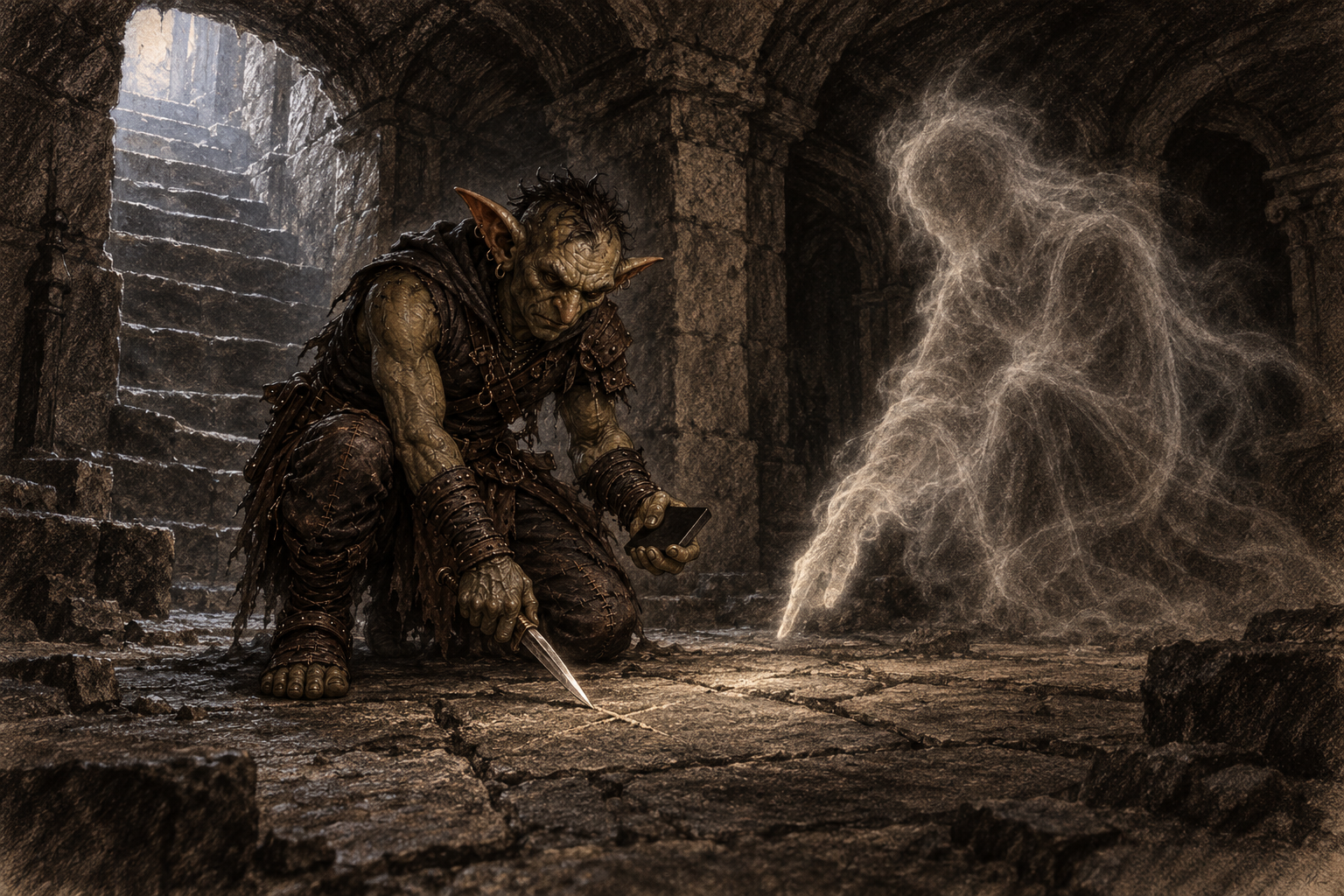
During the October 24 exploration, a resident spirit points Brax to stone above what he calls the family burial grounds. After Brax shows a small black object, the spirit identifies it as a key and speaks of accessing Simulcron records. The spirit also describes treasure and technology below. These statements have not been tested by opening the burial grounds. October 24 recording notes, part 3 [claim]
Brax marks the stone and collects tools. No excavation, recovered record or successful use of the object is recorded. The encounter does not establish that this object is itself a Simulcron, that every Simulcron is a key, or that the party has gained a working reader. October 24 recording notes, part 3.
Sources
Petorin’s 16th Adventure; October 24 recording notes, part 1; October 24 recording notes, part 2; October 24 recording notes, part 3. The recording notes are an editorial reading edition; links to the three original Omi recordings are preserved there. Real-world session dates do not supply an in-world calendar date.