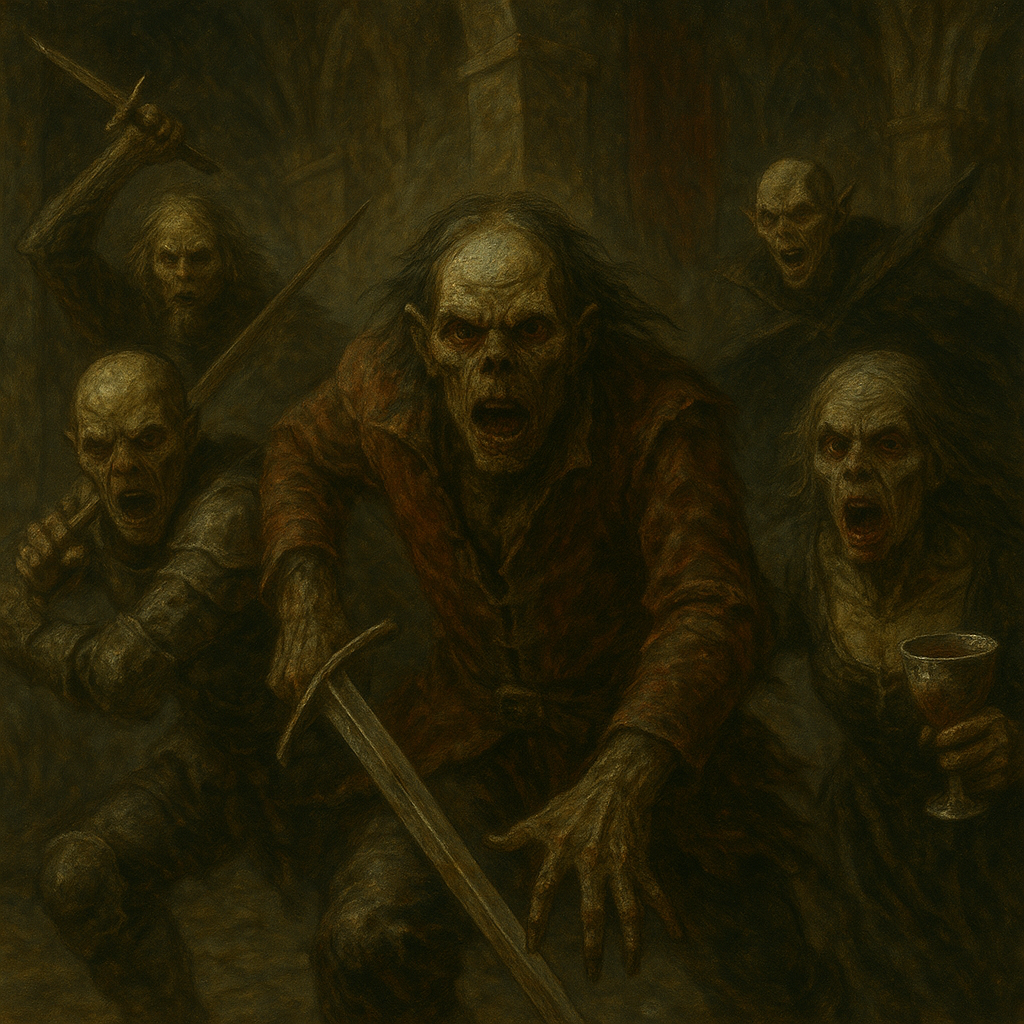
Pronunciation (approximate): IPA /ˈvæmpaɪr ɡulz/ · English: VAM-pyre GOOLZ
Overview
Vampire Ghouls are the most common yet most unstable progeny of the vampiric order, born not from deliberate design but from the generational degradation of bloodlines. Where Vampire Lords possess enough clarity to rule, scheme, and extract tribute, their descendants—whether created intentionally or through reckless predation—suffer from spiraling madness and feral hunger. Ghouls are less rulers than beasts of corruption, often incapable of restraint and driven by an insatiable need to feed. They are the visible face of vampirism for most mortals: clawed, frenzied, and merciless, a plague that stalks villages and frontier lands without purpose beyond survival.
Though they lack the coherence of their progenitors, Vampire Ghouls are far from harmless. Many attempt to establish “domains” in imitation of Lords, seizing territory and extorting tribute through terror and slaughter. Yet such dominions rarely endure, collapsing under the ghoul’s own instability or the violent reprisals of mortals and institutions. For this reason, Ghouls serve as both warning and weapon within the vampiric hierarchy. To Lords, they are expendable tools—set loose to weaken populations, sow chaos, or provide a convenient scapegoat for vampiric activity. To mortals, however, they are an ever-present danger, proof of the corruption’s spread and a reminder that vampirism left unchecked does not create kingdoms, but ruin.
Origins and Descent
The creation of Vampire Ghouls is the natural consequence of degeneration within the vampiric bloodline. All Ghouls ultimately descend from the first generation of Vampire Lords sired by King Arthur, but with each successive reproduction the essence of vampirism becomes thinner, more unstable, and more prone to corruption. Where a Lord may retain centuries of coherence, a Ghoul is born already teetering on the edge of madness. This degradation is so consistent that scholars of the Temple describe vampirism as a “withering lineage”—one that consumes itself in the act of perpetuation.
The process of descent is neither orderly nor predictable. Some Lords, out of arrogance or desperation, attempt to sire lovers, heirs, or entire courts, only to find that their progeny erupt into feral violence within days or decades. Others produce Ghouls inadvertently, leaving thralls too long within their shadow or failing to maintain the strict dominance required to stabilize the transformation. Over time, the madness compounds: Ghouls who sire more of their kind create creatures even more fractured, many little more than shambling predators. Thus the generational law of vampirism is one of inevitable collapse—each step removed from Arthur himself brings the line closer to incoherence and monstrosity.
It is this inevitability that shapes the dread of mortals and the disdain of Vampire Lords. Mortals know that every Ghoul population signals the hidden presence of a Lord further up the chain, while Lords regard Ghouls as reminders of their own potential fate. A Lord may rule for centuries, but in the end, the abyss of madness awaits even them, while their descendants rush headlong into it from the moment of their creation. In this way, Vampire Ghouls embody the corrupt destiny of vampirism itself: not dominion eternal, but a slow, inescapable unraveling.
Nature and Behavior
Vampire Ghouls are feral by definition, stripped of the clarity and discipline that allow Vampire Lords to function as rulers. From the moment of their creation, a Ghoul is consumed by hunger, violence, and madness, incapable of the restraint or cunning that marks their progenitors. They hunt without plan, kill without hesitation, and feed without thought of consequence. Their presence is often marked by wholesale slaughter rather than calculated predation: villages torn apart, livestock drained alongside their owners, and entire caravans left as mutilated husks. Unlike a Lord, a Ghoul cannot be bargained with or reasoned with—its instincts drown out any trace of higher thought.
Though some Ghouls attempt to imitate dominion, their efforts are grotesque parodies rather than coherent systems. What mortals describe as “domains” are little more than feeding grounds where Ghouls congregate, ruled not by law or tribute but by savagery and dominance displays. At best, these gatherings descend into pack-behavior, with the strongest Ghoul temporarily cowing the rest until it too is challenged and torn apart. Mortals caught in these territories are reduced to prey animals, their lives measured in how long they can evade notice rather than any negotiated arrangement. No such “domain” lasts for long, collapsing inevitably into cannibalism and ruin.
The feral nature of Ghouls makes them volatile and unpredictable. They may remain hidden in lairs for years, preying on stragglers and wanderers, before suddenly erupting into uncontrolled rampages that can depopulate entire regions. Their madness is constant, but its expression comes in waves: periods of eerie quiet followed by explosions of carnage. To mortals, this makes them uniquely terrifying. Where Vampire Lords at least maintain motives that can be understood, however twisted, Ghouls embody only chaos. They are the inevitable degeneration of vampirism made flesh, living engines of hunger and corruption that destroy everything they touch until destroyed themselves.
Madness and Corruption
Madness in Vampire Ghouls is not a failing that comes with time, but the very essence of their existence. From their first breath as undead, they are fractured minds bound to unquenchable hunger. This ferality is what distinguishes them most starkly from their progenitors: where Vampire Lords may stave off degradation for centuries, Ghouls are born already broken. Their thoughts are fragments of instinct and obsession, without the tempering hand of reason or memory. As such, their violence is not the product of strategy or malice, but of unbridled compulsion, the corruption of vampirism in its purest, most unrestrained form.
The corruption they embody spreads in two ways: through their predation and through their lineage. When Vampire Ghouls sire others, the result is not a new line of measured rulers but creatures even more degraded and unstable than themselves. With each generation, the madness compounds, birthing vampires too feral even to hunt effectively, reduced to little more than ravenous husks. This exponential decline ensures that Vampire Ghoul infestations burn brightly but briefly, devastating mortal populations before collapsing in on themselves as the ghouls turn cannibalistic. To scholars, this descent demonstrates that the vampiric curse is not a legacy but a rot, one that consumes itself as surely as it consumes its prey.
Among mortals, the presence of Ghouls is regarded as a living contagion. Entire regions plagued by them come to be spoken of as “blighted,” places where law, trade, and family life wither under the constant threat of feral attack. Unlike the dominions of Vampire Lords, which at least maintain a twisted semblance of order, Ghoul incursions leave behind only chaos. Survivors recount not merely loss of life, but the collapse of sanity within communities, as the constant fear of sudden slaughter corrodes trust and unity. In this way, Ghouls spread corruption without ever needing to conspire: their very existence is enough to unravel mortal continuity.
For this reason, both the Temple and the Coven classify Ghouls as irredeemable. They are not considered trials of discipline, nor candidates for purification, but abominations whose annihilation is a holy work. Where a Vampire Lord might be studied or occasionally bargained with for information, a Ghoul is to be slain on sight. Their madness is not seen as affliction but as identity, proof that the vampiric curse left unchecked inevitably collapses into feral corruption. In them, mortals see not merely a threat, but a mirror of what lies at the end of every vampire’s path should discipline fail.
Role in the Vampiric Hierarchy
Within the vampiric order, Vampire Ghouls occupy the lowest and most despised position, yet their presence is both inevitable and instrumental. Every Vampire Lord knows that their lineage will, in time, produce Ghouls: feral offspring whose instability makes them both dangerous and expendable. For this reason, Lords often weaponize their existence, releasing them into mortal lands to sow chaos, frighten populations, or weaken rivals. By allowing Ghouls to run unchecked, a Lord may later arrive as a "savior," offering stability in exchange for tribute, or simply use the destruction as cover for their own expansion. Thus, while Ghouls are reviled, they are also convenient instruments of terror.
In most cases, Ghouls are not permitted within the inner circles of vampiric dominion. Lords treat them as disposable pawns, useful for shock assaults, diversions, or the creation of fear, but never as trusted lieutenants. Their feral nature makes them impossible to control for long, and so they are often unleashed in waves rather than held in reserve. Some Lords corral them into hunting packs, directing their savagery at specific targets, but such arrangements inevitably collapse into cannibalism or betrayal. Their role is not to govern or build, but to destroy, leaving space for their progenitors to claim power in the aftermath.
Despite this contempt, Ghouls play a crucial role in maintaining vampiric dominance over mortals. They embody the ever-present threat that underpins the 3% Tithe—reminding mortals that refusal or defiance carries with it the danger of Ghoul incursions. Lords frequently allow rumors of nearby Ghoul packs to spread, manipulating fear to ensure compliance. In this way, the Ghouls act as the shadow of vampiric rule, ensuring obedience through terror even when a Lord is not present. Their role in the hierarchy is thus paradoxical: despised by the very beings who created them, yet indispensable to the perpetuation of vampiric control.
At the highest level, even Vampire King Arthur acknowledges their grim utility. While he himself advocates “kill on sight” as the proper response to Ghouls, he tolerates Lords who manufacture them as tools of dominion—so long as tribute continues to flow. This hypocrisy underscores their position within vampiric society: abominations that reveal the inherent corruption of vampirism, yet tools too effective to be abandoned. They are both a reminder of vampiric fragility and a weapon of fear, the expendable teeth of an empire of blood.
Domains of Ghouls
Unlike Vampire Lords, who carve out structured dominions and enforce tribute through systems of patronage, Vampire Ghouls cannot establish true domains in any enduring sense. Their feral nature makes them incapable of governance, diplomacy, or sustained order. Instead, what is often described as a "Domain of Ghouls" is little more than a wasteland—ruined villages, burned farmland, and hollowed towns where survivors live in constant terror. These territories are unstable by design, defined not by boundaries or laws but by the reach of predation. To live within such a place is to endure endless hunger, both one’s own and that of the monsters prowling the dark.
The "domains" Ghouls create rarely last for more than a generation before collapsing into ash or being absorbed by a Vampire Lord’s dominion. Yet their presence leaves lasting scars. Roads become unsafe, trade routes collapse, and once-prosperous communities are reduced to desperate, paranoid enclaves. In many cases, Lords allow such territories to fester intentionally, using Ghoul infestation as a living reminder of what life is like without "proper" vampiric rule. Thus, the Domain of Ghouls functions as a kind of negative space within the larger hierarchy: a warning of chaos that validates the order imposed by stronger vampires.
From a mortal perspective, domains overrun by Ghouls are regarded as cursed zones. Both the Temple and the Coven frequently mark such regions as blighted, urging migration or evacuation rather than attempting to reclaim them outright. Only the Daughters of the Eclipse, with their zeal for purging corruption, are known to march deliberately into such territories to burn out infestations root and stem. Even then, success is tenuous, for any stragglers may reconstitute packs, and even a single surviving Ghoul is enough to seed a new wave of devastation.
Philosophically, scholars describe Ghoul domains as the antithesis of Midnight’s mandate. Where her teachings demand discipline, order, and continuity, Ghoul-ruled wastelands embody decay, chaos, and annihilation. They are living proof of why vampires, and especially their feral spawn, are considered the greatest obstacle to apotheosis. In this sense, the Domain of Ghouls is not merely geographic but symbolic—a manifestation of corruption left unchecked, and a glimpse into the fate of all Azil should discipline fail.
Mortals and Ghouls
The relationship between mortals and Vampire Ghouls is one of unrelenting predation. Unlike Lords, who may see value in cultivating tribute and shaping their dominions for long-term survival, Ghouls consume without thought for tomorrow. To mortals, they are a constant and inescapable terror: their attacks are sudden, their hunger insatiable, and their presence impossible to bargain with. Even when mortals attempt appeasement—offering food, shelter, or even sacrificial victims—the Ghouls cannot be satisfied, for their instincts drive them to slaughter beyond necessity. Thus, no pact, payment, or appeal can shield a community from devastation once Ghouls settle nearby.
For survivors, life under Ghoul predation is marked by desperation and degradation. Families splinter, villages become fortified prisons, and paranoia consumes any sense of communal trust. Travelers tell of towns where every night is a siege, where crops rot in fields because no one dares to leave the walls, and where hunger becomes as much a killer as the monsters outside. Mortals caught in this cycle often look longingly to the rule of Vampire Lords or even to the rigid dominion of the Temple, reasoning that any structure—even one of oppression—is preferable to the madness of Ghoul-infested lands.
The Temple teaches that mortals who fall into Ghoul hands are effectively lost. While the Coven occasionally attempts rescues or cleansing rituals, both institutions acknowledge that once a Ghoul has fed upon a victim, the spiritual and physical corruption left behind is too deep to be healed. In many cases, those bitten but not slain outright become feral themselves, further seeding the cycle of destruction. For this reason, Midnight’s mandate is unyielding: wherever Ghouls take root, the only mercy is swift eradication by fire and blade.
Yet in a grim irony, mortals themselves sometimes become tools of Ghoul proliferation. Desperate warlords have been known to lure Ghouls into enemy territory, hoping to unleash their feral hunger as a weapon. Such gambits inevitably backfire, as the Ghouls devour foe and ally alike until nothing remains. In this way, mortals are both prey and, at times, unwitting accomplices to the spread of Ghoul domains—a tragic reminder of how corruption preys not only on the body, but on fear and folly as well.
Containment and Eradication
The containment of Vampire Ghouls is a near-impossible task, for their feral nature resists every form of control. Unlike Vampire Lords, who may at least negotiate tribute or enforce a semblance of order, Ghouls exist in a state of perpetual hunger that no mortal or immortal has ever succeeded in restraining for long. Efforts to wall them in, trap them in caverns, or seal them by wards have consistently failed: either the Ghouls tear themselves apart until one escapes, or their instinct drives them to claw ceaselessly until barriers collapse. For this reason, the Temple formally teaches that there is no such thing as containment—only delay. Ghouls cannot be kept; they must be destroyed.
Eradication, however, is equally grim. Ghouls are unnaturally resilient, their bodies sustained by corrupted lifeforce that renders wounds slow to kill and poison useless. They feel no pain, show no fear, and fight until shredded into pieces. The only proven methods of eradication are fire and consecrated steel. Fire denies them the flesh they crave, reducing their bodies to ash too swiftly for regeneration. Consecrated weapons, often blessed by Temple priests or forged in rituals of the Coven, are the few tools capable of severing the corruption that animates them. Strategies emphasize overwhelming force, as even a single surviving Ghoul is enough to repopulate a region within months through predation.
For this reason, the Daughters of the Eclipse often lead campaigns against Ghoul infestations, their zeal matching the brutality needed for such work. These purges are marked not by mercy but by efficiency: villages suspected of harboring infected are cleansed by fire, livestock is culled to deny sustenance, and whole stretches of land are abandoned to ensure that no trace of corruption persists. Survivors frequently call such acts cruel, yet the faithful insist they are mercies compared to the alternative of unchecked Ghoul infestation. In this way, the eradication of Ghouls is not only a practical necessity but a theological one, proof of obedience to Midnight’s mandate of survival.
The broader doctrine frames the battle against Ghouls as a perpetual war, one that cannot be won but must always be fought. To destroy them is to reaffirm mortal continuity; to fail is to invite annihilation. Thus, in every record, every teaching, and every sermon of the Temple, one phrase resounds regarding Vampire Ghouls: contain nothing, burn everything.
Legacy of Madness
The legacy of Vampire Ghouls is not measured merely in the lives they consume, but in the madness they leave behind. Wherever they rise, communities fracture into suspicion, fear, and violence. Survivors speak of neighbors turning on one another at the faintest whisper of infection, of families abandoning children in the night rather than risk discovery, and of villages where trust itself is the first casualty. This cultural erosion outlasts the Ghouls themselves; even after eradication, haunted memories linger for generations, carried in songs, curses, and warnings carved into village gates. The madness of the Ghouls spreads long after their flesh has been reduced to ash.
Scholars of the Temple often argue that this is their truest corruption: not simply the devouring of mortal blood, but the planting of terror so deep that mortals undo themselves. Communities emptied by Ghoul infestations rarely recover; many are abandoned entirely, left as ruins that serve as grim monuments to failure. Those that survive often adopt harsher laws, stricter rituals, and crueler punishments in the name of vigilance, perpetuating the Ghoul’s influence even in absence. In this way, the feral hunger of Ghouls reshapes culture, instilling a legacy of paranoia and brutality that echoes Midnight’s teaching—that madness, once seeded, is far harder to purge than flesh.
This legacy is compounded by the nature of descent itself. Because Ghouls can beget more of their kind in an endless cycle of degradation, every infestation carries the memory of a failure further up the hierarchy—a Vampire Lord who faltered, a council that grew complacent, or mortals who bargained when they should have burned. The ruins they leave are both warning and scar: a reminder that madness is not a distant danger, but an inheritance of every community too weak to act. Thus, the memory of Ghouls is preserved not only in the records of faith and scholarship, but in the nightmares of Azil’s peoples, passed down as both horror and instruction.
See Also
Recorded Campaign Encounters
In the first recorded session, ghouls emerge from an abandoned town's buildings and attack the survivors, including an unusually large, bloated creature carrying timber. Fenris describes ghouls as failed vampire transformations and warns that they become more agile at night. The party's daytime fight supports the practical importance of that warning; it does not establish a precise limit on ghoul numbers or strength.
Fenris subsequently records dead ghoul flesh melting into the ground. In Shiel's nightfall account, a vampire demands Melody's surrender before a horde advances through the failing ward. Shiel notices that the rushing ghouls appear to avoid companions who have laid down their weapons. That observed assault shows coordinated behavior under this vampire, without establishing how long such control can last. Another ghoul attack reaches Ollie and Melody at the ruin in the following account; the party suspects Daji's medallion may be attracting pursuit, but has not proved that explanation.