Pronunciation (approximate): IPA /ˈvæmpaɪr lɔrdz/ · English: VAM-pyre LORDZ
Overview
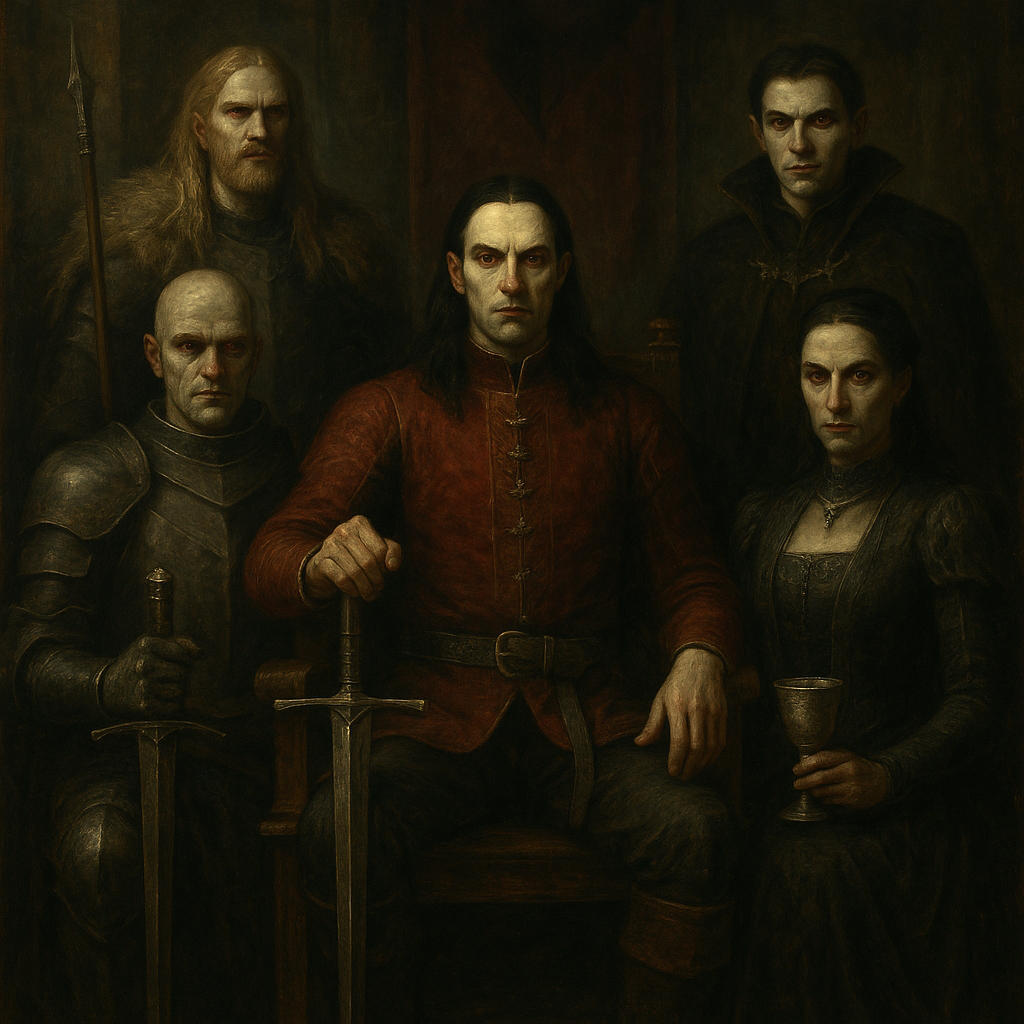
Vampire Lords are the pinnacle of vampiric power on Azil: immortal rulers whose dominion is not measured in years but in centuries, and whose hunger is not for blood alone but for sovereignty itself. Unlike the unstable Vampire Ghouls that descend from them—creatures more prone to madness with each generation—a Lord embodies enduring will and parasitic order. It is from the Lords that all vampiric lines originate, their strength radiating outward into lesser progeny, domains, and cults. Where ghouls are erratic, often feral and uncontrollable, Vampire Lords impose direction and hierarchy, binding corruption into structure. Their citadels are black thrones where tribute is gathered, madness festers, and mortals are reduced to chattel.
To the faithful of Midnight, Vampire Lords are the ultimate adversaries of apotheosis. Their existence guarantees that corruption will endure, for so long as a Lord rules, ghouls are spawned, domains carved, and tribute flows into the machinery of undeath. The Lords cannot be appeased, bargained with, or merely contained, for they do not wane with time, nor can their hunger be sated. Unlike mortal kings, they do not die; unlike mortal tyrants, they do not falter. Midnightian Apotheothics therefore identifies them as eternal obstacles to godhood, decreeing their total eradication as sacred necessity. Where a Vampire Lord endures, no mortal may hope to ascend.
Vampire King Arthur
The origins of Vampire King Arthur are shrouded in uncertainty and dread. What is known is that he emerged from The Rift, the wound in the world where reality itself frays and corruption seeps into Azil. Whether he was once mortal, or something born whole from that abyss, no account agrees. Some whisper he was a king who sought eternity and found it twisted; others claim he was the Rift’s first child, clothed in the memories of a man who never truly lived. What none dispute is that he is the First Lord, and from his bloodline all Vampire Lords descend.
Unlike the unstable vampire ghouls spawned by successive generations, Arthur’s direct progeny retain a terrible clarity. Those he sires are capable of reason, strategy, and dominion, each establishing their own citadel as an extension of his corruption. Through them, Arthur ensures that his influence radiates across Azil, a network of parasitic thrones bound to the will of their progenitor. His citadel, known in whispers as Nightmare, is both fortress and shrine, the seat from which he exacts the 3% Tithe and enforces his dominion. To the faithful of Midnight, Arthur is not merely an enemy to be slain, but the wellspring of vampirism itself—the keystone of corruption whose destruction is the only true path to ending the vampiric order.
Vampiric Madness
The phenomenon known as Vampiric Madness is one of the most unsettling aspects of the vampiric condition. While Vampire King Arthur and those Lords sired directly from his blood generally retain their faculties, observations across centuries confirm that madness is not absent but delayed. For reasons not yet understood, even the most calculating Vampire Lord may, after decades or centuries of dominion, fall into episodes of violent degeneration. These episodes are marked not by calculated cruelty but by chaotic, unconstructive violence, often directed against their own subjects or thralls. Entire domains have collapsed overnight under such frenzies, leaving mortals painfully aware that service to a Lord carries with it not only parasitism, but the looming shadow of eventual ruin.
Evidence suggests that this degeneration follows no strict timetable, but it is regarded as inevitable. Some Lords endure for centuries before displaying signs of instability, while others fracture after mere decades. The earliest signs are often subtle: an escalation of punishments without cause, paranoia against loyal retainers, or sudden withdrawals from the structures of tribute and governance. In time, these minor degradations accelerate until the Lord descends fully into madness. Scholars in the Temple and Coven alike argue that this reflects an underlying flaw in vampiric immortality, as the denial of natural death eventually corrodes the soul beyond repair.
The risk of madness increases sharply in vampires further removed from Arthur’s direct line. While some Lords can produce progeny capable of governing in his image, the majority of those sired exhibit instability from the outset. This is particularly true of Vampire Ghouls, who are the inevitable byproduct of successive generations. Unlike their progenitors, ghouls are almost entirely incapable of long-term reason, their domains collapsing into feral predation within years. The further removed a vampire is from Arthur, the more likely madness is not an eventuality but a starting condition. For this reason, it is exceedingly rare for Lords to convert lovers, children, or other figures of sentimental value, as the chance of birthing a mad husk outweighs any imagined legacy.
Curiously, Arthur himself appears to recognize the hazard of degradation. Accounts suggest that he occasionally offers succor to Lords descending into madness, urging them to surrender themselves before collapse. In other instances, paradoxically, he has been known to send warnings to mortals—whether Temple, Coven, or the Daughters of the Eclipse—advising them to act swiftly against a faltering Lord. This apparent contradiction is explained not as benevolence, but as pragmatism: a maddened Lord disrupts tribute, destabilizes domains, and jeopardizes Arthur’s own order. Thus, Vampiric Madness is both a terror to mortals and a liability to the vampire order itself—a flaw woven into their immortality, observed with grim certainty, but never fully understood.
Vampiric Patronage
The system of Vampiric Patronage is among the most insidious weapons wielded by the Lords of Azil. Where their hunger alone may devour a village, their patronage can hollow out kingdoms. Rather than erecting new orders, Vampire Lords prefer to infiltrate existing mortal institutions, weaving themselves into the fabric of governance, commerce, and law. Through subtle influence, they subvert councils, monarchies, republics, and fiefdoms alike, ensuring that policies are bent to their will and oversight of their abuses is quietly abandoned. Temples and covens often find themselves gradually driven out, not by open war, but by decrees and social pressures reshaped under vampiric influence. In this way, vampiric patronage does not conquer outright—it corrodes from within.
The offerings that accompany patronage are always calculated to exploit mortal ambition. A Lord may arrange the quiet removal of rivals, the delivery of immense wealth and treasure, the promise of protection against external threats, or the whispered counsel that shapes generations of rulers. These boons are never free; each one binds mortal beneficiaries deeper into the vampiric web, obligating them to overlook atrocities or enact laws favorable to their patrons. Over time, entire dynasties or townships can come to rely upon the vampire’s invisible hand, mistaking dependency for partnership. By the time such bargains are recognized for what they are, the institutions involved are often too compromised to resist.
To scholars of the Temple and Coven, vampiric patronage is considered more dangerous than overt dominion. While a Lord’s citadel can be besieged and a ghoul’s rampage put down, a corrupted state may persist for generations, indistinguishable from legitimate governance. Worse still, those who benefit from such patronage often become the most vocal opponents of reform, defending their benefactors out of self-interest. Midnightian Apotheothics therefore warns that patronage is not mere temptation but a form of possession, binding not only individuals but entire nations into the service of corruption. For this reason, any sign of vampiric infiltration is treated as a matter of divine mandate, demanding swift exposure and eradication before the web takes root.
Hierarchy
The hierarchy of the Vampire Lords is paradoxical: it is at once rigidly defined by bloodline and utterly fractured by rivalry. Each Lord descends directly from Vampire King Arthur, yet few acknowledge one another as peers. As a rule, Lords are isolationists, preferring to reign alone over their domains rather than share power or coordinate with their kin. This tendency toward solitude is born as much from pride as from paranoia, for each Lord views themselves as a potential successor to Arthur’s dominion. Yet history records rare moments of cooperation, when Lords form Shadow Councils—temporary alliances meant to unify multiple domains under shared purpose. Such councils are often startlingly efficient, particularly at rooting out instances of vampiric madness within their ranks, but they are plagued by an ever-present expectation of betrayal. Even the most enduring of these organizations have thrived not because of trust, but because of carefully balanced self-interest.
When new Lords arise, they are typically expected to carve out their own dominions from mortal realms. This expansion ensures the perpetuation of vampiric order while also dispersing potential conflicts among established rulers. However, many fledgling Lords prefer to sharpen their rule by preying on already subjugated territories, disguising their interventions as outbreaks of Vampire Ghoul predation. Such duplicity allows them to gain experience without incurring the scrutiny of older Lords. It is here that the authority of Arthur himself is most evident, for he dictates the boundaries of what is permissible. His decrees are simple: tribute must flow. A Lord who disrupts this flow or overreaches without sanction risks annihilation at Arthur’s hand.
Arthur’s enforcement of hierarchy is at once merciful and ruthless. He is known to be patient with newly sired Lords, even encouraging their survival against harsher rivals, and he counsels restraint among older Lords toward the inexperienced. Yet his patience is not limitless. Whole councils of Vampire Lords have been slaughtered without warning, their dominions left in ruins, while other transgressions go seemingly ignored so long as the tribute continues unabated. Scholars of the Temple have long noted this paradox: Arthur appears indifferent to internecine wars, even those that annihilate entire vampire-dominated nations, provided that his share of lifeforce is delivered. To mortals, this indifference is cold comfort, for it means their devastation is of no consequence to Arthur’s greater design.
At the lowest tier of the hierarchy are the Vampire Ghouls, creatures treated by Lords with open contempt. Though “kill on sight” is the common wisdom, Lords have been known to manipulate mortal perception by unleashing ghouls upon a population, only to intervene later as supposed saviors. This practice underscores the manipulative genius of vampiric order: problems are created only to justify further dominance. Within this structure, sires always maintain power over their progeny, ensuring that hierarchy is preserved in blood as well as politics. Yet, as with all vampiric order, this hierarchy is fragile—founded on fear, sustained by hunger, and enforced by Arthur’s unpredictable hand. The Vampire King alone remains unchallenged, both keystone and executioner, whose will sustains the parasitic order while keeping all within it perpetually on edge.
Life Cycle
The existence of a Vampire Lord is not a natural cycle but a distortion of one, marked by creation, dominion, and eventual collapse into madness. Unlike their ghoul-spawn descendants, Lords are not born of accident or instinct but of deliberate choice by Vampire King Arthur himself. To be sired by Arthur is to be set apart from the common rabble of undeath—imbued with reason, the capacity for command, and the grim stability required to sustain a domain. From their first breathless awakening, new Lords are expected to establish dominion, carving out territories where mortal lifeforce may be harvested and tribute offered upward. In these early years, the fledgling Lord is at their most vulnerable, reliant on Arthur’s patience and the forbearance of their elders to survive the trials of governance.
Once established, the Lord enters what may be called the Era of Dominion, a period that can last decades or centuries. Here the Lord reigns as a sovereign parasite, their strength growing in proportion to the lifeforce and tribute gathered from subjects and vassals. Their rule is marked by the corruption of mortal institutions, the slow reshaping of land and people, and the relentless consolidation of power. During this era, many Lords appear at their most formidable: calculating, lucid, and capable of outmaneuvering even the most disciplined mortal opponents. It is this stability that makes them so dangerous, for their hunger is hidden behind governance, their cruelty masked by the veneer of order.
Yet the immortality of a Vampire Lord is also their undoing. Over sufficient time, the first cracks of degradation appear: paranoia without cause, punishments meted out with disproportionate cruelty, or obsessions that consume their attention at the expense of tribute. These symptoms, initially subtle, inevitably grow until the Lord is no longer capable of maintaining the structures of dominion. This descent into Vampiric Madness manifests as unrestrained violence and destructive impulses, often directed against their own people. The transition is unpredictable—some fall within a few decades, others endure centuries before breaking—but the outcome is considered inevitable.
The final stage of a Vampire Lord’s life is the Collapse of Dominion, when madness eclipses reason entirely. Domains ruled for generations unravel overnight as their master turns predator upon thralls and subjects alike. Entire populations are slaughtered, citadels reduced to chaos, and tribute lost to Arthur’s network. At this point, even Arthur himself has been observed to intervene, either by destroying the maddened Lord outright or by alerting mortals to the danger. Rarely, a Lord will surrender themselves before this stage, but more often they are consumed in fire and blood. Thus, the lifecycle of a Vampire Lord is a closed circle: creation, dominion, degradation, and collapse. What makes them terrifying is not only their power, but the certainty that every Lord—no matter how cunning or strong—will one day turn to ruin.
Relations
The relations of Vampire Lords with the wider world are defined by contradiction: they are isolationists by instinct, yet parasites by necessity. Toward one another, their dealings are wary at best. Most prefer solitude, ruling their domains in silence, but alliances in the form of Shadow Councils are not unknown. These councils are pragmatic arrangements, forged to stabilize tribute flows, suppress outbreaks of vampiric madness, or wage campaigns against meddling mortals. Yet betrayal is never far from hand—ambition drives every Lord to imagine themselves as supreme, and alliances are undone as often as they are forged. That Arthur himself tolerates, and even occasionally encourages, such conflicts only deepens the instability of their relations.
With mortals, Vampire Lords cultivate a façade of order even as they devour from within. Patronage allows them to infiltrate kingdoms and councils, reshaping governance in their image. Relations with mortals are rarely uniform: to some, a Lord is a patron and protector, to others, a tyrant and predator. In every case, the ultimate relationship is parasitic—mortals are means to tribute, pawns in power, or fodder for hunger. Yet because destruction of the host guarantees ruin for the parasite, Lords are often more careful with mortals than with one another, treating them with a cold utilitarianism rather than open contempt.
Toward the great institutions of Azil—the Temple, the Coven, and the Daughters of the Eclipse—relations are more openly hostile. The Temple, with its rigid enforcement of Midnight’s mandate, is the most visible opponent to their dominion. The Coven, though more subtle, works to preserve mortal communion with the divine and arcane, directly opposing vampiric corruption. The Daughters, however, are regarded with special hatred: their zeal and unyielding pursuit of apotheosis threaten not only vampiric domains but the very possibility of vampiric permanence. Vampire Lords thus see in the Daughters an enemy as absolute as Midnight herself.
Finally, with Vampire King Arthur, relations are hierarchical and paradoxical. Every Lord owes their existence to him, and his decrees hold the weight of life or death. Yet many chafe under his unseen hand, imagining themselves free or even equal to their progenitor. Arthur’s rare interventions—slaughtering whole councils or sparing fledgling Lords—remind them of their dependence. Relations among Lords are therefore never only political; they are also shaped by the shadow of Arthur, who alone has the power to unmake them. In this sense, the relations of Vampire Lords, whether with mortals, institutions, or one another, are all expressions of the same truth: hunger bound by fear, ambition chained to dependence.
Methods of Eradication
Eradicating a Vampire Lord is rarely a matter of a single blade or a lone hero; it is a strategic, often sacrificial campaign that combines intelligence, ritual power, political subterfuge, and blunt force. Because Lords rule through layered institutions—thralls, corrupted magistrates, patronage networks, and ghoul infestations—the first requirement is to unravel those layers. Successful eradication normally follows a rough sequence: (1) reconnaissance and confirmation of the Lord’s locus and strength; (2) cutting or diverting tribute flows so the Lord is weakened economically and magically; (3) neutralizing ghoul-level disturbances that mask the Lord’s hand; (4) conducting a focused strike that combines martial force with Arcane/Divine rites capable of destroying a lord’s immortality; and (5) purging and sanctifying the domain so that corruption cannot re-seed. Each step carries danger, expense, and moral cost—no campaign to fall a Lord is clean.
Ritual and Relic. Pure martial might without ritual is usually insufficient. Vampire Lords are sustained by long-accumulated lifeforce, warded estates, and obscure rites that anchor them. The Temple and the Coven each supply complementary tools: the Temple’s rites of unbinding (long, complex liturgies that sever anchors of undeath) and the Coven’s sealing ceremonies (arcane bindings that expose a lord’s true heart) are most effective when synchronized. Relics—Dawnsteel blades tempered in Truefire, mirrors consecrated to eclipse-light, beads of unspent life (kept only as testimony, never to be used)—are legendary aids. In effect, the physical strike must coincide with a metaphysical undoing: the ritual cuts the tether that keeps the lord from final death while warriors force him into the exposed moment.
Tactics and Strategy. There are three broadly observed strategies in the historical record: Siege and Attrition (starving a citadel of tribute and supplies while whittling ghouls away), Surgical Strike (small, elite teams entering a lord’s heart to strike the source—often at a risk of great sacrifice), and Subversion (turning patronized institutions against the lord, exposing his crimes and fracturing his support). The Daughters of the Eclipse favor surgical strikes that cache heavy ritual costs against individual targets, while the Temple often prefers coordinated sieges that minimize ritual exposure though at higher civilian cost. Shadow Councils of Lords complicate all strategies by shifting tribute, sending reinforcements, or sowing false leads.
Political & Moral Costs. Even successful eradication spawns a vacuum. Vampire domains are often sovereign centers of commerce and law; their sudden collapse throws thousands into chaos. The Temple and Coven insist on rapid sanctification—public rites, record-corrections, and installation of provisional governance—to prevent re-colonization by ghouls or opportunistic lords. There are also moral lines: use of lifeforce or bargaining with corrupt powers may win battles short-term but fatally taint any aspirant’s path to apotheosis. Midnightian doctrine views any use of harvested lifeforce as soul-killing; thus, while some pragmatic actors have used forbidden methods to fell lords, such choices close the path to true ascension and corrupt reputations for generations.
Containment & Aftercare. Death does not always end vampiric danger. Domains must be cleansed—funerary rites for the dead, removal of cursed artifacts, and prolonged watch against second-generation ghouls who sprout from leftover blight. The Coven’s long-term wards and the Temple’s sanctified registers form the backbone of aftercare. Where possible, the Daughters establish small, disciplined garrisons or consecrated monasteries to shepherd populations back to stability and to guard against the temptation to trade with new predatory patrons. If eradication goes poorly—if a Lord descends into madness mid-campaign—the recommended course is immediate evacuation and signaling to the broader Midnightian network; corrupt domains can collapse faster than relief can arrive.
Legacy
The legacy of the Vampire Lords is written in scars across Azil—ruined cities, blighted farmlands, and generations of mortals who lived under their parasitic dominion. Wherever a Lord reigned, their influence lingered long after their destruction. Structures they corrupted often persisted, reshaped but not entirely cleansed: laws bent to favor their patronage, noble houses elevated through their protection, and cults that survived in secrecy, awaiting the chance to restore their master’s influence. Even the land itself bears their mark; citadels collapse into haunted ruins, soil is stripped of vitality, and entire bloodlines remain tainted by generations of subjugation. In this sense, the fall of a Lord rarely concludes their story—the echo of their reign endures, requiring centuries of vigilant watch to prevent resurgence.
Among scholars of the Temple and Coven, Vampire Lords are regarded as a permanent fixture of mortal history, rather than aberrations that can be erased. Their existence demonstrates both the dangers of unrestrained immortality and the seductive power of patronage. To Midnightian doctrine, their legacy is paradoxical: they are at once proof of the corruption that must be destroyed, and reminders of the vigilance required for true apotheosis. Each eradicated Lord becomes a cautionary tale, not only of what mortals must resist, but of what they might themselves become should they seek power without discipline. Thus, the legacy of the Vampire Lords is not merely one of terror and ruin—it is also a mirror, reflecting back the perilous temptation of eternity divorced from mandate.
Recorded Campaign Encounters
Fenris's opening notes attribute the survivors' forced march into battle to vampire lords. At the abandoned village, Shiel witnesses an unnamed vampire commander offer to spare those who lay down their weapons, declaring that he wants Melody. When Amra stands against him, he strikes her down; the ghouls appear to pass by those who surrender. Melody holds the enemy while Ollie evacuates the company. The commander is not identified as Arthur in these accounts.
The later Shina Port sequence depicts a busy port in Arthur's lands during a portal trial connected to Melody's memories. Its apparent everyday commerce adds context to the archive's account of vampire dominion, but remains a remembered setting rather than a confirmed visit to the present-day port.