Pronunciation (approximate): IPA /ˈwaɪvɚnz/ · English: WY-vernz
Wyverns are native to Azil’s mountains. They spit poisonous projectiles, form lifelong mating bonds, and can choose a single person with whom to live and fly. Domesticated wyverns are larger, faster in flight and longer-lived than wild ones. Game Master natural history notes; Game Master natural history notes; Game Master natural history notes.
Mountain Habitat and Behavior
A group of wyverns is called a clutch. In the wild, scarcity can turn encounters between wyverns into fights. When resources are not at stake, wyverns enjoy one another’s company and play. Their play can look violent, but the animals rarely injure or kill one another in play. Game Master natural history notes.
Wyverns spit poisonous projectiles and are naturally aggressive toward goblins, halflings and gnomes. Males are particularly aggressive, with one categorical exception: they refuse to fight pregnant females. Females are generally more docile, though they are capable of the same degree of aggression as males. Game Master natural history notes.
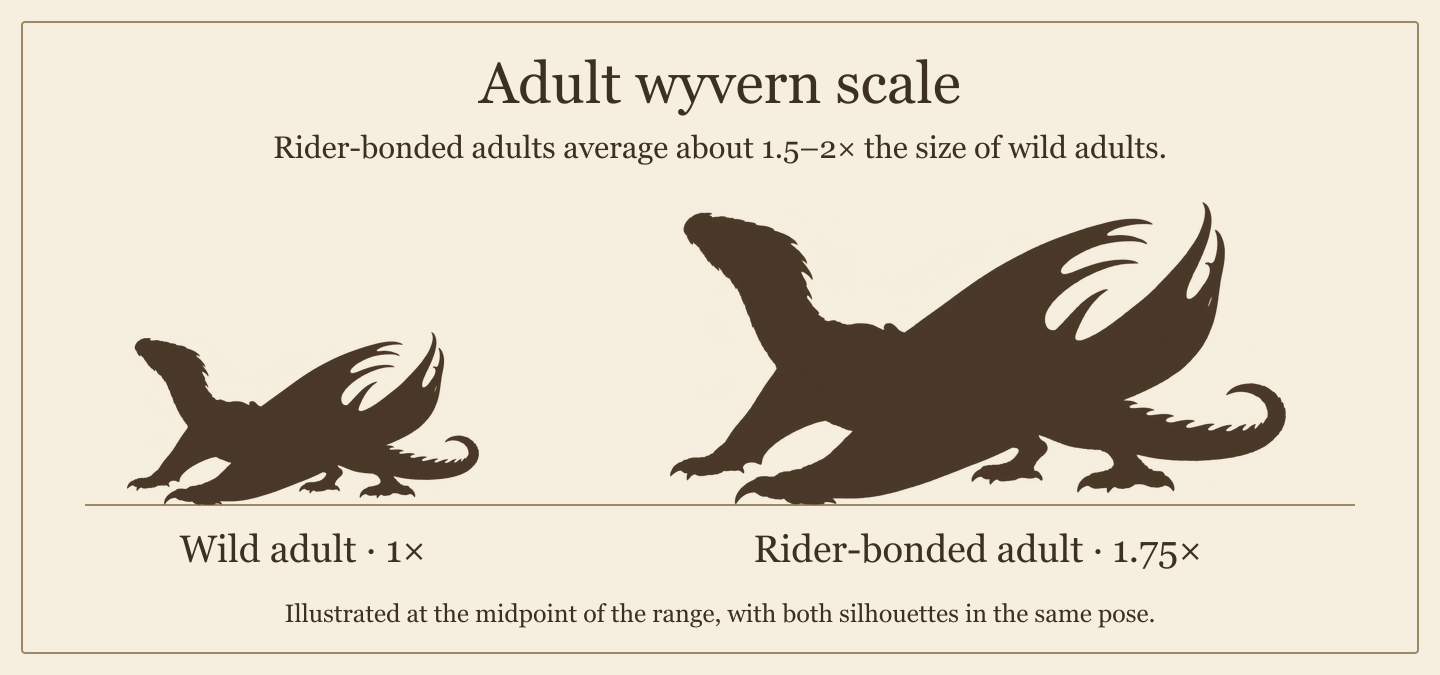
Adult Size
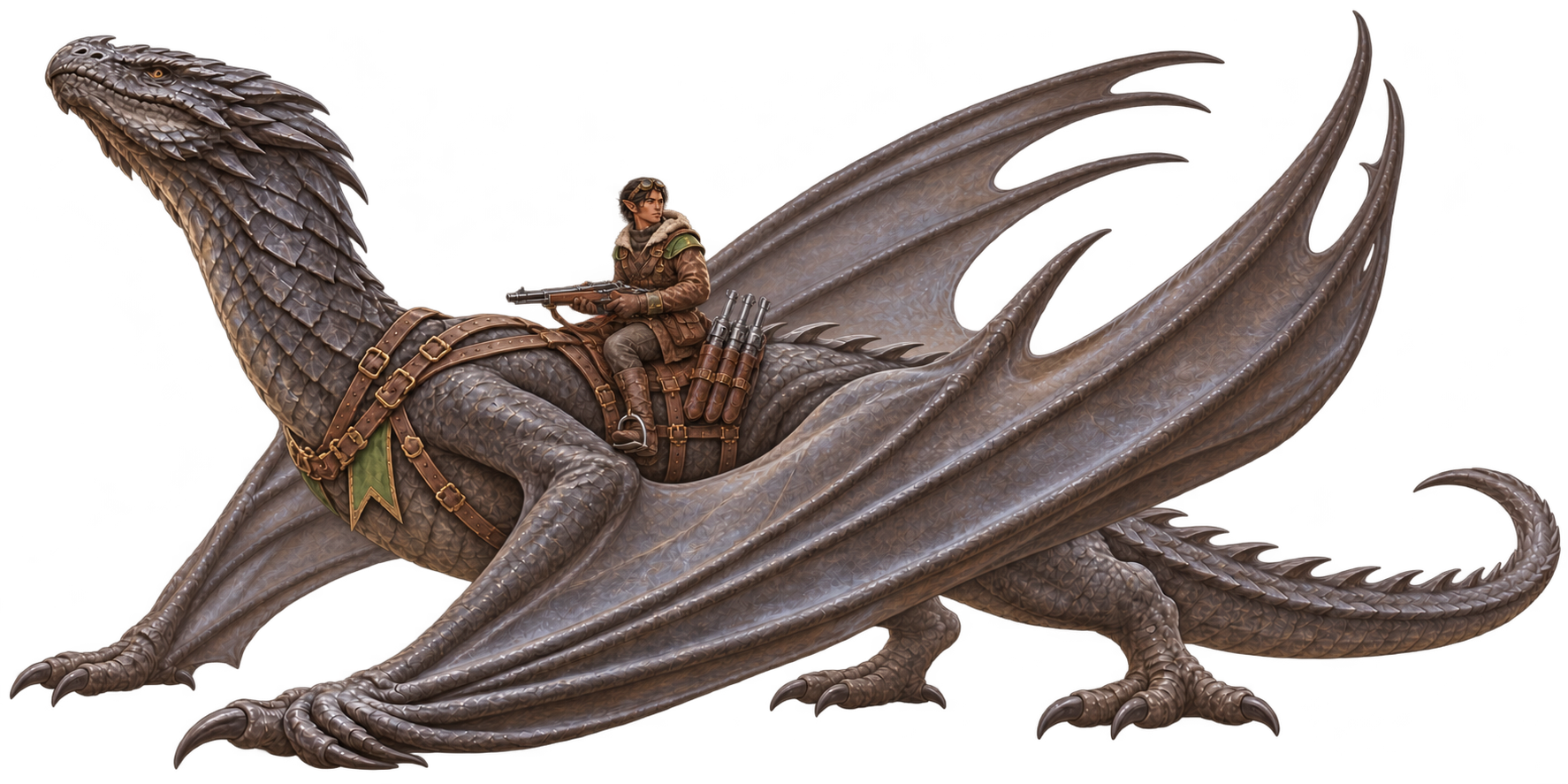
Domesticated adult wyverns with riders average about 1.5–2 times the size of wild adults. Individual size varies. Game Master clarification, November 8, 2026.
Breeding and Longevity
Wyverns form mating bonds for life. A female usually lays two or three eggs, with an estimated viability rate of about 66 percent. Breeding in captivity is uncommon, though it does occur. A wyvern that has chosen a rider often shows little interest in mating. The relationship it values with the rider is one of companionship and mutual belonging; it shows no mating interest in the rider. Game Master natural history notes.
Wild wyverns are smaller and slower than domesticated wyverns and live about 100–150 years. Domesticated wyverns readily reach 200–250 years, and a lifespan of 350 years is not unusual. Existing records suggest about 450 years as the upper limit. These comparisons describe the two populations without establishing what causes the differences. Game Master natural history notes.
Self-Domestication and Trust
Domestication begins with the wyvern choosing a particular handler. It may grow accustomed to other people feeding, tending or assisting it, but it reserves the rider’s place for the person it chose. Wyverns feel this attachment keenly. In the animal’s eyes, it belongs to the rider, and the rider belongs to it. If it comes to believe that bond is broken, the wyvern will often leave and become feral. Game Master natural history notes.
Wyverns rely on what they see and place absolute trust in their chosen riders. They normally refuse a different rider. An exception is a backup rider already aboard; even then, the wyvern may not realize until landing that its primary rider has died or become incapacitated. Game Master natural history notes.
Injury, Death and Mourning
A wyvern often becomes unusually docile and stays close to a rider dying of old age or injury, refusing to leave until it is sure the rider has died. If the rider is injured or unconscious, the wyvern may guard them until they are alert enough, making it difficult for healers to approach. A wyvern defending a dead rider’s body has been known to kill secondary handlers who try to remove it. Game Master natural history notes.
After a rider’s death, the wyvern may cry, refuse food and hold on to the body. When it resumes eating, drinking and sleeping, it may be gathering strength for departure. Most prefer to leave after mourning, often for the mountains, where many become feral. The circumstances of the loss matter: wyverns whose riders die of old age often settle happily into mountain life. Some deeply bereaved wyverns stop sustaining themselves and die. Game Master natural history notes.
Former Mounts in the Wild
Wyverns that leave a rider’s service often cooperate with other formerly domesticated wyverns. Their activities are most often a nuisance to the Vampire Kingdom. Game Master natural history notes.
Legends say a rider’s soul becomes one with the wyvern and that it carries on the rider’s mission. Game Master natural history notes [claim]
Generational Wyverns
Generational wyverns are rare and highly prized. After laying a clutch, a generational wyvern stays until it believes its rider can nurture the young. Its trust in the rider is so strong that these wyverns are not known to refuse even orders that appear suicidal. After the rider’s death, a generational wyvern often loses the will to live and can perish in time. Game Master natural history notes.
Olyn’s Riders
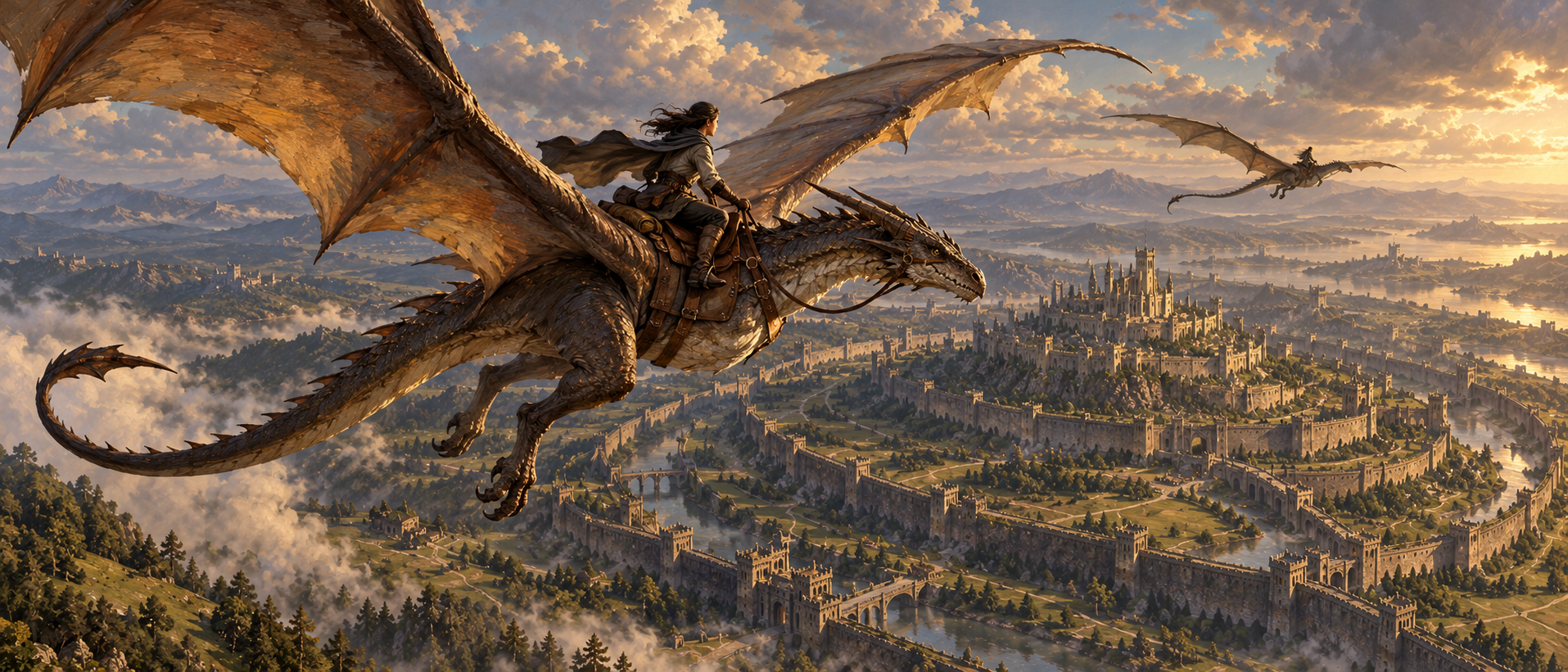
Olyn’s Wyvern Cavalry serves with wyvern mounts. The four squads assigned to the Iron Eyrie carry this partnership into military service. Game Master flight roster.
Reported Conflict
The visiting goblin delegation says that gold sent to Olyn supports wyvern riders who attack its people. This is the delegation’s complaint; the conversation independently confirms neither the financial arrangement nor a particular battle. October 24 recording notes, part 1 [claim]
The party later discusses the conflict between the riders and the Ore Screamers. Visiting Olyn remains a suggestion in that conversation. October 24 recording notes, part 2.
Limits of the Record
The study compares relative size and speed. Absolute dimensions remain unrecorded. It also leaves diet, the range and effects of the poisonous projectile, and the cause of differences in longevity open. The cavalry painting is an interpretive reference. Game Master natural history notes; Game Master natural history notes.
Gwen’s Mount in Shisa’s Account
Shisa’s updated background describes Rider Gwen Thorvald leading a huge winged mount from the ship’s hold, fastening her harness to its saddle and taking flight on bat-like wings. This is an observation within Shisa’s background rather than a party encounter; the account supplies no mount name, measured size or general biology. Shisa — updated background, paragraph 166; Shisa — updated background, paragraph 167.
Gwen’s wyvern is named Angel-Home. Game Master identification, November 7, 2026.
Sources
- Game Master natural history notes, November 7, 2026 — habitat, biology, behavior and the rider bond.
- Game Master flight roster — Olyn’s assigned squads and named mounts.
- Shisa — updated background, received October 29, 2026.
- Game Master direction, October 29, 2026
- October 24 recording notes, part 1
- October 24 recording notes, part 2
- Kyranmodan character direction
Related Articles
Passenger Handling and Rider Accounts
Green Team’s briefing tells the passengers to approach a wyvern only by the rider’s invitation and to avoid feeding, handling or staring into its eyes. On this flight the mounts carry open crates to the Iron Eyrie. Yerdiinij Kirovahn describes growing up with Black-Sun, and Bella Kyranmodan recalls being scarred during her first play with Bell-Beak.
The rider’s manual Brax reads gives roughly 66 percent for first-year survival. The natural history notes use roughly 66 percent for egg viability. The figures describe different stages. The manual also emphasizes the young wyvern’s choice of rider.
The Rider’s Manual Brax Reads
Melody gives Brax the wyvern rider’s manual. Its first-year survival figure is recorded separately from the natural-history notes’ figure for egg viability.