Pronunciation (approximate): IPA /ɪmˈpɪriən ˈmɪləˌtɛri/ · English: im-PEER-ee-un MIL-uh-tair-ee
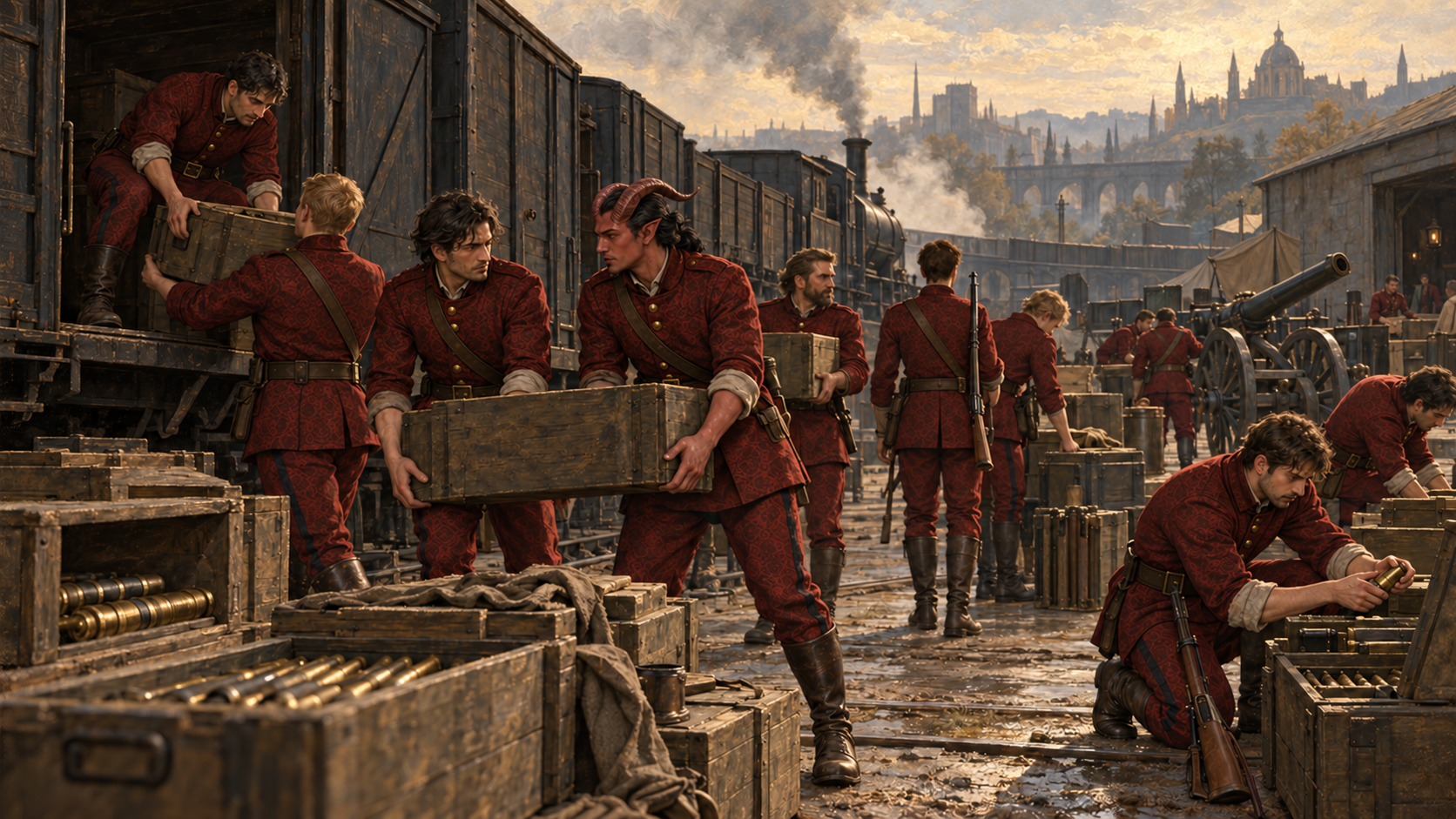
The Imperian Military was the mass armed structure described in the shared-world account of Holy Imperia. Its organization linked universal service, trained officers, industry, and religious oversight. Its stated priority was the state’s capacity to endure prolonged conflict. Banner and Pyre source.
Service and Command
Conscripts supplied foundational manpower, while regular and longer-serving personnel provided continuity. Officers were drawn through further training and evaluation associated with the Academy of Military Sciences. The source describes commission and noble status as conditional responsibilities rather than hereditary entitlements. Military command remained subject to Church and inquisitorial oversight. Banner and Pyre source. Banner and Pyre source.
Production and Logistics
Factories, railways, depots, and transport were integral to military capacity. The warfare account names rifles, artillery, chain guns, cavalry, and trains. It emphasizes replacement, supply, and the distribution of electrical power toward production. These are documented features of the described Imperian military economy; they do not establish that every contemporary people on Azil possesses the same technology. Banner and Pyre source. Banner and Pyre source.
Fronts and Internal Operations
On major fronts, the account describes layered static defenses, artillery, massed forces, and rotation of units. Against dispersed resistance, it describes mobile pressure intended to prevent insurgents concentrating or recovering. Cavalry remained useful for pursuit and terrain that limited machinery. These are broad doctrines, not maps or reconstructions of particular battles. Banner and Pyre source.
Magic as a Military Threat
The source explains overwhelming bombardment of magical threats through an asymmetry of replacement: ammunition could be produced in volume, while trained mages took far longer to replace. This describes Imperian doctrine and its destructive consequences, including the treatment of Celestian mage institutions. It is not a universal rule that firearms defeat magic, nor a statement about the limits of every campaign spellcaster. Banner and Pyre source. Banner and Pyre source.
Distinct Military and Sacred Stations
The source uses Saints for elite formations able to endure extreme conditions. It supplies no basis for equating them with the Arms of Gabriel, an appointed station with a separately confirmed purpose. Nor does this military account identify the participants in Sonata’s war, the Siege of Tambleton, or the End War. Banner and Pyre source.
Historical Scope
The source describes Imperia and its institutions in their own historical setting. It does not locate this institution within an exact reign or establish its survival into the campaign present. The current record of Holy Imperia ends with Sonata’s death more than 6,000 years ago; the empire’s later fate remains unknown. Current chronology clarification.
Sources
- Banner and Pyre lore export: Imperian Military.
- Banner and Pyre lore export: Officer Corp of Holy Imperia.
- Banner and Pyre lore export: Industrial Age Warfare.
- Banner and Pyre lore export: Celestian Republic.
- Game Master historical clarifications, October 23, 2026: historical limits and current family/divine canon.