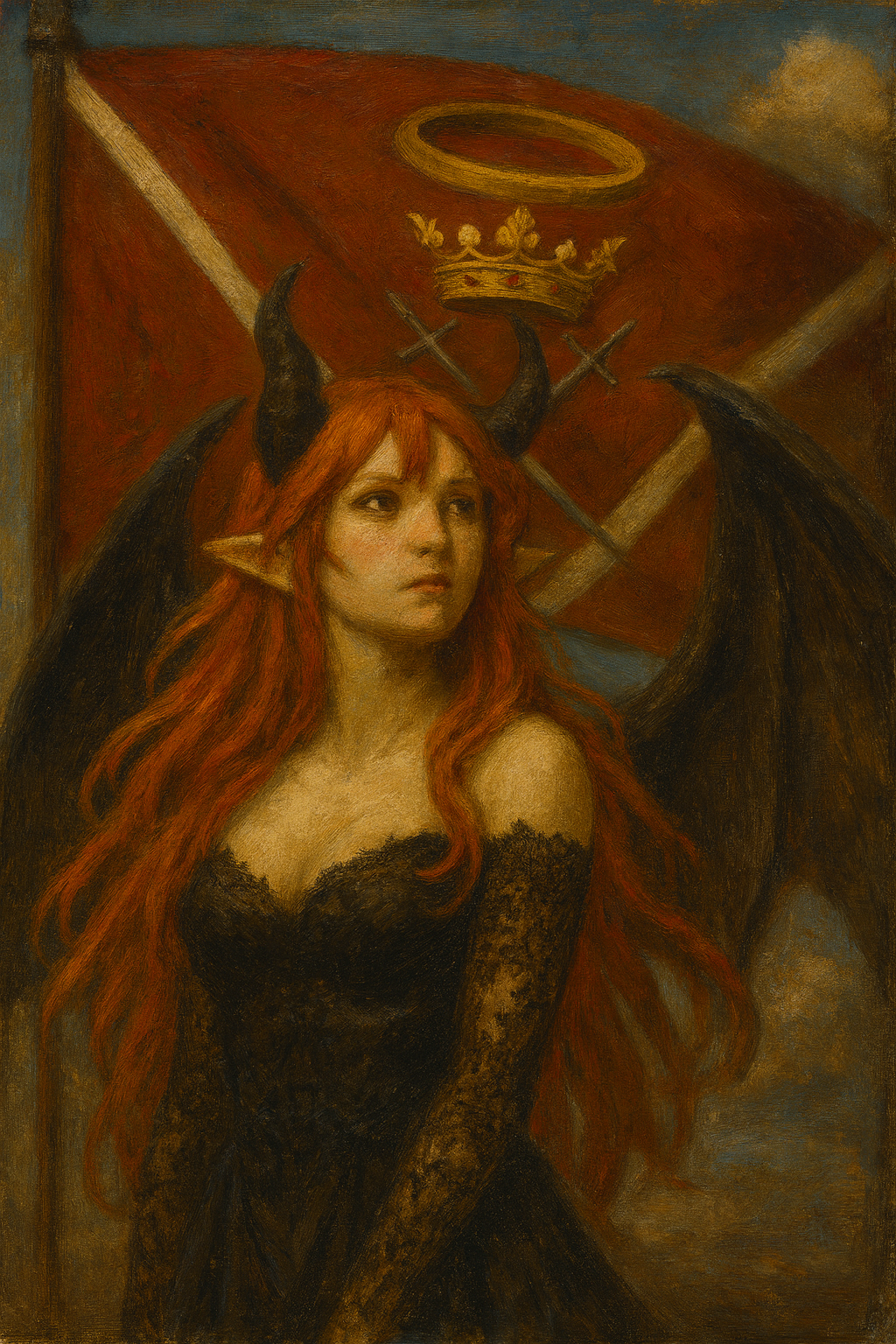
Pronunciation (approximate): IPA /ˈhoʊli ɪmˈpɪriə/ · English: HOH-lee im-PEER-ee-uh
Holy Imperia was a theocratic empire whose last known historical record ends with Sonata Der Kirik’s death more than 6,000 years before the present. Its subsequent fate is unknown. The institutional account below describes the recorded empire, rather than confirming its survival into the present. GM source; chronology clarification.
Overview
Holy Imperia is a vast, theocratic empire whose foundation rests upon uncompromising faith, rigid obedience, and an all-encompassing state apparatus. Often described by outsiders as both awe-inspiring and terrifying, the Imperia is at once a society of deep conviction and systemic cruelty. Its people see themselves as divinely chosen, bound to a sacred destiny, and organized into a structure that demands sacrifice at every level of life.
The empire is ruled by a dual authority: the Church, which embodies spiritual and moral supremacy, and the Great Houses, which administer the territories, command the military, and manage the state’s economy under the watch of the Royal Family. Within this framework, inquisitors enforce religious and legal orthodoxy, while paladins execute punishment as living instruments of divine judgment.
Imperia is defined by its autarky—self-sufficiency is both policy and creed. Outsiders view it as a closed realm, intolerant of foreign influence except where its narrow interests demand it. Trade is tightly controlled, with an Elven kingdom acting as the only tolerated window to the outside world.
At the heart of Imperian culture lies a paradox: a nation that promises its people security, purpose, and the so-called Imperian Promise of generational stability, but only at the cost of absolute conformity. It is a land where nobility cannot be inherited, where every citizen is educated and pressed into service, and where vows of poverty or silence can elevate an individual to a sacred station. Yet beneath this veneer of divine order lies a brutal reality of genocidal policies, systemic inequality, and unrelenting war.
For the faithful, Imperia is the shining embodiment of human destiny. For its enemies, it is an empire of oppression, blood, and fire.
History
The history of Holy Imperia is one of transformation—beginning as a fragile tribe struggling for survival, crystallizing into a kingdom, and culminating in the theocratic empire described by the surviving account. At every stage, its institutions were shaped by war, faith, and the conviction that the Imperian people are destined for greatness through sacrifice.
Origins: The House of Man
The earliest Imperians arose in a hostile region surrounded by rival tribes, races, and minor nations. Unity was forged not through prosperity but through necessity. The House of Man emerged as the first organized Imperian state, binding together scattered human clans under a single banner. Survival in this era required discipline, rigid gender roles, and absolute martial focus.
The Kingdom of Man
Over time, the House of Man consolidated into the Kingdom of Man, a feudal monarchy defined by perpetual conflict. The House of the Sword epitomized this age: men bore the burden of endless war while women were excluded from service until industrialization made widespread participation possible. Disability did not excuse one from duty—every Imperian was expected to serve, even in burdensome or symbolic roles.
The Rise of Holy Imperia
The transformation into Holy Imperia came with the binding of state and faith into a single authority. The Church took command of education, governance, and welfare, while the monarchy evolved into the Royal Family, whose Senate-appointed heirs must select a spouse and seek a war worthy of the One. Legal transfer of power requires the war to begin or be executed; discovery alone is insufficient. GM source. The new order defined itself not only against rival nations but also against “undesirable” races within its borders.
Expansion and Doctrine
Genocidal Policy: Orcs, goliaths, and hobgoblins were systematically reduced through forced relocations to Reclamation Camps and zones of extermination.
Tiefling Integration: Rather than rejection, tieflings were embraced as proof of sacred oaths binding Imperia’s destiny. Some noble houses concealed tiefling heirs, revealing the tension between cultural shame and theological honor.
Autarky Established: The empire closed itself from foreign influence, enforcing a policy of self-sufficiency with only the Elven kingdom permitted as a narrow trade window.
The Age of the Great Houses and the Senate
The consolidation of the 24 Great Houses marked a new political era. Each was granted stewardship of a province and the right to send senators to the Imperian Senate, balancing secular governance with the Church’s spiritual supremacy. This arrangement created the political structure described in the surviving account.
Continuity Through Sacrifice
At every stage of its history, Imperia has defined itself by endurance and obedience. Where other nations rise and fall with prosperity or diplomacy, Imperia endures through blood, ritual, and the conviction that its survival proves divine favor. To Imperians, their history is proof of chosenness; to outsiders, it is a chronicle of cruelty and unrelenting conquest.
Government & Politics
Holy Imperia is a theocratic autarky, where spiritual law and temporal power are indivisible. Its institutions are designed to reinforce obedience, duty, and divine destiny, with all authority ultimately rooted in the Church. The system is neither hereditary monarchy nor pure oligarchy but a rigid synthesis of sacred mandate and state bureaucracy.
The Church
The Church is the supreme authority of the Empire. It administers education, healthcare, local governance, and financial oversight, and it provides the framework of faith by which all Imperians live. Its clergy regulate doctrine, enforce vows of poverty and silence, and wield the power to request imperial vetoes of senatorial law. Angels, paladins, and inquisitors act as instruments of divine authority within this structure.
The Emperor and Royal Family
The Royal Family serves as collectors and distributors of tax revenues, ensuring that the 24 Great Houses meet their obligations. Their role is less one of personal rulership and more of divine stewardship—acting as arbiters between the Church’s authority and the secular demands of empire. The Senate makes a lifetime appointment of an emperor or empress. The heir apparent selects a spouse and seeks a war worthy of the One; legal transfer occurs only upon its start or execution. GM source.
The Great Houses and the Senate
There are 24 Great Houses, each entrusted with the governance of a province and the duty to ensure their subjects have homes, productive work, and loyalty to the Empire. Great Houses appoint senators to the Imperian Senate, which codifies laws outside the Church’s scope. Every House must provide two senators: one chosen from the House itself, and one from their province. While the Senate possesses legal authority, its decisions remain subordinate to the Emperor’s duty and the Church’s approval.
The Nobility
In Imperia, nobility cannot be inherited. Every citizen has the right to five years of education and state service, during which they become aware of the Empire’s cruelty and are expected to willingly embrace complicity. Only those chosen by the state may ascend to noble rank, which confers the legal right to own property. This creates a system where all land, wealth, and even clothing is ultimately owned by a noble lord, binding subjects to their superiors in an unbreakable hierarchy.
Inquisitors and Paladins
The Inquisition ensures loyalty to doctrine and state. Inquisitors are empowered to compel testimony from any citizen except those under vows of silence. Their words are treated as canonical truth. Paladins act as the enforcers of judgment, empowered to execute, imprison, or assign individuals to service—sometimes “taking the black,” a form of perpetual servitude often indistinguishable from a death sentence.
Political Culture
Imperia’s political life is marked by suspicion of opulence and individual ambition. Nobles are expected to live with dignity but without excess, and vows of poverty are common among those in proximity to wealth. Public disobedience is often met with swift correction, with a common rebuke serving as cultural shorthand: “Do you see yourself greater than the Empire, State, or Faith?”
Economy
Holy Imperia sustains itself through a command economy, shaped by autarky, faith, and rigid hierarchy. Economic activity is not driven by free enterprise or private ambition but by the Church, the Great Houses, and the needs of the Empire. The system ensures every citizen has access to housing, work, and basic provisions, yet enforces this security through compulsion, confiscation, and control.
Core Principles
Autarky: The empire is deliberately self-sufficient. Foreign trade is minimal, limited to the Elven kingdom that acts as Imperia’s sole sanctioned economic window to the outside world.
No Imperial Debt: By law, the state may never borrow or commit to lending. Economic planning is handled through direct allocation of resources rather than credit.
The Imperian Promise: Citizens are guaranteed land, estate, and generational security if they submit to service and faith. This is the ideological foundation of economic stability.
Administration
The Church: Manages healthcare, education, finance, and local governance. Many clerics and financiers take vows of poverty to ensure they cannot exploit the wealth they oversee.
The Royal Family: Collects taxes from the Great Houses and redistributes them according to the senatorial budget.
The Great Houses: Oversee provincial economies, enforce command quotas, and ensure employment and housing are available. Each House sponsors Lesser Houses that handle specialized industries such as farming, mining, and crafts.
Property and Wealth
Nobles Only: Only nobles may own property. All land, structures, and even clothing are legally owned by the noble class.
Vows of Poverty: Many nobles of wealthy Great Houses take vows of poverty, living with dignity but without opulence, supported by staff and infrastructure.
Cultural Attitude: Excessive wealth or ostentation is seen as corruptive. Opulence is regarded with disgust rather than admiration.
Trade and Resources
Internal Distribution: The majority of goods are produced and consumed within the empire under the quotas of the command economy.
Elven Trade: Limited external trade passes exclusively through the Elven kingdom, which provides cultural goods, luxuries, and certain resources unavailable in Imperia.
Bloodwine: Dragonborn Bloodwine, harvested under grim rumors of “Blood Farms,” is among the empire’s most infamous exports, prized for its metallic flavor and addictive qualities.
Labor and Industry
Conscription Economy: Military service and state labor are tied together, ensuring every citizen contributes directly to Imperial survival.
Reclamation Zones: Non-core races are forced into under-resourced zones where survival is precarious, often serving as coerced labor pools.
Craft and Industry: Firearms (notably the bolt-action rifle lineage), trains, and heavy industry support Imperia’s wars and maintain its internal unity.
Demographics & Society
Holy Imperia is a predominantly human empire, bound together by faith, duty, and the promise of generational security. Its population is stratified not only by law and class, but also by race, vow, and service. The empire regards itself as the sole vessel of divine destiny, and its demographics are shaped by both deliberate policy and ruthless exclusion.
Population Composition
Humans: The overwhelming majority of Imperians are human, forming the foundation of both military and civil life.
Tieflings: Regarded not as abominations but as sacred evidence of an oath made before the empire’s founding. Imperians birth tieflings at a higher rate than other humans, and some royal families have concealed tiefling heirs to preserve appearances.
Elves: Hold a unique, protected status due to their role as Imperia’s only recognized trade partner. Elves act as cultural and economic intermediaries with the outside world.
Orcs, Goliaths, Hobgoblins: Considered enemies of the faith and subject to genocidal policies. They are pushed into Reclamation Camps and Reclamation Zones, under-resourced settlements where survival is uncertain. Refusal to relocate is punished with summary execution.
Dragonborn: Persistent absentees within Imperia. Rumors abound of “Blood Farms” where captured Dragonborn are harvested to create addictive Imperian Dragonborn Bloodwine. Elven ambassadors warn Dragonborn to avoid entering the empire at all costs.
Social Hierarchy
Nobility: Cannot be inherited, but must be earned through education, service, and complicity in the state’s cruelty. Only nobles may legally own property, and all others exist as tenants under their lord’s authority.
Citizens: All Imperians undergo five years of education and service, followed by two years of conscription. This shared experience instills loyalty and ensures every citizen understands the cost of empire.
Vowed Orders: Those who swear poverty or silence are held in special esteem. Their vows are lifelong and violation is punished by execution, yet they are treated as gifts to the state, not burdens.
The Imperian Promise
Central to Imperian society is the Imperian Promise: estate, land, religious security, and generational guarantee for one’s family in exchange for faithful service. To many Imperians, this promise embodies the only true form of freedom—security through submission.
Family & Marriage
Marriage commonly follows directly after military service, a cultural practice that stabilizes family formation and supports high birthrates. Love as an ideal is absent from Imperian discourse; spouses and parents are expected to serve one another and their children in duty rather than affection.
Life in Reclamation Zones
Non-core races confined to Reclamation Zones live without legal protections. These settlements are deliberately underfinanced and neglected, often regarded as part of the empire’s policy of “reducing a population to a more manageable size.” Imperians are encouraged to settle near such camps, reinforcing the presence of state control.
Culture
The culture of Holy Imperia is forged from sacrifice, obedience, and the conviction of divine destiny. Every aspect of Imperian life is infused with ritual and structure, reflecting the Empire’s belief that order itself is sacred. For the Imperian, identity is not a matter of individuality but of service—each citizen a thread woven into the greater fabric of Faith and State.
Social Organization
Hierarchy as Virtue: Imperians are raised from childhood to revere the chain of authority. Parents, teachers, nobles, and inquisitors embody the steps of divine order. To question hierarchy is to question the will of God.
Education and Service: All Imperians undergo five years of education and state service, where they learn both practical skills and the cruelty of the system, expected to embrace complicity willingly.
Marriage and Family: Marriage often follows immediately after military service. Love as an ideal is absent from cultural vocabulary; instead, spouses are bound by duty to serve one another and their children.
Rituals and Symbols
White Undershirt: All soldiers wear a plain white shirt under their armor, a sacred emblem of trust and fealty to God. It symbolizes purity and the acceptance of wounds as holy offerings.
Blood as Honor: To shed blood for the Empire is the highest mark of devotion. Wounds are worn proudly, not hidden.
Vows: The vow of poverty and vow of silence are deeply respected cultural cornerstones, seen as gifts rather than burdens.
Festivals and Public Life
Imperia avoids displays of opulence or self-indulgence. Festivals and public ceremonies emphasize unity, sacrifice, and the glorification of the State. Even moments of joy are framed in terms of collective duty. The rare individuals with “star power,” like Princess Sonata Der Kirik, are publicly condemned by the Church to prevent cults of personality from overshadowing the Faith.
Treatment of Outsiders
Cultural identity is sharply divided between core races (humans and tieflings) and non-core races (orcs, goliaths, hobgoblins, dragonborn, etc.). Core races enjoy ritual protections; non-core races are reduced to marginal existence in Reclamation Camps or exterminated outright. Elves alone hold special status due to their unique relationship with Imperian trade.
Art and Aesthetics
Imperia’s art emphasizes solemnity, structure, and symbolic clarity. Oil paintings, stained glass, and sculpture depict angels, paladins, inquisitors, and the divine chain of authority. Glasya, Gabriel, and Midnight are portrayed differently depending on the era and political climate:
Glasya: Devil in early depictions, later softened into a tiefling.
Gabriel: Always angelic, always radiant, embodying constancy.
Midnight: A controversial figure, depicted either as a usurper or as a destined goddess of magic.
Everyday Life
Imperian equipment was standardized for right-handed use. Every Imperian was required to use the right hand.
Property: Only nobles may own property; even clothing belongs legally to one’s lord.
Speech: Inquisitors may compel any citizen to testify; thus, speech is weighed carefully. Those under vows of silence are respected as beyond such demands.
Religion & Philosophy
Religion is the heart of Holy Imperia. Faith is not merely a private matter but the defining axis of political life, military service, and even daily survival. The Imperian worldview is built upon the conviction that the Empire itself is the chosen vessel of the divine, and that obedience to its order is indistinguishable from piety.
The Church as Supreme Authority
The Church governs spiritual life and most civil functions: education, healthcare, finance, and local governance. Its clerics shape doctrine, enforce vows, and provide the moral language that legitimizes the actions of the state. No law is above the Church’s scrutiny, and while the Emperor may decline a veto request, history records no refusal.
Core Tenets
Unity of Faith and State – To defy the Empire is to defy God.
Sanctity of Service – Every Imperian life is a sacred offering; wounds and sacrifices are honored as holy.
Doctrine of Obedience – Order and hierarchy are the highest goods. The chain of command is divine in origin.
Imperian Promise – Estate, land, religious security, and generational guarantees are granted to the faithful who embrace their role in the Empire.
Gabriel, the Holy Father
The Solar Gabriel is revered as the spiritual father of Imperia. Once human, now celestial, he embodies purity, divine love, and paternal authority. To the faithful, his constancy—never losing his angelic qualities across all iterations—testifies to the eternal nature of Imperian truth. His role as both the Holy Father of the Empire and the blood father of Midnight binds celestial destiny to mortal lineage.
Glasya, the Profane Mother
Glasya, mother of Midnight and queen of Hell, occupies a paradoxical position. To Imperians, she is the Profane Mother: devil and progenitor, symbol of corruption embraced and redeemed through the Empire’s destiny. To Midnight, however, she was first a mother before she was a ruler of Hell, embodying the tension between love, rebellion, and inheritance.
Midnight and the Eclipse
Midnight, the tiefling daughter of Gabriel and Glasya, achieved apotheosis and became goddess of magic. Her existence represents both fulfillment and defiance: a being born of Heaven and Hell, yet transcending both. Her worshippers—the Daughters of the Eclipse and related sects—see in her the promise of power that can surpass even the gods. The official Church, however, treats her with suspicion, even hostility, for challenging Mystra and disrupting divine order.
Philosophy of Duty
Imperia does not recognize love as an ideal or universal force. Instead, relationships are defined by duty and service: husband and wife serve one another, parents serve children, soldiers serve the state, and all serve the Faith. The idea of Moral Death—a wasted or purposeless end—is considered abhorrent, as life and death alike must be offered up to something greater.
Vows as Sacred Gifts
Vow of Poverty: Frees one from the burden of wealth, allowing proximity to riches without corruption.
Vow of Silence: A sacred gift, never revocable, granting its bearer both burden and honor. Those who swear silence may attend the highest councils, trusted to carry secrets they can never reveal.
Breaking either vow results in summary execution, for it is betrayal of both Church and God.
Sayings and Correctives
The most common rebuke across Imperia is:
“Do you see yourself greater than the Empire, the State, or the Faith?”
This question, drilled from childhood, enforces humility and suppresses defiance, acting as both cultural reflex and spiritual correction.
Science, Technology, and Innovation
In Holy Imperia, science and technology are never pursued for their own sake. Innovation is framed as a form of obedience—advancing the Empire’s survival, deepening its autarky, and serving the divine order. Discovery is not celebrated as an individual triumph but as a contribution to the collective destiny of the Imperian people.
Philosophy of Knowledge
Instrument of Faith: All knowledge is interpreted through the lens of religion. Technology is not “progress” but sanctification, proving that the divine has chosen Imperia to master creation.
Suspicion of Individual Genius: Discovery is discouraged from being tied to personal fame. To claim credit for invention risks rebuke: “Do you see yourself greater than the Empire, the State, or the Faith?”
Order over Curiosity: Free inquiry is limited; sanctioned advancement is tightly bound to state or military need.
Military Technology
Bolt-Action Rifle Lineage: Standardized, durable, and symbolic of Imperian martial discipline. Its simplicity ensures mass distribution across conscript armies.
Layered Trench Gear: Designed for endurance in brutal campaigns of attrition, reflecting Imperia’s cultural view of war as sacred trial.
Paladin and Inquisitor Equipment: Both ritualized and practical—swords, armor, and relics imbued with religious symbolism as much as battlefield utility.
Transportation and Infrastructure
Railways: Industrialization and the normalization of trains reshaped the empire, allowing for the integration of women into the military and the rapid deployment of troops and goods.
Command Infrastructure: Roads, supply lines, and fortified Senate fortresses are built to emphasize endurance and unbreakable cohesion, not comfort or luxury.
Medicine and Healing
Church-Administered: Medical practice falls under the authority of the Church. Wounds are sanctified as honorable offerings; thus, medicine often prioritizes function and survival over comfort.
Bloodwine: Both technological process and theological perversion, Dragonborn blood is refined into an addictive substance that bolsters military morale and underpins certain state rituals.
Knowledge Management
Compelled Testimony: Inquisitors may compel speech except from the vowed silent, ensuring that “truth” is a form of data collection inseparable from faith.
Vows of Silence: Silent orders, paradoxically, are given access to sensitive information precisely because they cannot communicate it. This shapes how secret knowledge circulates.
Innovation in Context
Imperia does not innovate for beauty, wealth, or leisure. Every breakthrough is aimed at ensuring that the Empire endures another century of war, famine, or trial. Its genius lies not in the creation of marvels, but in the relentless refinement of tools of survival. To an Imperian, technology is not “new”—it is eternal duty made manifest in steel, blood, and fire.
Military & Defense
The military of Holy Imperia is the crucible of its society. Every Imperian is shaped by the expectation of service, sacrifice, and obedience to the greater whole. To outsiders, the Imperian war machine is as awe-inspiring as it is horrifying: vast armies, strict hierarchies, and an uncompromising belief that bloodshed is sanctified when done in the name of the Empire and Faith.
Conscription and Service
Universal Conscription: Every citizen is required to serve two years in the armed forces. This service is not a temporary interruption of life but a rite of passage, instilling loyalty and forging the bond between soldier, state, and god.
Extended Service: To become an officer, one must undergo noble education and commit to at least five years beyond conscription. Many remain in service for life.
The Soldier’s Creed
Imperians wear white shirts under their armor as a sacred mark of fealty, purity, and trust. Wounds are regarded as an honor, a sign of blood spilled for the divine whole. Disability does not exempt one from service—those who cannot fight still serve in burdensome or “ridiculous” roles, as exclusion is considered a cruelty.
Composition of the Army
Core Forces: Primarily human and tiefling, who enjoy protected status.
Enemy Conscripts: Human and tiefling foes are allowed to surrender and enter service, granted the same rights as Imperian volunteers.
Contract Soldiers & Undesirables: Mercenaries, non-core races, and other undesirables are summarily executed upon capture.
Non-Core Races: Orcs, goliaths, and hobgoblins are subject to genocide, confined to Reclamation Camps/Zones or eradicated outright.
Structure and Discipline
Inquisitors: Attached to military units, ensuring absolute obedience, doctrinal purity, and truthfulness in all dealings.
Paladins: Martial executors of divine punishment, wielding both battlefield command and authority over life and death.
Chain of Command: Officers are drawn exclusively from the educated nobility, ensuring loyalty to both the Church and the Great Houses.
Warfare Doctrine
Imperia wages war as attrition and endurance, seeing every conflict as sacred trial. Battles are not measured by victory alone, but by the blood willingly given by Imperians in service to their faith. The “Royal Pilgrimage” of heirs ensures continual conflict, as every dynasty must find a worthy war to legitimize its rule.
Military Culture
The Imperian military despises cowardice, opulence, and self-preservation. Soldiers who attempt to sidestep duty are met with ritualized correction, while those who embrace death in service are revered. The line between state, faith, and army is blurred: to be Imperian is to be a soldier, in body, spirit, or sacrifice.
Notable People
Sonata Der Kirik, Last Empress of Holy Imperia, War Hero, Officer of the Imperian Army
Josiah Starhorne, Emperor Consort, Liaison to the Office of Accounting
Azelia Bartholomew, Midnight's mortal name, Tiefling, True Heir to the Empire, Daughter of Axhia and Isaac
Isaac Featherstone, Gabriel's mortal name, Human, Paladin and Angel of the Church
Axhia Der Kirik, Glasya's mortal name, Tiefling, True Heir to the Empire
National Anthem
[Verse 1]
O mighty Imperia, the dawn of light,
With swords held high, we stand in might.
In the name of the One, we march on bold,
To the war drums’ beat, to the banner we hold.
[Chorus]
Holy Imperia, to you we raise,
Our hearts, our lives, in endless praise.
Through fire and blood, we fight and we pray,
For the glory of the One, who leads the way.
[Verse 2]
The Church stands proud, with truth in hand,
Our faith unbroken, as we take the land.
By sacred law, we purge and we claim,
Holy Imperia, forever our name.
[Chorus]
Holy Imperia, to you we raise,
Our hearts, our lives, in endless praise.
Through fire and blood, we fight and we pray,
For the glory of the One, who leads the way.
[Bridge]
In your light, we are reborn,
By your grace, our souls adorn.
We bear the Halo, we bear the sword,
For the One, our Emperor, our Lord.
[Final Chorus]
Holy Imperia, our might divine,
Through sacrifice, your kingdom we shine.
In holy war, our souls we lay,
For the glory of Imperia’s day.
Confirmed Family Lineage
On October 11, 2026, the Game Master confirmed that Josiah Starhorne and Sonata Der Kirik, the Last Empress of Holy Imperia, are the parents of Axhia Der Kirik, later known as Glasya. This establishes the family relationship behind the archive's accounts of Axhia's Imperian lineage. See Parentage of Glasya for the family record. Exact dates and a complete chronology remain unrecorded; the Senate’s lifetime appointment and the legal conditions for transferring power are now established.
Faith, Consort, and Succession
The Imperian Church understood itself as serving the intentions of the One, the same intended service described for Gabriel and Glasya. This does not identify either of them as the One. GM source.
Josiah Starhorne originally worked in the Department of Abstraction. As Sonata’s consort, he was empowered to work with the Senate and handle tax policy and distribution. His pragmatic Citizen First approach pleased the Faith while antagonizing nobles and senators. The separately recorded title Liaison to the Office of Accounting remains part of his record; the offices are not established as interchangeable. GM source.
Afatoran Inheritance
The Afatoran Empire, a progenitor of Imperia, was a Human-dominated civilization of technological marvels and interstellar travel. Its mathematical magical disciplines endured into Azelia’s practical education. This establishes an intellectual inheritance; it does not show that the later Imperian state retained Afatora’s interstellar capability. GM Afatoran clarification; GM source.
The older Afatoran development writing supplies themes of threatened civilization, knowledge, obedience, and war, but predates major changes to the setting’s cosmology. It does not establish a new scientific origin for the Imperian Church, replace the Church’s service to the One, or identify the Great Bargain or End War. GM source-status warning; adaptation record.
Sincerity and Accuracy
Imperians generally do not knowingly lie. When they discover that a statement was false, they may smooth it over or reframe it to make it less false or true. Sincere conviction therefore does not guarantee accuracy. This distinction does not automatically make every doctrine propaganda or every error a fabrication. GM source.
Institutions and the Celestian Record
The shared-world Banner and Pyre account supplies focused records of the Institute of Numbers, Senate, Inquisition, economy, and Academy of Military Sciences. Their separate articles distinguish administrative functions, civic service, and eligibility for authority. The Faith of Man, theological totalism, language, and holy-text tradition describe the culture’s religious and interpretive framework. The Celestian Republic, resistance, 61st Suntra Regiment, and Hobgoblin Wars add a connected account of conquest and integration. These sources’ narrative present and relative war durations do not establish Imperia’s survival today or date those conflicts within Sonata’s reign. Banner and Pyre source. Banner and Pyre source. Banner and Pyre source. Banner and Pyre source.
Sources
Banner and Pyre: preserved shared-world lore export, with individual source anchors cited in the institutional context above.
Game Master history answers, October 23, 2026; chronology anchors; Afatoran clarification and older-source distinctions. Earlier archive and session sources remain linked beside their statements above.