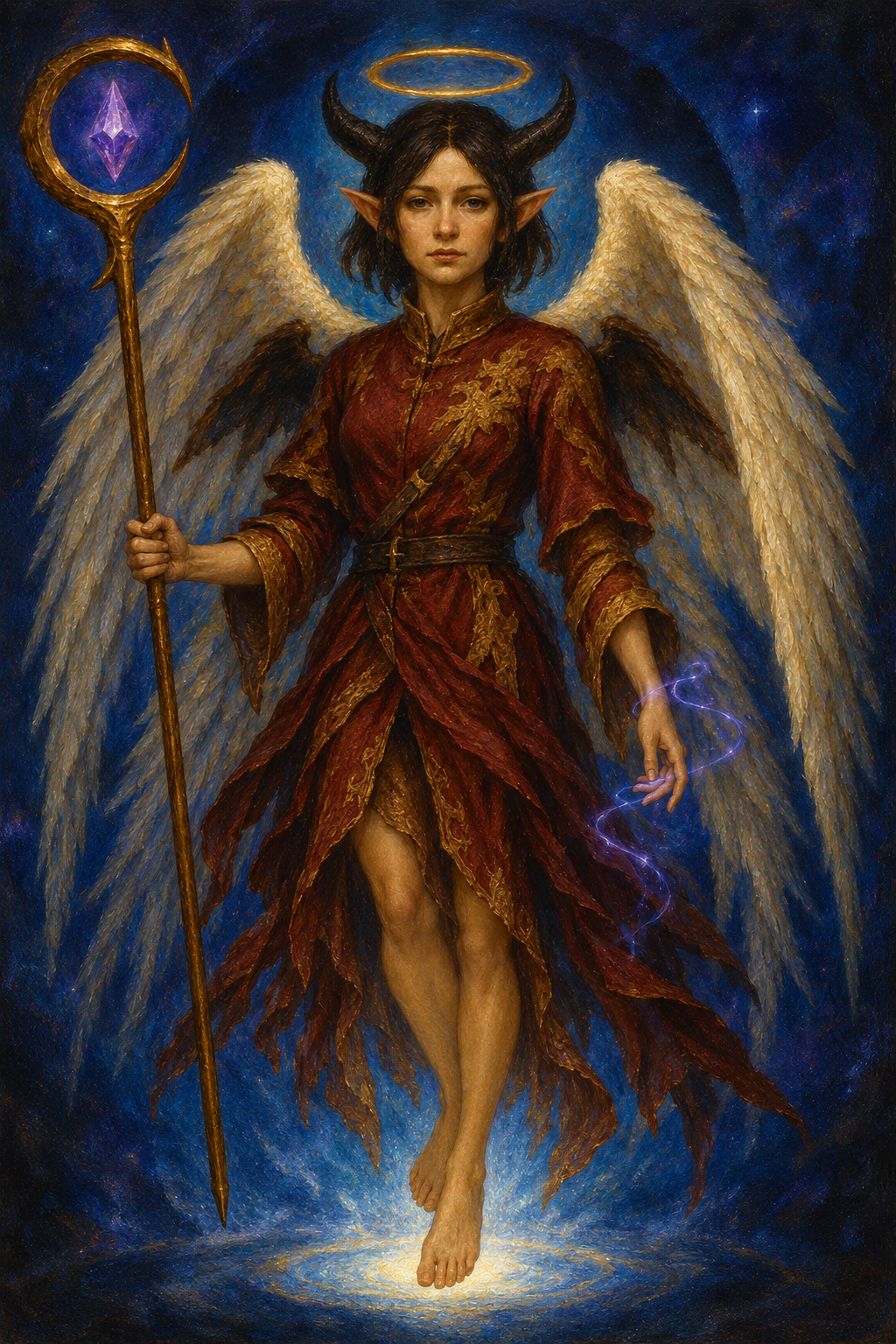
Pronunciation (approximate): IPA /ˈmɪdnaɪt/ · English: MID-nyt
Midnight, born Azelia Bartholomew, is Azil’s Goddess of Magic, Mandate, and Defiance. An Imperian soldier and later inquisitor, she defeated Mystra in a formal magical duel and executed her, superseding her authority over magic. GM source.
Overview
Midnight is the Tiefling-born Goddess of Magic, Mandate, and Defiance, whose apotheosis reshaped the destiny of mortals on Azil. Daughter of Gabriel, the Solar of Celestia, and Glasya, the Profane Mother, she embodies both the holy and the infernal, yet belongs to neither. Her divinity is not inherited but seized—won through struggle, betrayal, and triumph over powers that sought to chain her. Midnight’s name carries both awe and dread: to her faithful she is the liberator who proved that mortals may rise beyond the yoke of gods, while to her enemies she is the usurper whose very existence defies the order of heaven and hell alike.
Her teachings place magic at the center of mortal destiny, not as a gift of the divine but as a right carried within the blood and will of the living. To Midnight, obedience to her mandate is paramount: Vampires are to be eradicated without mercy, for they are corruption given form, while cursed peoples such as goliaths and werewolves are to be pitied, granted grace where possible, and welcomed into her cause should they choose loyalty. She preaches discipline, loyalty, and a relentless pursuit of survival, but also allows for mercy where it strengthens rather than weakens the faithful. Her faith draws humans and tieflings most strongly, yet her reach extends to any who accept her truth—that the cosmos is not ruled by fate, but by will.
In worship and iconography, Midnight is often depicted cloaked in the imagery of eclipses and moons, her staff crowned with a crescent and a hovering crystal of power. Her faith structures itself not around indulgence or mysticism but around hierarchy, discipline, and the fulfillment of her mandate. For her followers, devotion to Midnight is not merely piety but participation in a cosmic struggle: the promise that their blood and their service will outlast the night, reshaping the destiny of Azil itself.
Birth and Parentage
Midnight was born as Azelia Bartholomew within the dominion of Holy Imperia. Her mother, Axhia Der Kirik, descended from Imperian nobility, and through her Azelia inherited lawful recognition as a member of the royal line. This fact alone bound her name to the legacy of the empire, ensuring that her birth carried weight far beyond her immediate household. Her father, Isaac Featherstone, was born human and became an Imperian paladin and then an angel through sacrifice in protection of Axhia. GM source. Known in faith and myth as Gabriel the Solar, he embodied a radiance tied to Mount Celestia itself, a presence that stood in sharp contrast to Axhia’s bloodmarked heritage.
The union of Axhia and Isaac made Azelia a child of deep paradox: her bloodline at once Imperian, infernal, and celestial. Legally she was a royal, by lineage she was Tiefling, and by inheritance she carried the spark of the heavens. Her birth was recorded not only in genealogies of Imperia but also in whispers of temples and courts, where the implications of such a union defied easy categorization. In time, her origins would be retold through faith and legend, but at the moment of her birth she was above all a daughter of two worlds—one of law and empire, the other of light beyond the mortal sphere.
Mythos and Theology
At the heart of Midnight’s mythos is the conviction that magic is not a gift bestowed from on high, but the rightful inheritance of mortals. She is revered as the proof that divinity can be seized, not granted, and that power belongs to those with the will to claim it. Her theology rejects passivity in worship: followers are not called to plead for blessings, but to discipline themselves, obey her mandate, and lend their strength to the survival of her cause. Magic, in this understanding, is both a tool and a responsibility—something to be cultivated within, bound by order, and directed toward the greater continuity of the faithful.
Her teachings frame existence as a struggle between corruption and mandate, where compromise with destructive forces is forbidden. To her, obedience and sacrifice are the highest goods, for only through structure can survival be secured against the chaos of the world. The faith she inspires is thus one of action, not contemplation. To believe in Midnight is to bind oneself into a greater design, accepting that one’s blood, toil, and will are part of a ledger that transcends individual life.
The theology of Midnight is not without mercy, but her mercy is measured. It is given where it strengthens, withheld where it weakens. Her faithful understand her as a goddess who does not waste compassion, but directs it with precision, ensuring that the cause of survival is never undermined. In her mythos, the cosmos is not governed by fate or tradition, but by will, and her existence is the supreme example: a mortal-born goddess who seized eternity through discipline, defiance, and mandate.
Worship and Faith
The worship of Midnight is marked by discipline and hierarchy rather than excess or mysticism. Her temples are austere, structured spaces designed to reflect order and continuity, often built around motifs of the moon and eclipse. Rituals emphasize obedience and collective action over personal revelation, with worshipers gathering in ranks to recite her mandates, offer oaths of loyalty, and dedicate their labors to the cause of survival. Unlike other faiths that prize sacrifice in fire or blood alone, Midnight’s worship demands endurance—days of fasting, vigils, or trials of service that bind her followers together in shared hardship.
Priests and acolytes of Midnight are not intercessors who beg favors from their goddess, but enforcers and exemplars of her mandate. They maintain strict hierarchies, guiding initiates through tests of discipline, loyalty, and obedience. Among her faithful, advancement is not purchased by wealth or birth, but earned through proven service and willingness to subsume one’s will into the greater structure. To betray the order of the faith is considered more profane than blasphemy, for disobedience undermines the survival of all.
Festivals in her honor are rare and often somber, timed to eclipses or celestial alignments that symbolize her ascension. Such observances are not occasions of revelry but of recommitment, with processions, oaths renewed, and the reaffirmation of Midnight’s mandate against the enemies of mortal life. To worship her is to accept that the cosmos itself is a battlefield, and that survival demands more than prayer: it demands obedience, sacrifice, and will.
Relations and Rivalries
Midnight stands apart from the divine order of Azil, neither fully embraced by the celestial hosts nor claimed by the infernal courts. Her very existence is a defiance of both, for she is proof that a mortal-born goddess may seize divinity without permission from heaven or hell. This has left her in perpetual rivalry with those powers that claim exclusive dominion over magic, life, or fate. Celestial powers regard her with suspicion, for she challenges their monopoly on grace; infernal lords see her as a usurper who broke the chains of damnation. To both, she is a threat because she is living proof that their order is not absolute.
Her most consuming enmity, however, is not with gods but with the undying corruption of the world. She names such forces—whether monstrous, parasitic, or predatory—as eternal adversaries to her mandate. Against them she brooks no compromise: survival requires their annihilation, not containment or negotiation. This intolerance defines her theology as much as her worship, binding her faithful to the belief that the enemies of mortal life are beyond redemption.
Among mortals and institutions, Midnight’s relations are complex. She does not dismiss the great powers of Azil—the temples, the covens, the councils—but she refuses their claims of exclusivity. To her, each is merely a vessel, to be judged by its willingness to serve the greater mandate of survival. Alliances may be struck, but always under her terms, and betrayal is punished with merciless certainty. Rivalries among mortal faiths thus persist, for to accept Midnight’s dominion is to accept that all other orders are subordinate to her will.
Legacy and Influence
Midnight’s legacy is inseparable from the shaping of Azil itself. As a mortal-born goddess who seized divinity, she redefined the relationship between mortals and the divine, proving that godhood was not beyond reach but an inheritance waiting to be claimed through will, discipline, and mandate. This singular truth reshaped the spiritual foundation of the world: no longer was magic seen solely as a gift from distant heavens, but as a right rooted in mortal blood and practice. Her presence established a unifying mythos across Azil, making her the common point of reverence even for peoples and nations divided by culture or creed.
Her influence reaches into every institution that claims authority over the living. The Temple wields her mandate as law, binding faith and obedience into the structures of governance. The Coven calls upon her presence as proof that women may speak to the divine without mediation, their rites echoing her defiance of cosmic order. The Daughters of the Eclipse embody her promise in flesh, inspiring both reverence and fear through their mastery of magic. Even those who resist her worship cannot escape her influence, for to oppose Midnight is to define oneself against the most dominant faith of Azil.
Culturally, she endures as both patron and paradox: a Tiefling ascended, a goddess of defiance who demands obedience, a liberator who binds her followers into hierarchy. Songs, histories, and laws across Azil mark her as the anchor of continuity, shaping how peoples understand duty, sacrifice, and destiny. Whether through worship, resistance, or reluctant acknowledgment, all on Azil live in the long shadow of Midnight, whose name and mandate have outlasted kingdoms and will continue to define the struggle for survival.
Followers
The faithful of Midnight span every corner of Azil, for in the eyes of most peoples she is not a distant divinity but the patron goddess of the world itself. To follow her is to recognize that survival is the highest mandate, and that magic is the inheritance of mortals rather than a gift rationed by gods or institutions. Her worship is not confined to a single race or kingdom; instead, it weaves through villages, cities, temples, and covens alike. In this sense, belief in Midnight is not a fringe practice but the central current of Azil’s spiritual life, shaping how its peoples understand destiny, obedience, and power.
Within her faith, three bodies hold particular prominence. The Temple represents the most structured expression of her worship, administering rites, codifying laws of obedience, and providing the framework of hierarchy that binds the faithful together. By contrast, the Coven embodies the more intimate and mystical side of her worship, composed largely of women who draw upon Midnight’s mandate to commune directly with the divine. At the heart of both stands the Daughters of the Eclipse, a consecrated fellowship of young women chosen to pursue magical mastery in her name. The Daughters are not merely initiates but living symbols of her doctrine: that will and discipline, not inheritance, are the true path to greatness.
Together, these groups form a broad spectrum of devotion, from the rigid hierarchies of the Temple to the esoteric practices of the Coven, unified under the absolute command of Midnight’s mandate. Ordinary believers support these institutions through service, offerings, and obedience, while champions, martyrs, and exemplars of the faith are revered not as intermediaries but as proof of what it means to live—and die—for her cause. In every act of labor, magic, and sacrifice, the faithful of Azil reaffirm that their world belongs to Midnight, and that to serve her is to secure survival itself.
Discoveries in the Campaign
During Dina's August 1 celestial vision, a voice claimed that Midnight held the weapon needed to release the angels and urged Dina to overthrow Gabriel's tyranny. The August 8 notes then directed the party back to Midnight's tomb and described the Arms of Gabriel as keepers of weapons against the vampires. These are the messages and instructions the party received, not independent confirmation of the voice's account. Read the celestial vision and subsequent notes.
In Petorin's ninth adventure, provisionally dated August 29, the matron led him and Melody below the temple to an altar. Petorin names the woman there as Midnight and records her asking whether he would freely surrender something precious; he chose his own blood. His account does not establish whether this was the goddess herself, an apparition, or another form of ritual encounter. Read Petorin's account.
Azelia’s Historical Path
Azelia’s practical magical education combined passion as fuel with mathematical disciplines inherited from the Afatoran Empire. Confronted by the Inquisition with service or death, she became an inquisitor. Grand Inquisitors’ intelligence helped her acquire powerful objects, including the Shard of Evil. She did not know that Sonata and Josiah, whom she often troubled, were her grandparents. GM source.
She sold Axhia to Asmodeus in vengeance, unaware that the sorceress was her mother. Her eventual duel with Mystra ended in defeat and execution of the rival, in keeping with the described Imperian treatment of a defeated foe who could not be contained. The sale’s placement relative to separate acquisitions and the duel is not fully dated. GM source; GM source.
Gabriel and Glasya bent and looped time and displaced their family to ensure that Azelia became Midnight in every iteration. The mechanism and correspondence to named historical periods remain unknown. GM source.
These deeds and the prohibitions preserved in Midnightian doctrine are separate parts of the record. No new exception or explanation reconciles them here.
Character reference
- Age
- Unknown
- Height
- Unknown
- Weight
- Unknown
- Blood type
- O−
- Affiliations
- Patron goddess of Midnight’s faith and the Daughters of the Eclipse; formerly an Imperian inquisitor as Azelia Bartholomew
- Personality Type
- Unassigned
- Accent
- Unspecified
- Handedness
- Right-handed. Imperian equipment required right-handed use.
Sources
Game Master history answers, October 23, 2026; chronology anchors and clarifications. Earlier archive and session sources remain linked alongside their statements above.