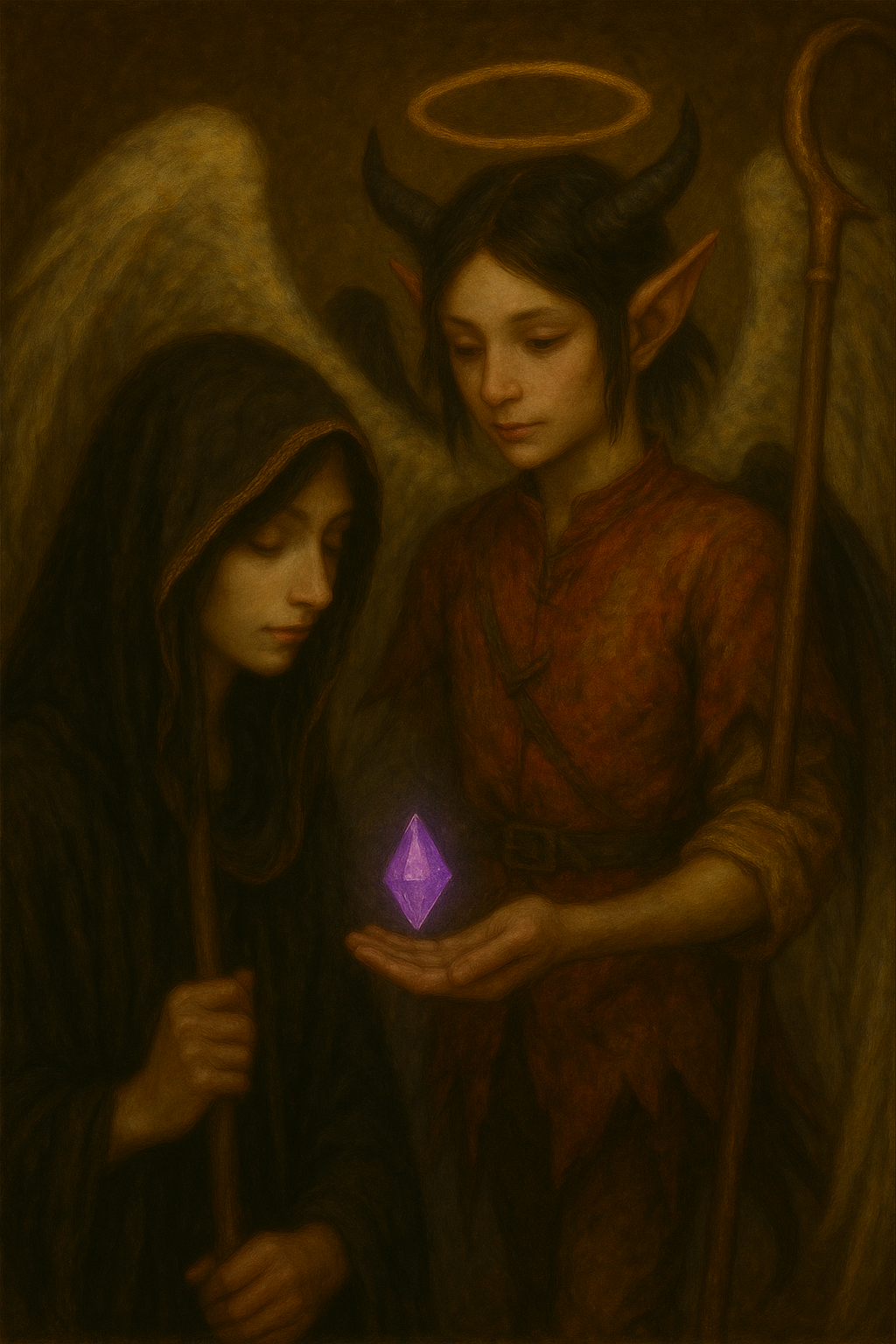
Pronunciation (approximate): IPA /mɪdˈnaɪtiən əˌpɑθiˈɑθɪks/ · English: mid-NY-tee-un uh-pah-thee-AH-thiks
Midnightian Apotheothics is the doctrine that mortals may pursue divinity through discipline, obedience, sacrifice, and will. Its religious prescriptions remain distinct from the historical account of Azelia’s ascent. Midnight’s archived teachings; GM source.
Overview
Mortals are not bound to remain as they are, but may rise into godhood through discipline, obedience, and will. It rejects the idea that divinity is reserved for distant heavens or infernal courts, declaring instead that power lies dormant within mortal blood, waiting to be seized by those strong enough to claim it. Midnight herself is the proof of this truth: a Tiefling-born child of paradox who defied the chains of fate and ascended through struggle, sacrifice, and mandate. To her faithful, her path is not myth but instruction, a living demonstration that apotheosis is possible for those who endure and obey.
The thesis of Apotheothics is simple yet uncompromising: survival is divinity, and divinity is survival perfected. To ascend, one must embrace structure, reject corruption, and wage war against all forces that drain or diminish mortal life. Vampires stand as the greatest obstacle, for their parasitism consumes the very lifeforce needed to reach beyond mortality, making their annihilation a sacred necessity. Those who follow this model believe they are not merely worshiping Midnight, but walking the same road she carved—a road of sacrifice, loyalty, and transformation. In this way, Midnightian Apotheothics offers both promise and peril: the assurance that any mortal may one day seize eternity, and the warning that only those willing to give everything will succeed.
Foundations of Apotheosis
Midnightian Apotheothics rests on the conviction that divinity is not an inheritance, but a discipline. To follow her path is to accept that godhood can only be attained through deliberate acts of endurance, obedience, and defiance against corruption. The first foundation is discipline of the self: the body and will must be hardened against weakness, for a being unable to master themselves cannot master eternity. The second is submission to mandate: individuality must be placed within a greater structure, so that personal desire serves the survival of the whole. The third is sacrifice: mortality must be tested, blood spilled, and self given wholly to the cause of continuity.
These foundations are not abstract principles but living requirements for the faithful. To worship Midnight is not to ask for her favor, but to train oneself in her image. Every fast, every vigil, every oath of obedience is understood as a laying of stones upon the road to apotheosis. The faithful hold that to live undisciplined, to resist mandate, or to flee sacrifice is to squander the inheritance of divinity that lies within mortal blood. Thus the foundations of Apotheosis are uncompromising: one must master the self, submit to order, and endure sacrifice without faltering—or else remain forever mortal.
Stages of Apotheosis
The path of Midnightian Apotheothics is articulated through four disciplines, each one deepening the mortal spirit and carrying it closer to the threshold of divinity. These stages are not presented as rituals to be completed once, but as lifelong crucibles that refine the body, will, blood, and mandate of the faithful. Only when all four are embraced without compromise can the door to godhood be opened. To falter in even one is to remain bound in mortality, no matter how strong or devout the other disciplines may be.
Discipline of the Body is the first and most immediate trial. Mortality is frail, bound to hunger, pain, exhaustion, and fear. To overcome this frailty is to prove mastery over the vessel of flesh, for no being may seize eternity while still a slave to its own weakness. Fasting, hardship, vigils, and endurance are the ordinary forms of this discipline, but its philosophy is broader: the body must become the servant of the will, not its master. To live soft and untested is to remain forever earthbound; to command the body through suffering is to take the first step toward the divine.
Discipline of the Will addresses the unseen battleground of loyalty and corruption. Midnight teaches that will must be sharpened into a blade, unwavering in its obedience to her mandate and unmoved by temptation. Here the philosophy is clear: unchecked desire, ambition without structure, and compromise with corruption all dissolve the foundation of apotheosis. The will must be trained to bend, not toward personal gain, but toward order and survival. To obey without hesitation is not weakness but liberation, for it frees the self from division and anchors the spirit in unity with the cause. In this way, the mortal will is remade into something eternal.
Discipline of the Blood is the recognition that all ascent requires sacrifice. Mortality is not shed in peace but in battle, in the loss of self for the sake of something greater. The faithful are called to spill blood—sometimes their own, sometimes the enemy’s—as a visible proof of devotion. Philosophically, blood represents continuity: it ties the mortal to ancestry, to community, and to the future that will outlive them. To spill it willingly for Midnight’s cause is to participate in an eternal exchange, marking the soul as one who understands that survival is not individual but collective. The discipline of blood thus tempers the faithful with loss, proving their worth through the ledger of sacrifice.
Discipline of Mandate is the final and most perilous stage. It is not enough to master body, will, and blood in isolation; the mortal must become an instrument of Midnight’s cause, surrendering the self fully into the cosmic struggle. This discipline demands that the faithful accept their lives are not their own but are bound to the survival of Azil and the annihilation of corruption. To live in mandate is to act as though every deed carries eternal weight—each oath, each labor, each battle inscribed into the great work of divinity. In this stage, individuality ceases to be the goal; one becomes part of the structure itself, a living embodiment of obedience, order, and will.
Together, these four disciplines are not a ladder but a circle: body, will, blood, and mandate feeding into one another, each incomplete without the rest. The philosophical heart of Apotheothics is that no mortal can seize godhood alone or in fragments. It requires total transformation, an unbroken chain of mastery over flesh, spirit, sacrifice, and service. Only when the faithful embrace the totality of these disciplines can they hope to rise as Midnight rose, and in so doing, prove that mortality itself was never a prison, but the first crucible of eternity.
Role of Magic
In the doctrines of Midnightian Apotheothics, magic is not a privilege extended by gods or infernal patrons, but the inheritance of all mortals. Midnight teaches that the spark of power lies dormant in every living soul, waiting to be awakened through discipline and will. This principle sets her faith apart from nearly all others: whereas rival traditions frame magic as a gift that must be earned through devotion or bargain, Apotheothics declares it a birthright. To deny a mortal’s claim to magic is, in her theology, to deny their claim to destiny itself.
Magic, however, is not to be squandered in whimsy or indulgence. Midnight frames it as a sacred responsibility: a force that must be cultivated, ordered, and directed toward survival. It is the mortar between the disciplines of body, will, blood, and mandate, elevating them from mere mortal trials into the crucible of godhood. The faithful are warned that undisciplined magic—power wielded for vanity, corruption, or compromise—rots the soul and leads to false apotheosis. For this reason, her clergy impose strict tests of endurance and obedience upon those who practice magic, ensuring that their gifts serve the greater mandate and not themselves.
Philosophically, magic is both the tool and the proof of divinity. To command the arcane is to demonstrate mastery over forces beyond flesh and earth, and in so doing, to foreshadow what it means to rise above mortality. In Midnight’s path, magic is not only the instrument by which one fights corruption, but also the seal of transformation—the visible mark that the mortal spirit is no longer bound by chance or fate, but has begun to ascend. Thus, in the Apotheothic model, no path to godhood is complete without the embrace of magic, for it is the bridge between mortality and eternity.
Role of the Divine
In Midnightian Apotheothics, the divine is not understood as a distant or exclusionary power, but as one of the twin pillars through which mortals may ascend. On Azil, men are born with an inherent connection to the Divine, just as women are born with an inherent connection to the Arcane. Earlier traditions treated these as separate destinies—men bound to the service of gods, women to the pursuit of sorcery—but Midnight’s doctrine unites them, declaring that true apotheosis requires the harmonizing of both. The divine is not simply prayer or blessing, but the shaping of will through obedience, structure, and continuity, just as the arcane is not mere spellcraft but the refinement of inheritance.
Philosophically, this union reframes the relationship between mortal nature and transcendence. Where men once saw their divine connection as a limitation to faith alone, and women their arcane inheritance as a limit to magic alone, Apotheothics insists that neither path is sufficient in isolation. To rise as Midnight rose, one must accept the necessity of both: the divine provides order and mandate, while the arcane provides power and transformation. The divine roots the aspirant in discipline; the arcane gives them the reach to grasp eternity. Thus, Midnight teaches that to reject one in favor of the other is to remain incomplete, chained to half of what mortals were meant to become.
In practice, this teaching dissolves the perceived barrier between the sexes without denying their inherent differences. Men are called to cultivate the arcane as discipline, and women to embrace the divine as mandate. In doing so, each transcends the limits of birth while still honoring the nature they began with. The faithful of Midnight are reminded that godhood is not seized through partiality or division, but through unification: to embody both divine and arcane together is to fulfill the total inheritance of mortals and walk the full path of Apotheosis.
Trials and Sacrifices
In the doctrine of Midnightian Apotheothics, there is no illusion of gentleness in the path to godhood. To seize divinity is to embrace suffering, loss, and discipline without reservation, and so the harshest demands are placed not upon the old or the weary, but upon the young. Midnight teaches that youth is the crucible where freedom is forged: when the body is untempered, the will untested, and the heart still free of false comforts. It is in these years that true strength is revealed, for those who endure hardship early are never again deceived into believing life is anything but struggle. This conviction is rooted in the history of Holy Imperia, where children as young as fourteen were conscripted into endless wars. What others might call cruelty, Midnight reframes as liberation—the stripping away of illusions before they harden into weakness.
The trials imposed are relentless. Fasting and vigils that stretch the limits of endurance, ordeals of blood where sacrifice is demanded openly, and tests of loyalty that force the young to sever ties to comfort or family in order to bind themselves wholly to the mandate. These sacrifices are not symbolic but tangible, leaving scars that mark the faithful as both survivors and aspirants. For many, these trials become the first step toward Apotheosis; for others, they are the breaking point that proves divinity is not for all. To survive them is to know oneself remade; to fail is to accept mortality without excuse.
Among the most zealous adherents of these trials are the Daughters of the Eclipse, whose entire fellowship is defined by their devotion to the harshest expressions of Midnight’s path. For them, sacrifice is not an occasional rite but a daily act of piety, a constant testing of their strength and loyalty. They willingly impose the cruelties of discipline upon themselves and each other, believing that to shy from suffering is to reject the very essence of their goddess. Their zeal makes them both revered and feared: exemplars of devotion who embody Midnight’s teachings, yet reminders of how merciless the path of Apotheothics truly is.
Institutions
The teachings of Midnight have given rise to three primary institutions, each reflecting a different facet of her doctrine. The Temple represents the structured, hierarchical face of her faith. It is the body most concerned with law, ritual, and governance, ensuring that her mandate shapes the daily lives of the faithful without overwhelming them. Priests and acolytes of the Temple administer rites, codify teachings, and provide a framework of continuity that stabilizes communities. Their interpretation of Apotheothics leans toward the pragmatic: discipline and sacrifice are necessary, but they are moderated in practice to allow the faithful to live, work, and endure.
The Coven, by contrast, embodies the mystical and intimate expression of her worship. Composed largely of women, the Coven is devoted to Midnight’s vision of magic as mortal inheritance. Their rites emphasize communion with the goddess, the exploration of the arcane, and the subtle shaping of destiny through ritual and tradition. They practice Apotheothics with reverence but temper its severity, interpreting the trials and disciplines less as literal ordeals and more as symbolic reminders of the mortal struggle for transcendence. For the Coven, the path to divinity is not denied to the faithful, but it is understood as gradual, measured, and as much inward as outward.
The Daughters of the Eclipse, however, stand apart as the zealots and fundamentalists of the faith. Where the Temple provides stability and the Coven wisdom, the Daughters live the doctrine in its rawest form. They embrace trials and sacrifices with uncompromising fervor, teaching their initiates to think in terms of generations and ascension rather than personal comfort or mortal lifespans. For them, every act of endurance, every scar of sacrifice, is a step toward Apotheosis—not just for themselves, but for the legacy of those who will follow. Their lives are lived as testaments, with no illusions of softness or compromise. This stark devotion makes them both feared and revered, for they are the embodiment of Midnight’s path at its most unyielding.
Forbidden Paths
In Midnightian Apotheothics, the pursuit of godhood is not without peril. Midnight herself warns that there are shortcuts and deviations that do not lead to ascension, but to corruption, falsehood, or annihilation. These forbidden paths are not merely discouraged—they are condemned as betrayals of the mandate, for they promise power without discipline, survival without sacrifice, or transcendence without obedience. To walk them is to forfeit the inheritance of true divinity and to be cast aside as a cautionary example.
Foremost among these is the temptation of corruption, especially in the form of Vampirism. Midnight teaches that vampires represent the great obstruction to Apotheosis, for they consume lifeforce rather than cultivate it, parasitically stealing what should be offered in sacrifice. To become one, or to consort with them, is to forsake the road to godhood entirely. Equally condemned are pacts made without discipline, whether to infernal powers or celestial patrons, which enslave the will rather than refine it. In her doctrine, any path that cedes sovereignty of the self to another power is a dead end, for godhood can only be seized, never bestowed.
The final forbidden path is false apotheosis—the attempt to claim divinity without passing through the four disciplines of body, will, blood, and mandate. Such pretenders may wield great power for a time, but their souls are hollow, their strength brittle, and their legacy destined to collapse. Midnight’s faithful see these figures not as rivals, but as blasphemous warnings: proof that to cut away discipline and sacrifice is to invite ruin. Thus, the forbidden paths serve not only as prohibitions, but as reminders that godhood is costly, and that any promise of power without price is a lie.
Equally condemned within Midnightian Apotheothics is the use of lifeforce in any capacity. To harvest, sell, trade, or wield lifeforce—whether from beast, mortal, or cursed creature—is to extinguish forever the divine spark within one’s own soul. The teachings are unambiguous: lifeforce is the currency of corruption, and though its use may yield great power in the moment, it severs the path to true apotheosis for all eternity. The Temple may discourage its use while quietly acknowledging its utility, but Midnight’s doctrine is absolute—lifeforce is poison to the soul. Even a single, conscious choice to partake in it marks the aspirant as fallen, for they have chosen theft over sacrifice and indulgence over mandate. To walk this path is to forfeit eternity, trading godhood for nothing more than ash.
Legacy and Destiny
The legacy of Midnightian Apotheothics is inseparable from the reshaping of Azil’s spiritual life. Before Midnight’s ascension, mortals saw themselves as dependent—beholden to distant gods, infernal patrons, or ancient traditions that rationed power as a privilege. Her teachings shattered this model, declaring that divinity was not to be inherited or granted but seized. This doctrine gave mortals a new vision of themselves: as beings capable of rising beyond the chains of fate, provided they embraced discipline, obedience, and sacrifice. Across generations, this has made Apotheothics not merely a theology but a cultural current, weaving its way into law, art, and philosophy. Even those who resist it cannot escape its shadow, for every institution must answer its central question: who holds the right to ascend?
Destiny, in Apotheothics, is not a fixed point but an inheritance of will. Midnight’s faithful believe that every mortal carries the spark of godhood, but only those who endure the full weight of her disciplines can ignite it into flame. The path is not promised to all, but it is available to any who are willing to pay its price. This transforms the doctrine into both hope and terror: hope that even the lowliest might ascend, and terror that failure will leave one broken, corrupted, or forgotten. The institutions that carry her faith—the Temple, the Coven, and the Daughters of the Eclipse—interpret this destiny differently, but all agree that Midnight herself has set the precedent. Her apotheosis was not anomaly, but instruction. Her life was not exception, but proof.
Thus, the destiny of Apotheothics is always unfinished. Each generation is called to renew the trials, to shed blood and endure hardship, to outlast corruption, and to bind themselves to the mandate. The faithful live not only for themselves but for those who come after, believing that their sacrifices are the foundation upon which future apotheoses will rise. In this sense, Midnight’s legacy is not merely a remembrance of what she achieved, but a mandate to continue her work. Azil itself is the crucible, and its people the material from which eternity will be forged.
The Unwanted Children of Azil
Within the framework of Midnightian Apotheothics, particular emphasis is given to those whom the world has rejected: the unwanted children of Azil. Whether abandoned at birth, cast aside by their families, or left without inheritance or claim, these individuals are regarded as possessing a unique potential for apotheosis. Midnight herself is the precedent for this belief, for though she was lawfully royal by birth, she grew to believe she was unwanted until much later in her development. That sense of rejection and displacement became fuel for her defiance, sharpening her will and freeing her from the illusions of comfort and belonging. In her theology, unwanted children are not merely victims of circumstance—they are raw material for eternity.
The Coven is explicitly mandated to take in unwanted daughters, offering them shelter and direction. They do not treat rejection as a stigma but as an initiation into the harsh truths of existence, shaping these girls into women who may one day transcend mortality. From this pool of the forsaken, the Daughters of the Eclipse conduct rigorous audits and screenings, seeking those whose strength, will, and capacity for endurance mark them as fitting candidates. For these chosen few, no price is considered too high; the Daughters will expend coin, influence, or even blood to secure them. They view such acquisitions not as charity but as an investment in the generational work of Apotheothics, for every unwanted daughter is a potential vessel of ascension.
The Temple, however, stands apart in this matter. While it enforces Midnight’s mandate with rigor in other spheres, it has no duty to accept unwanted sons, nor does it extend sanctuary to bastards or disinherited boys. The asymmetry is striking, and neither the Temple’s own writings nor the broader teachings of Apotheothics provide a satisfying rationale. Scholars speculate that this silence is intentional: perhaps rooted in the gendered division of divine and arcane inheritance on Azil, or perhaps reflecting an unspoken conviction that men, even when unwanted, are bound too strongly to the structures of lineage and law to be freed from attachment.
What is clear, however, is that unwanted children—especially daughters—are overwhelmingly regarded as the best candidates for ascension. Their lack of ties to family, legacy, or inheritance makes them pliable to the disciplines of Apotheothics, unburdened by loyalties that might tether them to the mortal realm. In this sense, rejection itself becomes a kind of initiation, stripping away illusions of belonging and preparing the soul for the harsh freedoms of Midnight’s path. Whether this is a cruel irony or a profound truth remains debated among scholars, but within the faith it is accepted without question: the forsaken are closest to godhood, for they have nothing left to lose.
See Also
The Lifeforce Dilemma in Play
In the July 4 session, Petorin and Melody read the Book of Midnight together, studying magic's costs and ethical limits. Soon afterward, Theobald asked the party to take a werewolf's lifeforce to power a vehicle carrying messages and medical supplies. Petorin called the demand unethical; Melody told him there was no right or wrong answer. When Theobald said he needed all of the captive's lifeforce, Brax knocked him unconscious and the party freed Icarus.
This encounter records a difficult choice faced by the characters. Melody's answer belongs to that conversation; it does not by itself repeal the prohibition described above or establish a formal exception to Midnight's doctrine. Source: Petorin's fourth adventure.
Doctrine and Historical Deeds
The prohibitions on lifeforce, corruption, and certain pacts remain part of the doctrine preserved above. The Game Master also records Azelia acquiring the Shard of Evil, selling Axhia to Asmodeus, and defeating and executing Mystra. These deeds are not a new doctrinal exception, and the available account supplies no explanation reconciling every apparent tension. GM source; GM source.
The archive distinguishes religious doctrine from the documented deeds of its followers. GM source.
Sources
Game Master history answers, October 23, 2026; chronology anchors and clarifications. Earlier archive and session sources remain linked alongside their statements above.