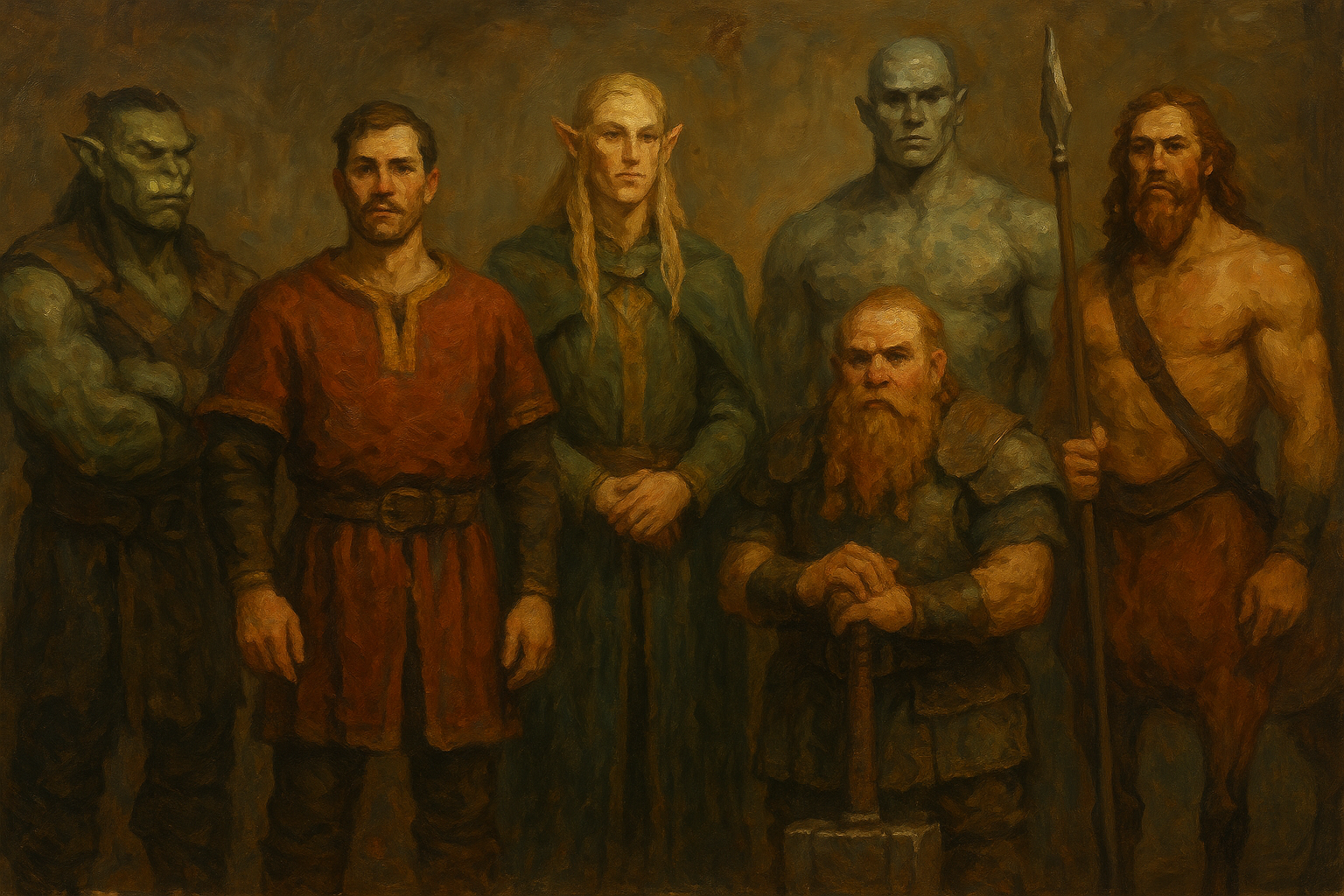
Pronunciation (approximate): IPA /ˈreɪsɪz əv ˈæzɪl/ · English: RAY-siz uv AZ-il
Humans - 52%
Humans on Azil are the most numerous race, their adaptability and drive forming the backbone of every major kingdom and alliance. Unlike the longer-lived races, humans carry little inherited memory; instead, they build vast institutions of law, faith, and war to preserve their place in a world always threatening to consume them. This has made them the primary rivals of the Vampires, for while they cannot match them in strength or longevity, humans endure through sheer numbers and the relentless march of their societies. Armies of common soldiers, bound by discipline rather than bloodlines, are the human answer to predation. To the Vampires, they are both prey and the one race that cannot be easily erased, forever returning in new banners and generations.
Culturally, humans lean toward extremes of devotion and ambition. They can raise monuments and faiths with frightening speed, yet abandon them just as quickly when power shifts. This instability makes them fertile ground for Midnight’s legacy, for she was born of their blood and their contradictions. To many, she represents the possibility of breaking free from old patterns; to others, she is the most dangerous reminder of humanity’s tendency to birth forces it cannot control. In the civilizational order of Azil, humans are the great weavers—fragile alone, but nearly unstoppable when united, shaping the world not through innate might but through the weight of their collective will.
Tieflings - 18%
Tieflings on Azil live in the shadow of both suspicion and reverence. Marked by infernal blood, they bear horns, tails, and eyes that unsettle many, but within human societies they are afforded a level of acceptance rarely seen elsewhere. This tolerance is not born of charity but of necessity: the memory of Midnight, the apotheosized daughter of mortal and celestial, who bore the Tiefling’s form with pride. Her existence sanctified their image among the faithful, granting them legitimacy and a place within human-built orders. In these lands, a Tiefling might rise as scholar, soldier, or priest without the same barriers faced in other realms, though whispers of their “true nature” never entirely vanish.
Culturally, Tieflings have developed sharp instincts for survival. Some embrace piety and the structures of human law to prove loyalty, while others lean into their heritage of cunning and ambition, unafraid to claim power by guile or pact. Outside the circles of Midnight’s faith, however, their lives are less certain. Elves and dwarves often regard them with unease, or outright disdain, while among orcs and goliaths they are distrusted as tricksters or weaklings. Thus, a Tiefling in Azil often walks a narrow line: respected within human faith-driven civilizations, yet treated as an omen or outsider beyond those borders. This duality has instilled in them both resilience and a deep awareness of how others perceive them.
Midnight herself was an Imperian Tiefling by birth, a child of Gabriel and Glasya, and her ascension reshaped the destiny of her kind. Her story lingers as proof that the blood of tieflings can carry both damnation and divinity, a paradox that defines how the race is remembered and judged across Azil.
Elves - 7%
Elves on Azil are an old and patient people, their civilizations rooted in continuity rather than conquest. Where humans build institutions to outlast fragile lifespans, elves embody that longevity directly, carrying centuries of memory within a single generation. This has granted them unmatched artistry, deep arcane traditions, and an unshakable sense of superiority toward the younger races. They often present themselves as preservers of balance, yet their aloofness can easily turn into paralysis, as they weigh every choice against the backdrop of eternity. To humans, elves are both admired for their grace and mistrusted for their unwillingness to sacrifice themselves in wars against the Vampires.
Culturally, elves thrive in seclusion, forming enclaves that guard knowledge and bloodlines with zeal. Their faiths and philosophies vary, but most share a reverence for continuity—whether through the preservation of forests, archives, or magical traditions. In matters of Midnight, their opinions are divided: some see her as a dangerous rupture in the cosmic order, while others view her ascension as a proof of mortal defiance against both gods and Vampires. Yet even when aligned with human causes, elves rarely commit themselves wholly, preferring to lend wisdom, magic, or small companies of warriors rather than entire nations to foreign struggles.
To the Vampires, elves are a valued prey—prized for the rarity of their blood and the allure of their long lives. Yet unlike humans or tieflings, they are far less numerous, and their isolationist tendencies have left them ill-suited to resist in the wars of attrition that shape Azil. Elves endure, but often at the cost of others, choosing survival over sacrifice.
Dwarves - 10%
Dwarves on Azil are a people of stone, steel, and memory. Where humans adapt and elves endure, dwarves root themselves in permanence, building citadels and halls that can outlast empires. Their societies are ordered around craft, clan, and oath, with a reverence for the labor of hands as sacred expression. To a dwarf, forging a blade or carving a stone is not merely industry but a covenant with the world, a statement that something solid can remain amidst the chaos of Azil. This deep attachment to permanence makes them wary of both Vampires and Midnight—creatures and forces that represent change without consent, corruption that seeps into what should endure.
Culturally, dwarves are known for bluntness and suspicion, especially toward races whose loyalties seem too easily swayed. They trust proof of work over promises, and are far more likely to judge a person by the strength of what they build than the beauty of what they claim. Dwarven faiths are often entwined with stone and forge gods, emphasizing toil, order, and preservation. Yet despite their stoic exterior, dwarves are not without passion—they drink deeply, fight fiercely, and hold grudges with legendary fervor. Against Vampires, they are stalwart defenders of their mountain holds, though their numbers are too few to project lasting influence far beyond their own fortresses.
To Midnight, dwarves offer a cautious respect. Some regard her ascension as another unpredictable upheaval, one that could fracture what little stability Azil has left. Others whisper that she, like them, carved her destiny through labor and endurance, proving that even flawed material can be reforged into something greater. Yet whether they revere or fear her, dwarves rarely commit themselves beyond their strongholds, preferring to outlast the storms of history behind walls of stone.
Orc - 4%
Orcs on Azil are a people forged in hardship, their lives defined by hunger, conflict, and an unyielding will to endure. Their clans are bound together by trials of strength and loyalty in battle, with leaders rising not by blood but by deeds. To outsiders, this makes them appear as raiders and berserkers, yet within their own ranks, orcs see themselves as the last honest survivors of a world that grinds the weak beneath it. They wage brutal wars of attrition against the Vampires, refusing to bow even when outnumbered or outmatched, and their scars—physical and cultural—speak of a race that survives by defiance alone.
Culturally, orcs are uncompromising, direct, and suspicious of diplomacy that hides weakness behind words. Their songs and rites honor the fallen as much as the living, for every death is remembered as a gift to the survival of the clan. While they have often clashed with humans and dwarves over land and resources, they recognize in both a shared devotion to continuity and order, even if they do not share the same methods. Elves, tieflings, and halflings tend to regard orcs with disdain, an attitude the orcs repay in kind, convinced that most races dress cowardice in the trappings of “civilization.”
In the matter of Midnight, however, orcs occupy a uniquely cursed place. Though she was herself born of rejection and contradiction, Midnight despises the orcish race with a fervor that eclipses her contempt for any other. To her, they embody chaos without higher purpose: endless strife for its own sake, unworthy of refinement or redemption. This hatred has hardened into dogma among her faithful, who often see the extermination of orcs not merely as practical policy but as sacred duty. Thus, while the Vampires feed on orcs as prey, Midnight seeks their annihilation—a destiny that ensures orcish survival will always be fought in blood and fire, against foes both mortal and divine.
Goliath - 2%
Goliaths on Azil are a race of towering strength and endurance, born into harsh environments where survival itself is a daily trial. Their nomadic clans carve out a life in mountains, tundras, and wastelands, where few others can endure for long. Among themselves, strength and resilience are honored above all, but their culture also prizes fairness, merit, and the ability to carry burdens for the sake of the group. This gives them a reputation as both fearsome warriors and steadfast companions, though outsiders often see only their size and ferocity, reducing them to living weapons in the wars of others.
Culturally, goliaths are marked by fatalism. They know their lives will be short compared to elves or dwarves, and that their race is scattered, never forming kingdoms or lasting realms. This has made them simultaneously humble and proud: humble in the face of their own limits, but proud in the knowledge that what they do accomplish is earned through toil and grit. They are often drawn to mercenary work, guard duties, or pilgrimages of strength, seeking meaning in service as much as in combat. To humans and tieflings, they are sometimes admired as exemplars of physical might, but just as often treated as outcasts who cannot fit into settled life.
From Midnight’s perspective, goliaths are a cursed and unfortunate people—marked by hardship but not by inherent malice. Unlike her hatred of orcs, she views goliaths with pity and acceptance, granting them a place within her mandate if they choose to follow her. To her faithful, this has translated into a rare mercy: goliaths are not seen as tainted or profane, but as strugglers who can be uplifted through loyalty and devotion. For this reason, many goliaths who have no lasting home find themselves in Midnight’s ranks, serving a cause that recognizes their burdens without condemning their blood.
Dragonborn - 1%
Dragonborn on Azil are a rare and often misunderstood people, born with the legacy of dragons in their blood but without the dominion or hoards of their ancient progenitors. They walk the world as living symbols of strength, pride, and destiny, yet their small numbers have left them scattered across kingdoms, seldom able to form nations of their own. This rarity has made them objects of fascination, suspicion, and sometimes outright exploitation—admired for their power but feared for the draconic fire that smolders within them. To the Vampires, dragonborn are prized quarry, their blood said to burn with a potency unlike any other, making them a target whenever their presence becomes known.
Culturally, dragonborn carry themselves with a deep sense of honor and duty, often to ideals rather than to bloodlines. Many live by strict personal codes, holding truth and oath as sacred, even when the societies around them see such values as inflexible or naïve. Their scattered existence means that no single dragonborn culture dominates Azil; instead, they adapt to local ways while preserving fragments of draconic heritage through oral tradition, ritual combat, and ancestral rites. This has given rise to both wandering swordmasters who dedicate their lives to proving their worth, and quiet mystics who guard what remains of draconic wisdom.
In the eyes of Midnight, dragonborn are neither cursed nor sanctified but are seen as rare instruments of fate. Their dwindling presence on Azil makes them tragic, yet she does not spurn them; instead, she welcomes them as individuals into her mandate, recognizing in them a potential for greatness that mirrors her own defiance of destiny. To her faithful, a dragonborn’s devotion is considered a high honor, a sign that even the scions of dragons bend willingly to Midnight’s cause.
Halfling - 3%
Halflings on Azil are a quiet and often underestimated people, living in the margins of greater powers yet enduring through cunning, adaptability, and community. They rarely establish kingdoms or empires, instead weaving their lives into the fabric of larger societies or carving out hidden enclaves where the land is gentle and the soil fertile. Where humans rely on law and orcs on strength, halflings survive by remaining overlooked—traders, farmers, scouts, and storytellers who can slip through the upheavals of war with little notice. To the Vampires, they are not a favored prey, but when hunted they prove infuriatingly elusive, their small size and communal networks allowing them to vanish into countryside or shadow with remarkable ease.
Culturally, halflings thrive on simplicity and closeness. Their hearths are places of warmth, their festivals marked by music, food, and laughter that persists even when the world darkens around them. Yet their cheer is not ignorance; it is defiance. Halflings know they cannot match elves in magic, dwarves in craft, or humans in sheer numbers, but their strength lies in refusing despair, and in remembering that life is meant to be lived even under the shadow of empires and gods. They are natural wanderers as much as homebodies, with many choosing the road over the hearth, becoming merchants, guides, and companions to those who might otherwise walk alone.
Midnight herself has little direct doctrine regarding halflings, but she does not exclude them. To her, they are a people of little ambition, yet much heart—a reminder that survival need not always come through war or apotheosis. Those halflings who choose to follow her are welcomed without disdain, their devotion viewed as sincere even if their role in her great mandate is small. In this way, halflings embody a quiet paradox: the smallest of peoples, yet among the hardest to erase.
Other - 3%
Not every people of Azil fit neatly into the dominant categories of human, tiefling, elf, dwarf, orc, goliath, dragonborn, or halfling. The world is vast, its frontiers marked by strangeness and survival, and countless smaller populations persist in the shadow of empires and the struggles between gods and Vampires. These peoples rarely command large realms or enduring institutions, but they leave their mark on trade routes, forgotten valleys, and remote strongholds. Many live as scattered tribes or hidden enclaves, tolerated by the greater powers so long as they do not threaten established order. To the faithful of Midnight, they are not dismissed outright—though they may never form the core of her vision, those who swear themselves to her mandate may still find a place in her ranks.
Some of the notable “other” peoples include:
Tabaxi – Nomadic and feline, often appearing as traders, storytellers, and wanderers of the world’s far edges.
Centaurs – Proud and reclusive, their tribes are bound to the open plains and wildlands, clinging fiercely to freedom from outside rule.
Kenku – Raven-folk cursed to speak only in echoes, often feared as spies or omens but treasured as messengers by those who earn their trust.
Tritons – Dwellers of the deep seas, occasionally surfacing to enforce pacts of balance or to war against threats rising from the abyss.
Goblins – Numerous but fractured, surviving in hidden burrows and scavenger bands, often dismissed yet impossible to eradicate entirely.
Firbolgs – Gentle giants tied to deep forests, guarding ancient groves and relics with quiet strength and a mistrust of the wider world.
Aasimar – Mortal-born with celestial touch, rare and often burdened by expectations they neither sought nor welcome.
More – There are an ample amount of other mortal races. Consult with the DM if you want to include other races.
Together, these races form the “other” of Azil—not united, not dominant, but enduring in niches carved across the land and sea. Their destinies are shaped as much by proximity to the great struggles as by their own traditions, and while few rise to prominence, they embody the sheer diversity of life that continues to resist the darkness.
Vampires - Unknown Quantity of Lords [ Non-Playable ]
The Vampires of Azil are not to be bargained with, trusted, or tolerated. They are predators who wear the mask of civility, creatures that consume not only the blood of mortals but the will of nations, hollowing out kingdoms until nothing remains but husks bound to their hunger. Every oath they swear is a lie, every gift they offer a trap, and every alliance they propose a prelude to betrayal. To parley with them is to invite corruption into the heart of your people, for the vampire’s touch is patient—it does not always strike in the night with fangs, but seeps slowly into courts, councils, and kin until resistance collapses from within. Those who believe themselves clever enough to outwit them soon find their minds ensnared and their loyalties twisted.
Midnight’s mandate is unambiguous: the vampires must be eradicated, root and branch. They are not rivals to be contained nor neighbors to be endured, but an infection to be burned from Azil with fire and steel. No pact can bind them, no repentance can redeem them, for their very existence is a violation of mortal life. To collaborate with them, even in desperation, is treachery against Midnight and all who follow her cause. Only in their destruction can the living world endure. Their castles must fall, their covens scattered, their names forgotten—until no shadow remains deep enough to hide them.
Werewolves - Unknown [ Roleplay Only Table ]
The werewolves of Azil remain one of the least understood peoples of the world, living in hidden clans scattered across wilderness and shadow. Their numbers are uncertain, their migrations are the subject of constant speculation, and they seem bound by instincts that place them apart from settled races. What little is known is marked by contradiction: they are a people of family and loyalty, yet cursed with the need to prey upon mortal life. Most encounters with them are fleeting—violent in some cases, wary in others—but always shrouded in mystery.
Their lifeforce has made them dangerously valuable. To the Temple, it is a means of casting great magics without reliance on the Coven; to the Coven, it is a channel through which their women may commune directly with the gods, bypassing the authority of the Temple. The Vampires covet it as well, though their true purpose for such lifeforce remains a matter of speculation and dread. This exploitation has left the werewolves preyed upon by institutions far stronger than themselves, reduced to commodities in struggles not of their choosing.
Midnight’s teachings regard werewolves with a particular kind of pity. She names them victims of circumstance—creatures bound by instinct and hunger, yet not bereft of dignity or family. They are deserving of mercy when it can be afforded, provided their predation does not endanger the faithful. To hunt them for their lifeforce, however, is condemned even by the Temple as a profound evil, an act of theft against life itself. Thus, the werewolves endure in uneasy exile: feared by mortals, hunted by powers, yet begrudgingly respected by those who see in them not monsters, but kin caught in a curse.
Campaign Observations: Lycanthropy
The party’s encounters add individual cases to this broad survey. On the July 4 journey, they freed the werewolf elder Icarus from Theobald’s intended life-force extraction; the elder identified another captive as his daughter and invoked Midnight’s protection. Later, Petorin’s 13th Adventure records the giant wolf guarding Ollie and Harmony returning to Leashira deSable’s half-elf form. These cases establish family ties and a transformation within the company without revising population estimates or proving one religion shared by all werewolves. See Werewolves for the observations and the limits of Melody’s treatment.
Individual Race References
Human · Tiefling · Elf · Half Elf · Orc · Half Orc · Hobgoblin · Goblin · Halfling · Gnome · Dwarf · Asamir · Tabaxi · Goliath.
These entries distinguish published D&D reference traditions from the campaign account above; the archive’s population figures remain an undated overview.