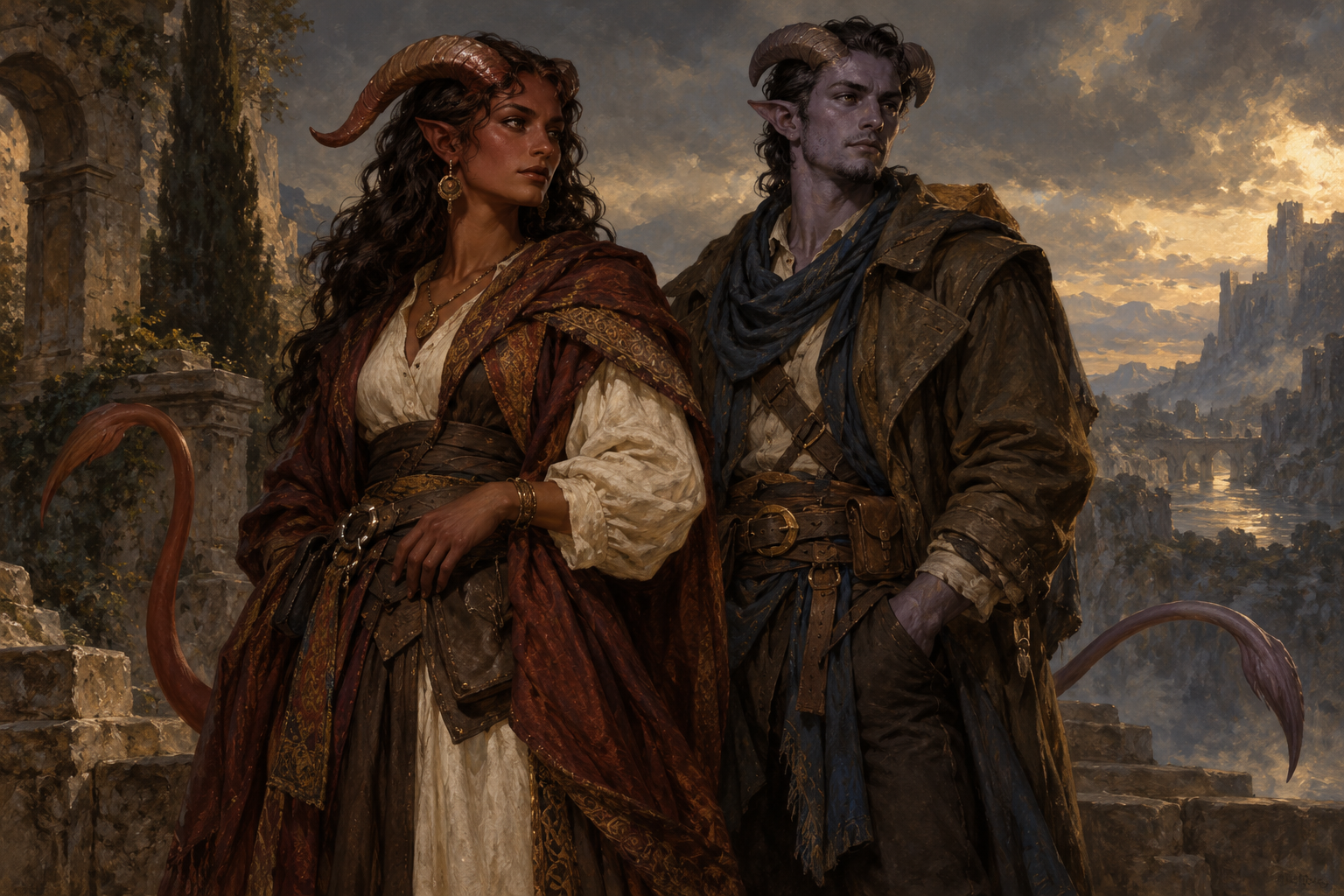
Pronunciation (approximate): IPA /ˈtiflɪŋ/ · English: TEEF-ling
Published D&D Reference
Published D&D connects tieflings with fiendish ancestry or the Lower Planes; that legacy does not determine a person’s morality. D&D Beyond Basic Rules, Character Origins.
Midnight’s Eclipse
Races of Azil lists tieflings at 18% and describes unusual acceptance within human societies shaped by Midnight’s example. The campaign records Midnight as tiefling-born. This local religious history is Midnight’s Eclipse homebrew, rather than a general account of tieflings in every D&D setting.
Bars bets and gold describes a tiefling associated with the tavern and two tiefling women accompanying Gracus. Those descriptions do not establish Gracus’s ancestry, the women’s biographies, or any shared affiliation beyond the encounter.
Historical Imperian Acceptance
The Imperian account describes humans and tieflings as populations positioned for full integration into the state, including among conquered Celestians. Its religious sources interpreted tiefling lineage through a Covenant story joining guardianship and judgment. That interpretation belongs to the Faith of Man; it is not adopted as the confirmed biological origin of every tiefling. The current campaign’s demographics, Midnight’s tiefling birth, and the independently established family history remain unchanged. Banner and Pyre source. Banner and Pyre source. Banner and Pyre source.
Sources
Banner and Pyre: preserved shared-world lore export, with individual source anchors cited in the institutional context above.
The original campaign accounts and documents remain linked beside the earlier statements above. October 23 Game Master clarifications control the historical and biographical limits.