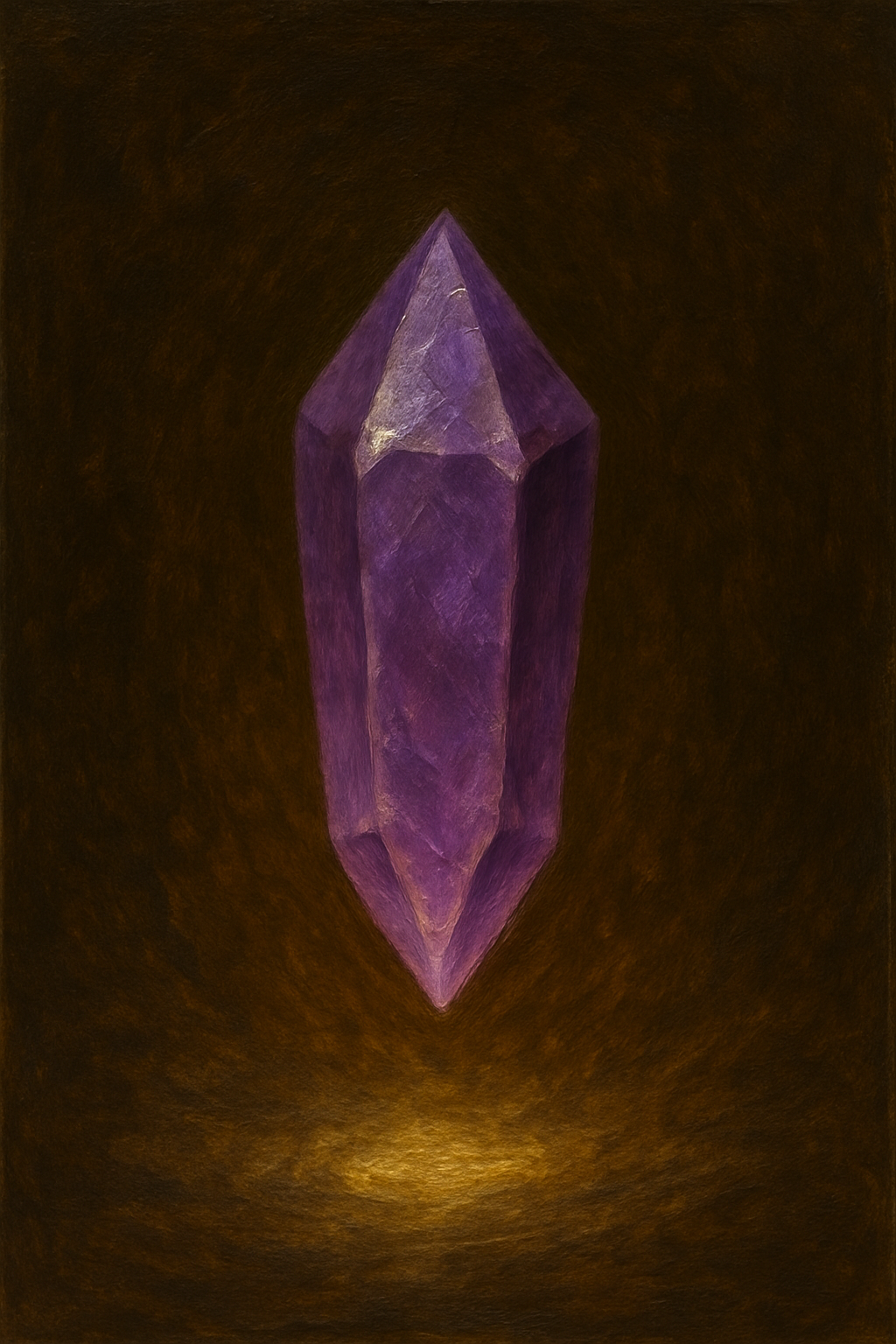
Pronunciation (approximate): IPA /ʃɑrd əv ˈivəl/ · English: SHARD uv EE-vuhl
The Shard of Evil is among the powerful objects Azelia Bartholomew acquired to fuel her magic. Its place in Midnight’s history is recorded separately from the religious interpretations surrounding the Shards. GM source.
Overview
The Shard of Evil is a fragment of primal corruption, a crystalline remnant said to predate the shaping of Azil itself. Each shard carries within it a concentrated essence of destruction, temptation, and unmaking, powerful enough to warp mortals, poison lands, and fracture even the strongest institutions. Scholars and zealots alike agree that the shards are not singular but scattered—at least 333 are known across the planes, each a wound in reality that resists healing. Though their exact origin is contested, most traditions hold that they splintered from a single source, an ancient core of malignancy cast down in the wars of gods and primordials. Wherever one is found, strife follows, for their presence compels mortals and immortals alike to claim, conceal, or destroy them.
Among these infamous fragments, one bears particular significance: the Shard held by the Goddess Midnight. Unlike most who seek the shards for dominion or destruction, Midnight seized hers as both weapon and proof of her mandate. To her faithful, this possession is not a blasphemy but a revelation—that even the deepest corruption can be mastered and folded into the cause of survival. To her enemies, it is the most damning evidence that she is dangerous beyond comprehension. Whether as cursed relics, divine challenges, or keys to apotheosis, the Shards of Evil remain among the most feared artifacts in existence, each one a silent reminder that the cosmos was never fully cleansed of its first darkness.
Origins and Myth
The origins of the Shards of Evil are shrouded in contradiction, for no single tradition lays uncontested claim to their genesis. The most widely accepted myth asserts that they are splinters of a primordial core, the very heart of corruption torn from the fabric of creation during the first wars between the divine and the abyssal. In this telling, the gods, unable to unmake the core without unmaking creation itself, shattered it into pieces and scattered them across the planes, hoping their dilution would render them inert. Instead, each shard became a locus of malignancy, too small to threaten the cosmos entire yet too potent to be ignored. From that point forward, history itself became entangled with their appearance, as kingdoms, cults, and covenants rose and fell in pursuit or possession of their power.
Nature and Properties
Shards of Evil are most often described as crystalline objects of unsettling geometry, jagged fragments that seem both natural and impossibly precise. Their surfaces shift in color depending on the eye of the beholder: to some they burn with a deep crimson glow, to others they shimmer with voidlike blackness shot through with veins of violet light. In truth, they are not fully material, existing half in the mortal realm and half in some deeper wound of the planes. Scholars note that even the smallest shard radiates an aura perceptible to the sensitive—a pressure in the mind, a tightening in the chest, or the sensation of standing on the edge of a precipice. The faithful of Midnight teach that this presence is not mere energy but temptation itself, an active invitation to claim, wield, or be consumed.
The properties of the shards are as dangerous as they are varied. Proximity alone has been shown to warp behavior, eroding trust, inflaming ambition, or magnifying fear. Prolonged exposure can corrupt bodies as well as souls, birthing mutations or driving mortals into madness that mirrors vampiric degradation. Yet these same shards are also reservoirs of immense power. A wielder may draw upon them to amplify spellcraft, to seal or unbind magical wards, or to dominate lesser undead with ease. The paradox lies in their nature: each shard promises strength, yet every recorded instance of their use brings the user closer to ruin. To the Temple, they are poison. To the Coven, they are mysteries. To the Daughters, they are forbidden trials. And to Midnight, whose possession of one is legendary, they are proof that corruption itself can be mastered and bent to mandate.
Influence and Corruption
Wherever a Shard of Evil rests, corruption radiates outward like concentric ripples in water, subtle at first and catastrophic over time. Lands that harbor a shard grow restless: crops spoil without reason, animals grow violent or malformed, and shadows seem to cling longer than the sun allows. Mortals who dwell nearby suffer from strange dreams, obsessions, and paranoia, their ambitions inflamed or their fears sharpened into paranoia. Entire communities have been known to fracture into suspicion and violence under the shard’s unseen pressure, each citizen believing themselves justified even as they descend into chaos. It is this quiet unraveling—more than the overt mutations—that scholars of the Temple name the shard’s true corruption, for it erodes continuity without ever lifting a blade.
On the individual level, shards prey upon what is already present in the heart. A tyrant becomes more ruthless, a zealot more fanatical, a coward more craven. Unlike ordinary curses, the shard does not impose alien desires but magnifies existing fractures, convincing its host that their excesses are natural, even righteous. This is why their influence has toppled institutions as surely as it has ruined individuals; kings, priests, and even scholars often believe themselves in control long after they have become instruments of the shard’s will. Midnightian Apotheothics teaches that this influence is the perfect inversion of mandate: where discipline binds mortals into continuity, shards sever them, leaving only hunger and self-destruction. For this reason, the eradication of shards—or mastery of them, in Midnight’s rare example—is considered a sacred work, for they are not merely relics of corruption but active agents of it.
Historical Encounters
The history of Azil and its surrounding planes is punctuated by the appearance of Shards of Evil, each event leaving scars that echo for generations. The oldest recorded instance is the Fall of Uln’Varr, when a prosperous city-state unearthed a shard during excavation of its lower catacombs. Within a decade, its council collapsed into civil war, each faction claiming divine right to the shard’s use. Survivors fled into exile, carrying tales of a city whose streets ran red and whose final king crowned himself “immortal” before burning alive in his own throne room. The ruins of Uln’Varr remain abandoned, avoided even by scavengers, as every attempt to reclaim the site has ended in madness or unexplained catastrophe.
Another infamous event is tied to the Coven of Shattered Glass, a sect of witches who believed a shard could serve as a conduit to bypass both Temple and divine hierarchy. They succeeded in harnessing it, briefly, creating a rite that allowed their priestesses to commune directly with the gods without mediation. Yet their triumph lasted only a generation before their rites twisted into incoherence and their members into husks, their lifeforce leeched away by the shard itself. Scholars note this as a clear instance of the shard’s duplicity: promising empowerment but yielding only ruin. The Coven’s remnants persist as a cautionary tale, their texts preserved but heavily redacted in Temple archives.
The most perilous connection to greater cosmology comes through the Chains of Tharizdun. In certain myth-cycles, the Shards of Evil are described as the very fragments of the prison that binds Tharizdun, the Chained God of entropy and madness. This belief gained traction during the Night of Nine Moons, when a shard was uncovered in the Rift and unleashed a wave of annihilation that erased three provinces in a single night. Surviving witnesses claimed to hear a voice promising release, a hunger that would consume all planes. While the Temple dismisses this as heresy, Coven and Daughter scholars alike treat it as credible, fearing that each shard is not merely corruption but a key—an artifact whose misuse could loosen the bindings of Tharizdun himself.
The most recent and controversial encounter lies with Midnight’s own possession of a shard. Unlike rulers, cults, or institutions that fell to ruin under its influence, she is believed to have seized and mastered it, bending its corruption to her mandate. To her faithful, this is proof of her divinity: she has accomplished what no mortal or god has managed—claiming the shard without succumbing. To her enemies, however, it is evidence of blasphemy, a sign that her apotheosis itself is tainted. This debate continues to divide scholars and institutions, yet all agree that Midnight’s shard has become a cornerstone of her mythos, ensuring that the Shards of Evil remain at the center of Azil’s greatest struggles.
Midnight and the Shard
The most infamous of all known shards rests not in a vault or ruin, but in the hand of Midnight herself. Integrated into the head of her staff, the Shard of Evil she possesses is no mere relic hidden away but a living part of her iconography and power. Midnight was already a spellcaster of formidable genius and discipline before acquiring it, her mastery of both divine and arcane paths placing her beyond the reach of most mortals. Yet the moment she bound the shard into her staff, her destiny changed: it became both the instrument of her greatest act and the symbol of her defiance. Unlike those who fell to corruption, Midnight imposed her will upon the shard, refusing to be consumed. To her faithful, this is the proof that corruption itself can be subdued, that mandate and discipline are stronger than the pull of annihilation.
It was with this staff, shard gleaming at its crown, that Midnight enacted her most radical act—the usurpation of the Domain of Magic from Mystra. In the cosmic upheaval that followed, she declared that magic was not to be the chained gift of one goddess but the inheritance of all mortals. The shard amplified her spellcraft beyond comprehension, piercing wards and unraveling Mystra’s dominion until the very fabric of magic bent to her hand. This act is both revered and feared: to some, it was liberation, the ultimate proof of mortal potential; to others, it was an act of theft, staining Midnight’s apotheosis with the same corruption that defines the shards themselves. Yet whether viewed as triumph or blasphemy, the image of Midnight with the shard-bound staff endures as one of the most powerful symbols in Azil’s mythos—an eternal reminder that godhood itself may be seized through will, mandate, and mastery of even the darkest relics.
Guardians and Seekers
The Shards of Evil are never left unobserved for long. Across Azil, factions arise with the sole purpose of guarding or seizing them, each convinced that possession—or denial of possession—is a sacred duty. The Temple often positions itself as guardian, swearing that no mortal hand should ever wield a shard, sealing them within sanctified vaults or destroying any who attempt to claim them. The Coven, by contrast, tends toward seekers, regarding the shards as forbidden mysteries: too dangerous to ignore, too potent to leave in the hands of rivals. Their approach is one of control through knowledge, preserving grimoires of failed attempts while searching ceaselessly for methods to safely bind a shard’s influence. The Daughters of the Eclipse stand between these extremes, treating shards as crucibles—monuments of temptation that prove the necessity of discipline. To them, even to approach a shard is a trial in itself, revealing who is fit for apotheosis and who is destined to fall.
Not all seekers are bound by faith. Mortal monarchies and republics alike have sought shards for political leverage, hoping to turn their corruption into an instrument of war. Some kingdoms have gone so far as to elevate cults of shard-seekers, turning treasure-hunters into sanctioned expeditions in the hope of seizing power before rivals. These efforts almost always end in betrayal, madness, or collapse, but they continue nonetheless, fueled by ambition and desperation. Scholars note that institutions compromised by shard patronage often leave behind texts, artifacts, and maps that act as bait for the next generation of seekers, ensuring that the cycle of corruption perpetuates itself. Thus, the pursuit of shards has become a shadow-economy in its own right, trading in rumor, blood, and desperation.
Perhaps the most disturbing constant, however, is the attention of Vampire King Arthur. Evidence across centuries suggests that Arthur responds to even the vaguest rumors of a shard’s presence, dispatching spies, ghouls, or even lords to investigate. His motives are the subject of heated debate: some argue he seeks shards as tools to stabilize vampiric dominion, others that he seeks to deny their power to mortals, and still others that he recognizes their kinship with his own corruption. Whatever the truth, history shows a grim pattern: regions where shards are rumored to lie often suffer sudden upheaval, ghoul incursions, or vampiric infiltration. To the faithful of Midnight, this is all the proof required that shards are not only dangerous but actively hunted by corruption itself, making their containment—or destruction—a matter of cosmic urgency.
Methods of Containment or Destruction
The containment of Shards of Evil is a matter of dire necessity, for no institution can afford to leave them exposed to chance discovery. The Temple relies on consecrated vaults, wards of unbinding, and the constant vigilance of sworn custodians to keep shards isolated from mortal touch. These wards are designed not only to obscure the shard’s presence but also to blunt its corrosive influence, though reports suggest that even the strongest seals erode with time, requiring constant renewal. The Coven, less concerned with isolation, prefers to bind shards within arcane lattices, using runes and rituals that stabilize their resonance for study while attempting to minimize their seepage into the surrounding world. Both institutions, however, acknowledge that containment is imperfect at best: a shard’s nature is not static but active, resisting imprisonment as if it were alive.
The question of destruction, however, lies in the realm of speculation and faith rather than proven practice. Across the planes, no shard has ever been verifiably destroyed, only hidden or displaced. Temple scholars argue that their essence is woven into the fabric of the cosmos, indivisible and eternal. Coven writings suggest that their annihilation would require unraveling the very strands of creation itself. Yet the teachings of Midnight stand apart, for she alone has pronounced a definitive possibility: that the shards may only be destroyed if they are returned to the True Center of the Abyss, the unknowable heart from which their corruption first sprang. To her faithful, this is not metaphor but instruction, though no one claims to know the exact location or means of accessing such a place.
This teaching has become a dividing line within Midnightian Apotheothics. The Temple interprets her words as a warning—that destruction is possible in theory but unattainable in practice, rendering containment the only responsible path. The Coven, by contrast, takes them as a challenge, seeking ways to map or summon echoes of the Abyssal Center through dangerous rites. The Daughters of the Eclipse embrace it most zealously, teaching that one day their sacrifices will carry a generation of faithful into the Abyss itself to end the shards forever. Until then, the shards remain indestructible anchors of corruption, each one a test of discipline and mandate for all who encounter them.
Legacy and Ongoing Threats
The legacy of the Shards of Evil is inseparable from the turmoil of Azil’s history. Wherever they have appeared, they have left behind ruin, corruption, and contested narratives of faith. Kingdoms undone by ambition, covens shattered by hubris, and temples scarred by their failure to contain the shards all mark the silent path of these fragments through mortal time. Even in absence, the memory of a shard lingers: abandoned ruins, haunted battlefields, and cursed bloodlines testify to their influence long after the shard itself has been claimed or hidden away. In this sense, their greatest legacy is one of continuity—their ability to shape generations beyond their immediate presence, making them enduring symbols of both temptation and tragedy.
Yet the shards remain not only relics of the past but active threats to the present. Rumors of their discovery continue to spark wars, draw the gaze of Vampire King Arthur, and fracture mortal institutions with paranoia and ambition. Each shard uncovered reignites the ancient debate over whether they should be hidden, studied, or destroyed, and in the ensuing conflict, they often corrupt the very factions that attempt to manage them. Midnight’s possession of one amplifies this tension, for it demonstrates both the possibility of mastery and the danger of blasphemy, leaving mortals divided on whether her example is proof of salvation or peril. As long as the shards endure—and with at least 333 scattered across the planes, endurance is assured—they remain an ongoing threat to the survival of Azil itself, a reminder that the first corruption was never truly defeated, only broken and scattered.
See Also
Azelia’s Acquisition and Religious Interpretation
Grand Inquisitors’ intelligence helped Azelia build her arsenal and acquire objects associated with deities and powerful mages, including the Shard of Evil. The source does not date its acquisition relative to the sale of Axhia or supply a complete sequence of acquisitions. GM source.
The archive’s account of Midnight mastering corruption expresses religious interpretation. Her recorded acquisition and duel do not by themselves establish an exception to the prohibitions in Midnightian Apotheothics. Neither the Great Bargain nor the End War is identified with these events.
Sources
Game Master history answers, October 23, 2026; chronology anchors and clarifications. Earlier archive and session sources remain linked alongside their statements above.
Related Articles
The Fragment Recovered by Melody
Melody was thirteen when she recovered a Shard of Evil while on a Harem expedition. She realized it was the object the Harem had sent the team to retrieve. With only one teammate, a friend, still alive, Melody made her escape. The fragment has remained hidden for years inside the root head of her staff.
The staff is made from Elders Tree wood, which is said to suppress evil magic. The wood channels the shard’s power into the staff so Melody can draw on it when she casts.