Pronunciation (approximate): IPA /feɪθ əv mæn/ · English: FAYTH uv MAN
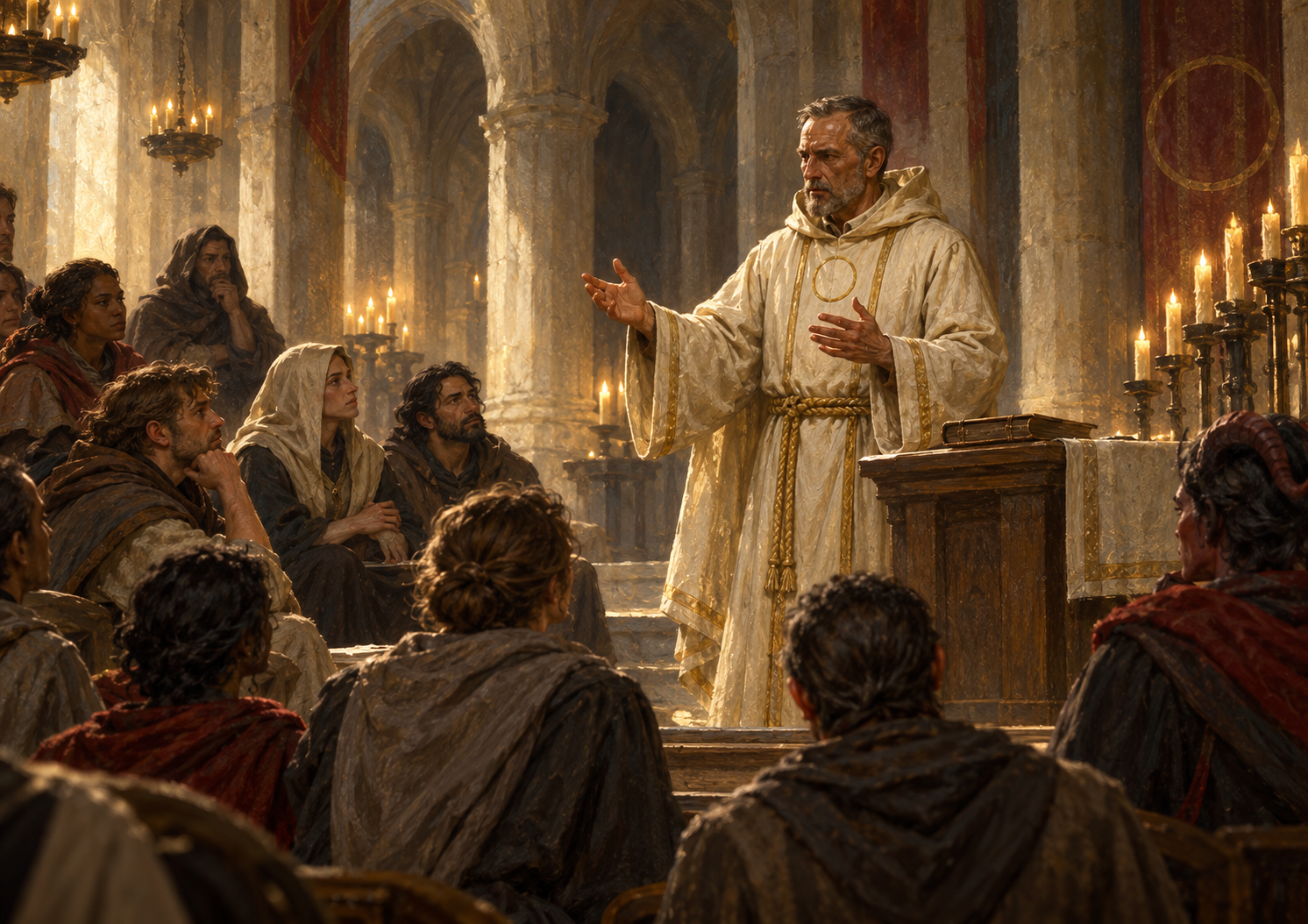
The Faith of Man was the religious tradition described in the Imperian account, centered on disciplined service to the One. Its teachings interpreted existence as an obligation and connected religious practice with law, authority, and civic purpose. The source also uses Faith of the One in discussing those teachings. Banner and Pyre source.
Doctrine of Alignment
The tradition taught that reality possessed a unified order and that moral life required alignment with it. Its own terms treated fragmentation, purposeless suffering, and wasted lives as failures. These are descriptions of the Faith’s moral framework; they do not establish that its adherents possessed complete knowledge of reality or that its judgments were infallible. Banner and Pyre source. Banner and Pyre source.
Practice and Interpretation
Prayer was described as discipline of the will, ritual as habituation, and law as an enforceable expression of doctrine. Interpretation was mediated through trained authorities, hierarchy, and prescribed language. The account presents this mediation as necessary for finite minds; the claim of metaphysical necessity belongs to the tradition. Banner and Pyre source.
Church and Civic Authority
The Imperian Church administered doctrine together with major civil functions. The Inquisition enforced orthodoxy, while the Senate and Great Houses carried out other governing work. The Game Master confirms that the Church understood itself as serving the intentions of the One, as did Gabriel and Glasya; that shared intended service does not identify any of them as the One. October clarification. Banner and Pyre source. Banner and Pyre source.
Holy Texts and Continued Service
The Holy Texts preserved the tradition’s accounts, disciplines, legal interpretation, and ritual language. Its eschatological teaching described service continuing after death under Gabriel’s command. That belief is not independent confirmation of the fate of every soul, and its final-war imagery is not identified with the archive’s unresolved End War. Banner and Pyre source. Banner and Pyre source.
Relation to the Present Cult
Aegean’s service to the One and Primrose’s investigation establish the present Cult of the One as a campaign subject. The common name and theological background do not supply an organizational succession, complete cult creed, or a confirmed identity for the One. Those questions remain open in the current campaign record. Leashira’s October 3 source account.
Historical Scope
The source describes Imperia and its institutions in their own historical setting. It does not locate this institution within an exact reign or establish its survival into the campaign present. The current record of Holy Imperia ends with Sonata’s death more than 6,000 years ago; the empire’s later fate remains unknown. Current chronology clarification.
Sources
- Banner and Pyre lore export: Faith of Man.
- Banner and Pyre lore export: Theological Totalism.
- Banner and Pyre lore export: Holy Imperia.
- Banner and Pyre lore export: Holy Texts.
- Banner and Pyre lore export: Holy Father Gabriel.
- Game Master historical clarifications, October 23, 2026: historical limits and current family/divine canon.