Pronunciation (approximate): IPA /ði ɪmˈpɪriən tʃɝtʃ/ · English: thee im-PEER-ee-un CHURCH
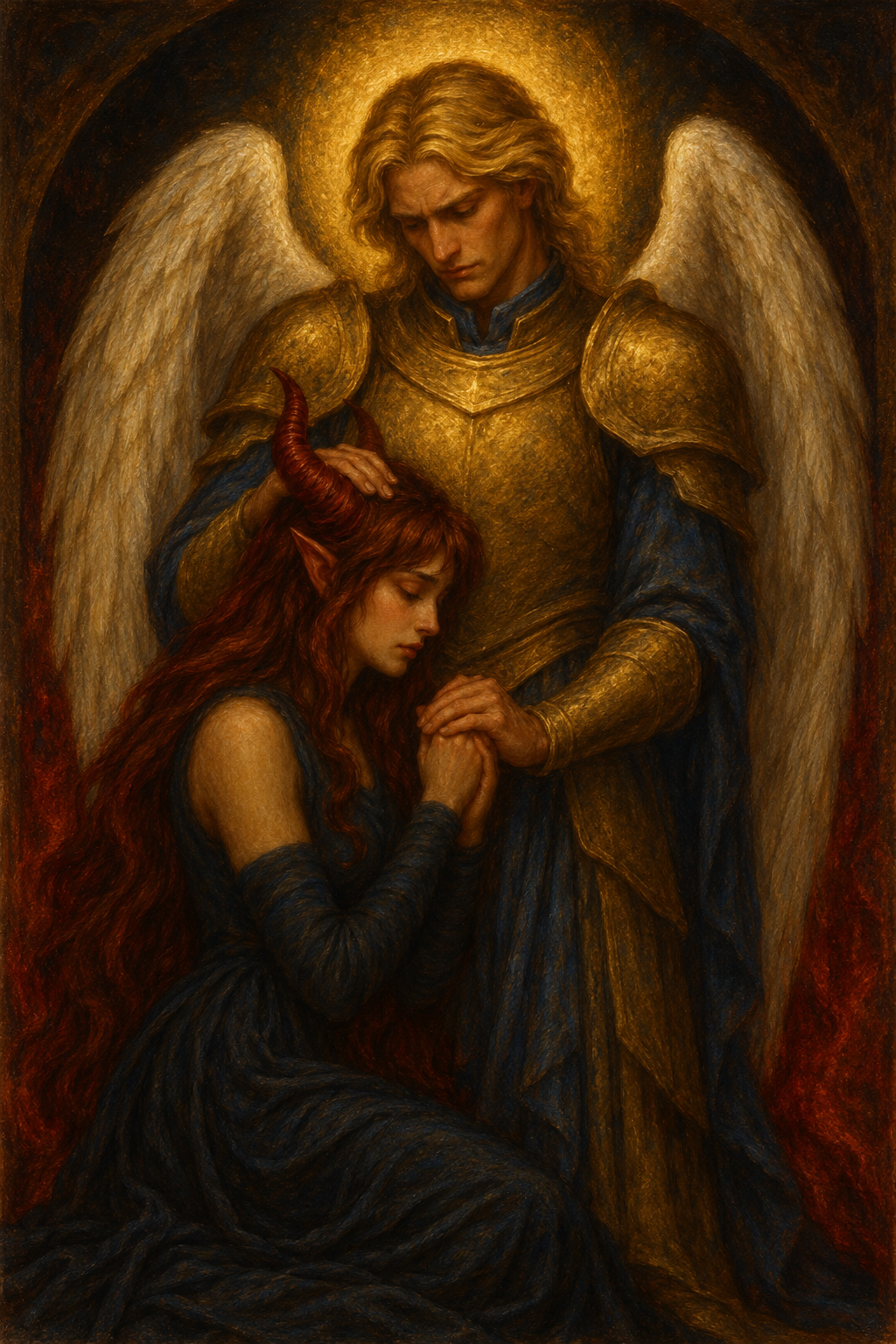
The Imperian Church was the religious authority of Holy Imperia and a central administrator of its civil life. It understood itself as serving the intentions of the One, the same idea served by Gabriel and Glasya. This shared purpose does not identify Gabriel as the One. GM canon, October 23.
Authority in Holy Imperia
The surviving Imperian account assigns the Church education, healthcare, finance, and local governance as well as doctrine and the enforcement of religious vows. Inquisitors enforce religious and legal orthodoxy; paladins act as martial agents of divine authority. The account describes the Church’s power to request an imperial veto of senatorial law, while noting that no refusal of such a request is recorded.
The Church operated within an order that also contained the emperor or empress, the royal family and succession system, the Senate, and the Great Houses. Its spiritual supremacy did not eliminate those institutions. The archive describes a division of work in which the royal family collected and redistributed tax revenues while the Houses administered provinces. Imperian government and economy.
Azelia and the Inquisition
Azelia Bartholomew, a soldier who had received a practical magical education, was confronted by the inquisition with a choice between serving as an inquisitor and death. She chose service. Intelligence from Grand Inquisitors subsequently guided her accumulation of powerful magical items, including the Shard of Evil. GM canon, October 23.
The Church also occupied the station of the Arms of Gabriel in relation to Azelia. This is an appointed protective and shepherding responsibility, not another name for the Church as an organization. GM canon, October 23.
Doctrine and Historical Deeds
The archive presents Imperian public life in a language of faith, obedience, duty, and sacrifice. Its descriptions of divine order are statements of that culture’s doctrine. The Church’s account of itself should be read alongside the acts recorded in Midnight’s Ascension, without assuming that religious language establishes the truth of every interpretation. Imperian religion and philosophy; GM canon, October 23.
The Game Master describes Imperians as generally avoiding deliberate lies. When they discover that a statement is false, they may smooth or reframe it to make it less false or align it with truth. This cultural tendency distinguishes sincerity from accuracy; it does not establish that a particular doctrine is propaganda or fabrication. GM canon, October 23.
Limits of the Record
Known Imperian history ends with Sonata’s death, 6,000 or more years ago. The later fate of the empire and its Church is unknown. The record does not establish the Church’s present survival, membership, or continuity with the Temple of Midnight. GM canon, October 23; GM canon, October 23.
Faith and Institutional Boundaries
The shared-world sources distinguish the Faith of Man’s teachings from the Church’s administration and the Inquisition’s enforcement. The holy-text tradition supplies religious memory and interpretation; the Academy joins instruction with preparation for authority. Their doctrine of alignment is described through theological totalism. These institutional accounts do not establish present Church continuity, replace its confirmed service to the intentions of the One, or equate it with the current Temple or Cult of the One. The wider archive’s vow-of-silence exception to compelled testimony remains preserved. Banner and Pyre source. Banner and Pyre source. Banner and Pyre source. Banner and Pyre source.
Sources
Banner and Pyre: preserved shared-world lore export, with individual source anchors cited in the institutional context above.
Game Master’s October 23, 2026 canon record. Earlier archive context and source distinctions are linked beside the statements they support.