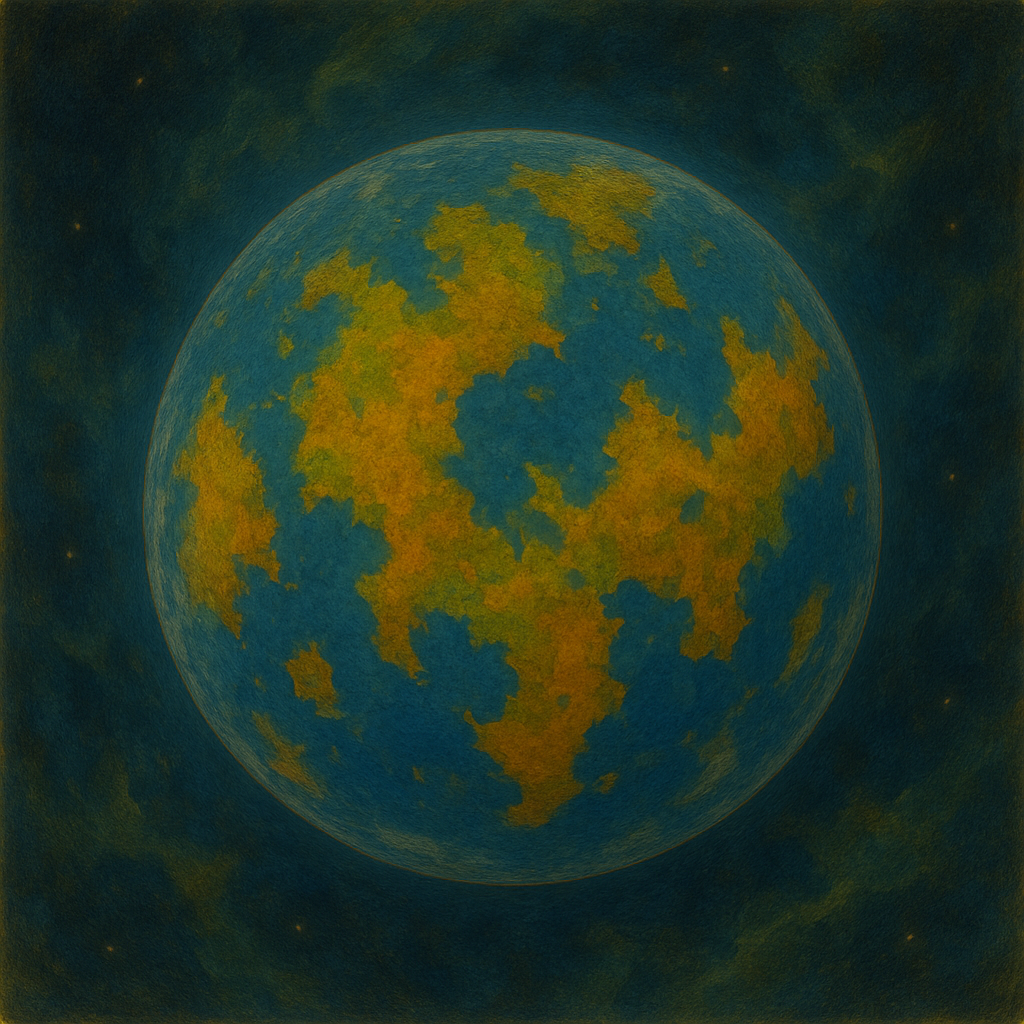
Pronunciation (approximate): IPA /ˈæzɪl/ · English: AZ-il
Azil is a warm-temperate, ocean-bearing terrestrial world orbiting Solaris Primaris once every 360 days. The red dwarf Solaris Secundus supplies the light of the Red Nights; a recurring interval without either star marks the first night of the Festival of the Eclipse. [1] [2]
The numerical values below form the astronomical model requested by the Game Master on October 26, 2026. They are calculated parameters, distinguished from the preserved accounts and artwork. [1] [2]
Astronomical facts
| Class | terrestrial planet |
|---|---|
| Mass | 1 Earth masses |
| Radius | 6,371 km |
| Temperature | 294.1 K (global mean surface) |
| Bond albedo | 0.3 |
| Orbit | 1.000202 AU about Primaris |
| Orbital period | 360.00000 Azil days |
| Rotation | 23.934 hours (sidereal) |
| Axial tilt | 3° |
| Eccentricity | 0 |
| Apparent diameter from Azil | Not applicable to an observer on Azil |
Overview
Azil is a warm-temperate, ocean-bearing terrestrial world orbiting Solaris Primaris once every 360 days. The red dwarf Solaris Secundus supplies the light of the Red Nights; a recurring interval without either star marks the first night of the Festival of the Eclipse. [1] [2]
Physical characteristics
Azil’s model mass and radius equal Earth’s, giving a surface gravity of 9.82 m/s². About 71% ocean coverage and a nitrogen–oxygen atmosphere with water vapour support a vigorous water cycle. The adopted global mean surface temperature is 21 °C: about 6 °C warmer than Earth’s approximate 15 °C reference, with oceans rather than a desert-world climate. At a Bond albedo of 0.30, the 1.1195-Earth insolation gives an equilibrium temperature of 261.9 K (−11.3 °C). A 32.3 K greenhouse difference raises the mean surface to 294.15 K. These are model assumptions, not a full climate simulation; stronger evaporation and rainfall are expected, while individual regional climates remain unspecified. [1] [2]
Orbit and rotation
Azil’s year is exactly 360 solar days, each adopted as 24 hours. Its circular orbit has semimajor axis 1.000202 AU and mean orbital speed 30.23 km/s. The corresponding prograde sidereal rotation is 23.93352 hours: 361 turns relative to the stars per 360-day year. A small 3° axial tilt keeps the seasonal solar variation modest. No month structure or new season names are assigned. Secundus’s perturbations are small corrections to this mean-element orbit, not extra central mass in the two-body year calculation. [1] [2]
Observation from Azil
An observer standing on Azil has no single apparent disk size for the world itself. Primaris is about 0.554° across, while Secundus is about 0.0143–0.0174° (0.86–1.04 arcminutes). Secundus is farther away at conjunction and nearer at opposition. Father is the larger moon orbiting Azil; Song follows its already-recorded wobbly orbit around Father and can pass behind it. Both can appear in a red-tinged night sky. No lunar periods, distances or phases are assigned here. [2]
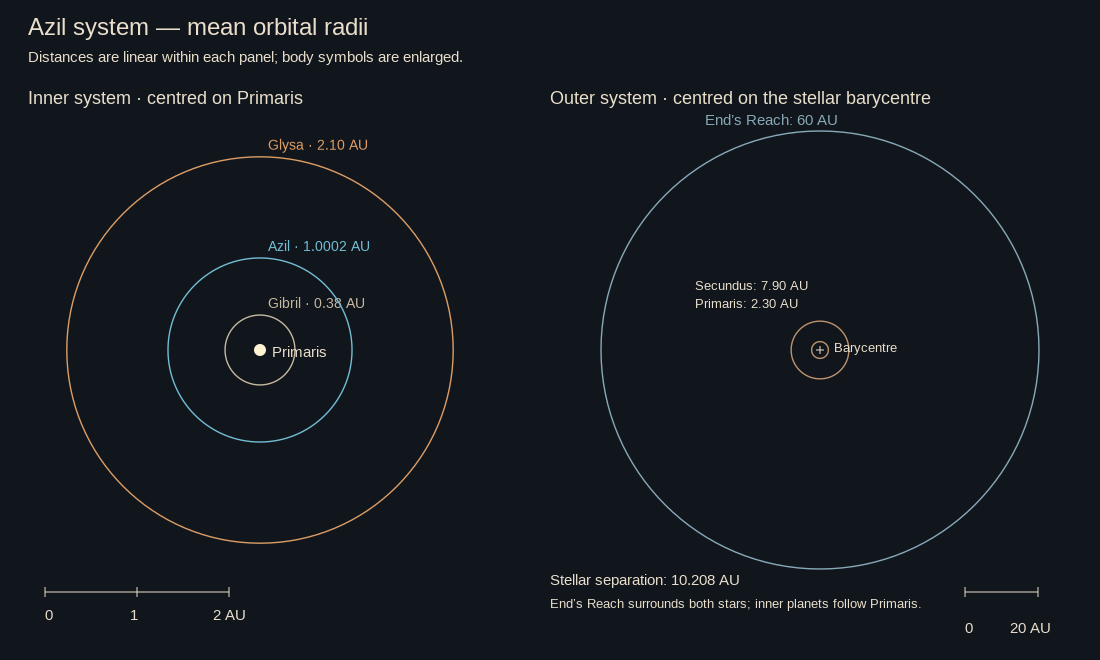
Azil system
Solaris Primaris ☀
  └ Gibril (small rocky)
  └ Azil (habitable world)
  └ Glysa (hot gas giant)
  └ Solaris Secundus (red dwarf)
  └ End’s Reach (cool outer gas giant)
This is the Game Master’s outward ordering. End’s Reach surrounds both stars; the diagram therefore separates Primaris-centred and barycentric scales. [1] [2]
True-dark nights and the Festival of the Eclipse
The Festival of the Eclipse officially starts on the first night of true darkness. At the calculation’s 45° north reference latitude, the model gives one complete starless sunset-to-sunrise night every 373 days (1.0361 Azil years), with the calendar position shifting 13 days per year. This is a reference latitude, not a measured latitude for Vesper Court. In the computational epoch, the first starts at sunset on Year 0 Day 19, absolute day 19.742739, and ends at day 20.257266: about 12 hours 21 minutes. [1] [2]
The calculation checks the entire night: Primaris’s upper limb has set, and Secundus’s upper limb stays below the level geometric horizon. The finite stellar disks make this narrow conjunction window possible; simply declaring a broad elongation cutoff would give the wrong count. Over the repeating mean-element cycle, each true-dark night lasts about 11.55–12.35 hours. “True darkness” here excludes direct starlight, not twilight, moonlight or artificial light. No lunar phases are inferred.
The mean Red Nights opposition follows conjunction by 186.5 days, half the synodic period. The festival’s dates and night count are model-dependent; no duration of festival celebrations, rites or participants is supplied. [2]
Preserved campaign record
Azil's Heavens
Azil lies in a binary star system. It orbits Solaris Primaris; the red star Solaris Secundus lies farther away and causes the Red Nights. Two moons accompany the world: Father, which orbits Azil, and Song, which follows a wobbly orbit around Father.
Sources
- Game Master direction, October 26, 2026: fixed order, 360-day year and festival rule.
- Calculated astronomical model: numerical assumptions, visibility, stability and timing, with primary scientific references.
Sources
Supplied by the campaign's Game Master on October 11, 2026.