Pronunciation (approximate): IPA /soʊˈlɛrɪs praɪˈmɛrɪs/ · English: soh-LAIR-iss pry-MAIR-iss
Solaris Primaris is the principal star of the Azil binary system and the sun around which Gibril, Azil and Glysa orbit. Its pale cream-white daylight supports Azil’s warm, ocean-bearing climate. [1] [2]
The numerical values below form the astronomical model requested by the Game Master on October 26, 2026. They are calculated parameters, distinguished from the preserved accounts and artwork. [1] [2]
Astronomical facts
| Class | G1 V |
|---|---|
| Mass | 1.03 solar masses |
| Radius | 723,528 km |
| Temperature | 5822.6 K (effective) |
| Luminosity | 1.12 solar |
| Orbit | 2.302530 AU about the stellar barycentre |
| Orbital period | 10329.23077 Azil days |
| Rotation | 240 hours (sidereal) |
| Axial tilt | 7° |
| Eccentricity | 0 |
| Apparent diameter from Azil | 0.554° |
Overview
Solaris Primaris is the principal star of the Azil binary system and the sun around which Gibril, Azil and Glysa orbit. Its pale cream-white daylight supports Azil’s warm, ocean-bearing climate. [1] [2]
Physical characteristics
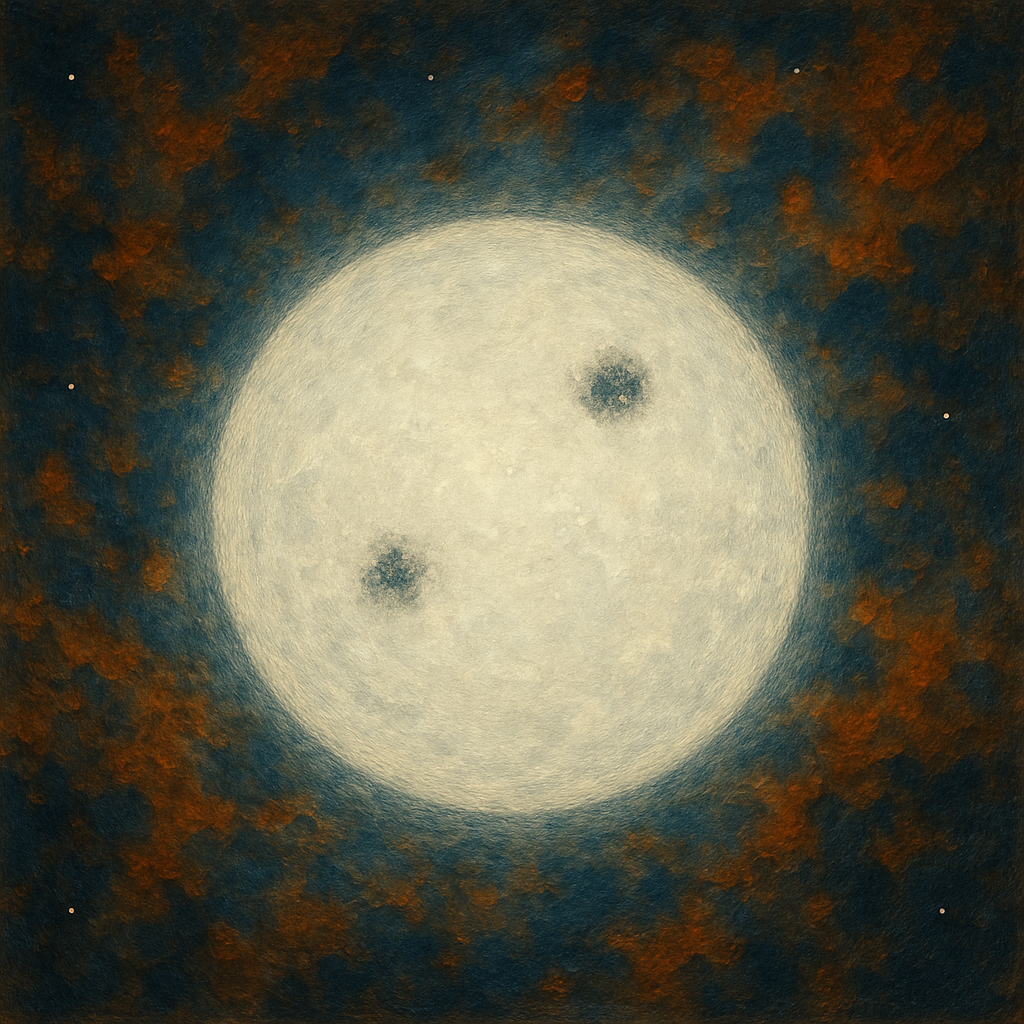
Primaris is represented by a G1 V main-sequence star of 1.03 solar masses and 1.04 solar radii, with an effective temperature of about 5,823 K and luminosity of 1.12 times the Sun’s. Its continuum is white with a pale cream appearance; the preserved artwork’s cool halo and two sunspots are illustrative rather than a temperature map. The model adopts an age of 0.8 billion years and solar metallicity ([Fe/H] = 0). [1] [2]
Orbit and rotation
Primaris and Secundus orbit their common centre of mass every 10,329.23 Azil days (28.6923 Azil years), at a constant relative separation of 10.2079 AU. Primaris’s own barycentric radius is 2.3025 AU; its speed about that centre is about 2.43 km/s. Azil’s orbit is calculated around Primaris’s 1.03 solar masses, not the combined binary mass. Primaris rotates once in 10 days; its adopted spin tilt is 7° relative to the orbital normal. [1] [2]
Observation from Azil
At Azil’s nearly 1.0002 AU orbital radius, Primaris spans about 0.554° (33.25 arcminutes). The circular orbit keeps this almost constant at conjunction and opposition with Secundus. Quiescent normal illuminance above the atmosphere is about 140,900 lux; the adopted clear atmosphere transmits about 105,700 lux onto a horizontal surface with the star overhead. Primaris supplies white-cream daylight; atmospheric scattering can still make the daytime sky blue. [2]
Variability and activity
The epigraph’s “breathing” is represented by gentle rotational spot modulation with a ten-day period and a luminosity semi-amplitude of 0.05% (0.1% peak to peak). It is not a large radial pulsation. Sunspots and ordinary magnetic activity can coexist with otherwise steady daylight; the illustrated pair of spots does not imply permanent marks. [1] [2]
Preserved campaign record
Light in Dina's Vision
Solaris Primaris appears in Dina's August 1 vision, triggered when she joins a celestial tablet to the pillar beneath Rashkhan's palace. After an out-of-body passage through stars and worlds, she finds herself near the place where she grew up. A white star shines over a hill, identified in her notes as Solaris Primaris, casting a peaceful glow.
Petorin appears beside her during the experience, and a voice addresses Dina as a lost child and inheritor. The handwritten account records this encounter without identifying the speaker as the star itself or establishing a physical journey to Solaris Primaris.
Azil's Sun
Solaris Primaris is the star that Azil orbits. It is the nearer star of a binary system; its companion, Solaris Secundus, is a red star farther away. Supplied by the campaign's Game Master on October 11, 2026.
Sources
- Game Master direction, October 26, 2026: fixed order, 360-day year and festival rule.
- Calculated astronomical model: numerical assumptions, visibility, stability and timing, with primary scientific references.