Pronunciation (approximate): IPA /ˈɡlaɪsə/ · English: GLY-suh
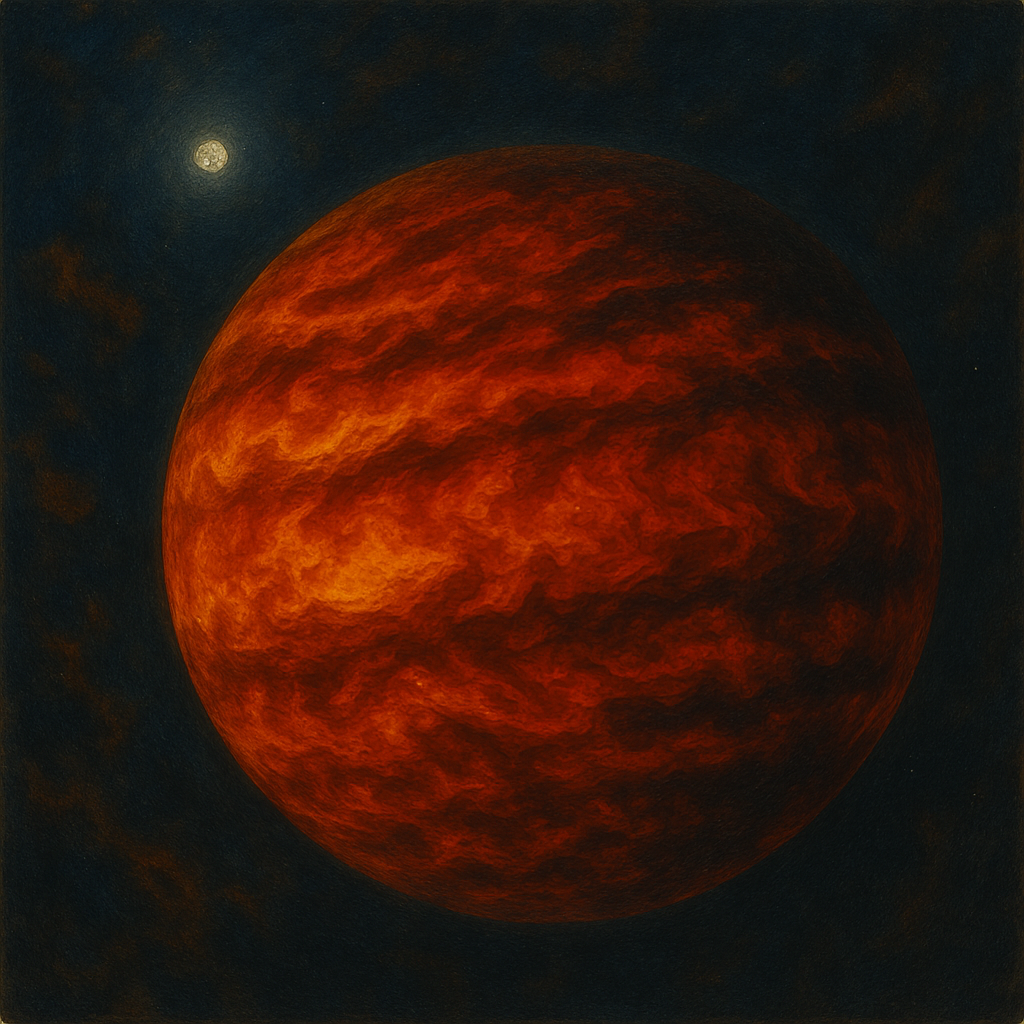
Glysa is a massive, internally hot gas giant orbiting Solaris Primaris outside Azil. Its own retained formation heat, rather than proximity to either star, accounts for its hot radiating atmosphere. [1] [2]
The numerical values below form the astronomical model requested by the Game Master on October 26, 2026. They are calculated parameters, distinguished from the preserved accounts and artwork. [1] [2]
Astronomical facts
| Class | gas giant |
|---|---|
| Mass | 10 Jupiter masses |
| Radius | 73,407 km |
| Temperature | 452.7 K (effective) |
| Bond albedo | 0.35 |
| Orbit | 2.100000 AU about Primaris |
| Orbital period | 1090.17780 Azil days |
| Rotation | 10 hours (sidereal) |
| Axial tilt | 3° |
| Eccentricity | 0.02 |
| Apparent diameter from Azil | 65–191 arcseconds |
Overview
Glysa is a massive, internally hot gas giant orbiting Solaris Primaris outside Azil. Its own retained formation heat, rather than proximity to either star, accounts for its hot radiating atmosphere. [1] [2]
Physical characteristics
Glysa’s adopted mass is 10 Jupiter masses and its radius 1.05 Jupiter radii. Its hydrogen–helium envelope has no solid visible surface; gravity at the adopted radius is about 235 m/s². With a Bond albedo of 0.35, stellar irradiation alone gives an equilibrium temperature of about 177 K. Residual formation heat supplies an intrinsic effective temperature of 450 K, producing a combined effective radiating temperature of about 453 K (180 °C). The shared model age is 0.8 billion years; slow cooling of a massive young giant supplies the heat without inventing an outburst or close stellar encounter. This is a chosen cooling state, not an exact evolutionary-track fit. No rings or satellite census are specified. [1] [2]
Orbit and rotation
The adopted semimajor axis is 2.10 AU, eccentricity 0.02, period 1090.18 Azil days (3.028 Azil years) and characteristic circular speed 20.96 km/s. The orbital plane is shared with Azil. Its 10-hour sidereal rotation and 3° spin tilt are model parameters. The orbit lies well inside the 3.8615 AU circumprimary stability boundary. The binary companion does not cross the planetary orbit. [1] [2]
Observation from Azil
As an outer planet, Glysa can be seen far from Primaris’s glare, including near opposition. Conservative orbital-distance bounds put its apparent diameter at roughly 65–191 arcseconds (1.1–3.2 arcminutes). The internal heat that makes Glysa hot is mainly infrared and does not make it a second visible sun. Reflection from the stars still governs ordinary naked-eye appearance. [2]
Sources
- Game Master direction, October 26, 2026: fixed order, 360-day year and festival rule.
- Calculated astronomical model: numerical assumptions, visibility, stability and timing, with primary scientific references.