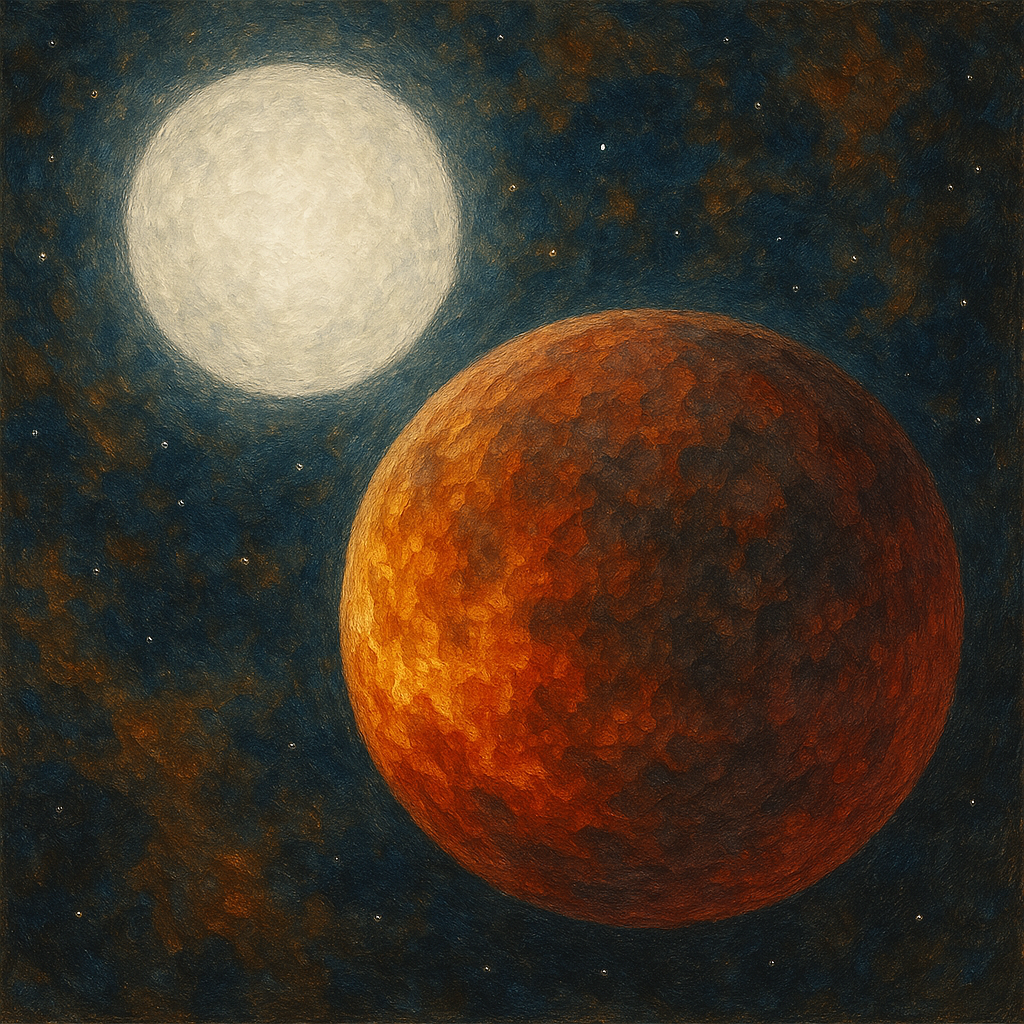
Pronunciation (approximate): IPA /dʒɪˈbril/ · English: jih-BREEL
Gibril is the small rocky innermost planet of Solaris Primaris. Its close orbit gives it a short year and a hot, nearly airless surface. [1] [2]
The numerical values below form the astronomical model requested by the Game Master on October 26, 2026. They are calculated parameters, distinguished from the preserved accounts and artwork. [1] [2]
Astronomical facts
| Class | rocky planet |
|---|---|
| Mass | 0.12 Earth masses |
| Radius | 3,313 km |
| Temperature | 449.9 K (global radiative equilibrium) |
| Bond albedo | 0.12 |
| Orbit | 0.380000 AU about Primaris |
| Orbital period | 84.30376 Azil days |
| Rotation | 1400 hours (sidereal) |
| Axial tilt | 1° |
| Eccentricity | 0.03 |
| Apparent diameter from Azil | 7–15 arcseconds |
Overview
Gibril is the small rocky innermost planet of Solaris Primaris. Its close orbit gives it a short year and a hot, nearly airless surface. [1] [2]
Physical characteristics
The model gives Gibril 0.12 Earth masses and 0.52 Earth radii, with a mean density of about 4.7 g/cm³ and surface gravity of 4.36 m/s². A silicate crust and iron-rich interior are consistent with that density. Its Bond albedo is 0.12. A negligible mineral exosphere provides little heat redistribution: the approximately 450 K equilibrium temperature is a whole-body radiation balance, not a uniform ground temperature. The surface facing the star can be much hotter and the long night much colder. No rings or satellites are assigned. [1] [2]
Orbit and rotation
The adopted semimajor axis is 0.38 AU, eccentricity 0.03, period 84.30 Azil days (0.234 Azil years) and characteristic circular speed 49.04 km/s. The orbital plane is shared with Azil. Its 1400-hour sidereal rotation and 1° spin tilt are model parameters. The orbit lies well inside the 3.8615 AU circumprimary stability boundary. The binary companion does not cross the planetary orbit. [1] [2]
Observation from Azil
Gibril remains near Primaris in Azil’s sky. Its greatest elongation is approximately 23° in the circular comparison, making dawn and dusk its principal viewing opportunities. Its disk is roughly 7–15 arcseconds across, using the conservative minimum and maximum distances allowed by the adopted inner orbit. Those are geometric size bounds, not a visibility guarantee through Primaris’s glare. [2]
Sources
- Game Master direction, October 26, 2026: fixed order, 360-day year and festival rule.
- Calculated astronomical model: numerical assumptions, visibility, stability and timing, with primary scientific references.