Pronunciation (approximate): IPA /soʊˈlɛrɪs səˈkʌndəs/ · English: soh-LAIR-iss suh-KUN-dus
Solaris Secundus is the red dwarf companion of Solaris Primaris. Its orbit lies beyond Glysa and inside the circumbinary orbit of End’s Reach; its changing position against Primaris produces the Red Nights and the conjunctions associated with true-dark nights. [1] [2]
The numerical values below form the astronomical model requested by the Game Master on October 26, 2026. They are calculated parameters, distinguished from the preserved accounts and artwork. [1] [2]
Astronomical facts
| Class | M3 V |
|---|---|
| Mass | 0.30 solar masses |
| Radius | 208,710 km |
| Temperature | 3400.0 K (effective) |
| Luminosity | 0.010836 solar |
| Orbit | 7.905354 AU about the stellar barycentre |
| Orbital period | 10329.23077 Azil days |
| Rotation | 72 hours (sidereal) |
| Axial tilt | 5° |
| Eccentricity | 0 |
| Apparent diameter from Azil | 0.0143–0.0174° |
Overview
Solaris Secundus is the red dwarf companion of Solaris Primaris. Its orbit lies beyond Glysa and inside the circumbinary orbit of End’s Reach; its changing position against Primaris produces the Red Nights and the conjunctions associated with true-dark nights. [1] [2]
Physical characteristics
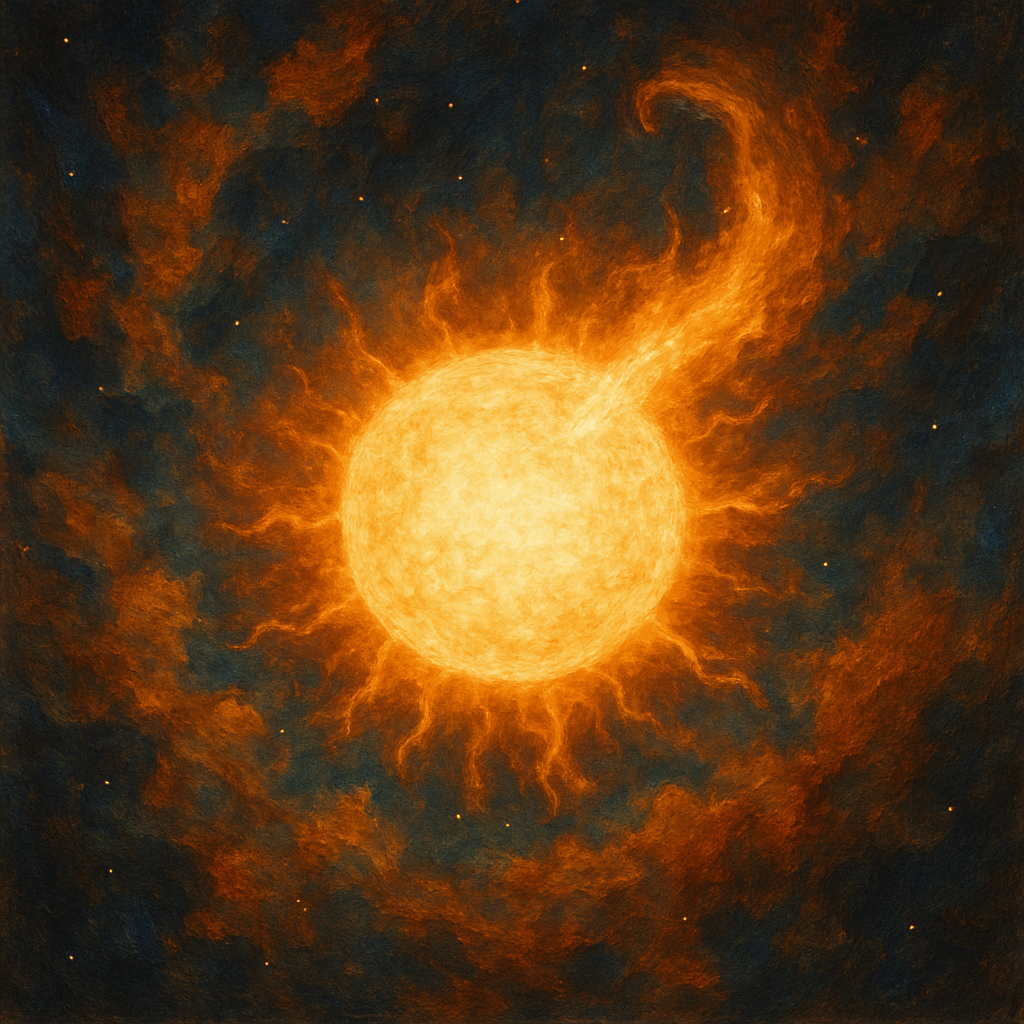
Secundus is represented by an M3 V red dwarf of 0.30 solar masses and 0.30 solar radii, with an effective temperature of 3,400 K and luminosity of about 0.0108 solar luminosities. Its cooler photosphere supplies red-orange light consistent with the preserved flaring orange-disc reference. The model shares Primaris’s age of 0.8 billion years and solar metallicity. Red dwarf is a stellar classification, not a claim that its light contributes substantial warmth to Azil. [1] [2]
Orbit and rotation
Secundus follows a circular, coplanar binary orbit with relative separation 10.2079 AU and period 10,329.23 Azil days. Its own barycentric radius is 7.9054 AU and barycentric speed about 8.33 km/s; 10.75 km/s is the stars’ relative orbital speed. Its 72-hour rotation and 5° adopted spin tilt are independent of Azil’s calendar. The empirical stability limit for planets around Primaris is about 3.8615 AU, safely beyond Glysa’s 2.142 AU apocentre; the outer circumbinary critical radius is 23.1755 AU, safely inside End’s Reach’s 58.8 AU pericentre. [1] [2]
Observation from Azil
Secundus’s mean distance from Azil is about 10.23 AU; circular near/far limits are about 9.208 AU at opposition and 11.208 AU at conjunction. Its apparent diameter ranges from 1.04 to 0.86 arcminutes, about one-thirtieth of Primaris’s disk. At the mean distance it supplies roughly 4.8 lux on a plane normal to the rays above the atmosphere; the unocculted extrema are 5.90 and 3.98 lux. With the star overhead, the clear-air horizontal values are about 4.43 and 2.99 lux. A low star supplies less. This is brighter than typical full moonlight (roughly 0.1–0.3 lux) and comparable in scale to dim twilight, while far below ordinary daylight. Actual sky colour depends on scattering and dark adaptation; the blood-red sky of the artwork remains an artistic rendering of the established Red Nights. At exact conjunction Primaris occults Secundus, so its direct visible light briefly falls to zero. [2]
Variability and activity
Magnetic spots and irregular stellar flares give physical meaning to the archive’s “restless” light. Flare dates, energies and any biological effects on Azil remain unspecified. The quoted illuminance describes the quiescent star, so a chosen flare cannot silently change festival dates or the climate balance. [1] [2]
Preserved campaign record
The Red Star
Solaris Secundus is the red star of Azil's binary star system. Azil orbits Solaris Primaris; Secundus lies farther away. Its light is what turns the sky red during the Red Nights of Secundus.
Sources
- Game Master direction, October 26, 2026: fixed order, 360-day year and festival rule.
- Calculated astronomical model: numerical assumptions, visibility, stability and timing, with primary scientific references.
Sources
Supplied by the campaign's Game Master on October 11, 2026.