Pronunciation (approximate): IPA /rɛd naɪts əv səˈkʌndəs/ · English: RED NYTS uv suh-KUN-dus
Orbital geometry and calculated timing
Secundus lights the night side most strongly near opposition, rising around Primaris’s sunset and remaining visible through much of the night. Its light is red-orange. The mean opposition occurs 186.5 days after conjunction in the 373-day synodic cycle; exact local rise, set and illuminance depend on latitude and season. The model supplies about 3.98–5.90 lux of unocculted normal illumination above the atmosphere, before horizon projection and atmospheric loss. [2]
At the calculation’s 45° north reference latitude, the opposite conjunction geometry gives one full true-dark night per 373 days. The Festival of the Eclipse officially starts on the first night of true darkness. This does not specify celebration length or lunar phases. The existing Father/Song orbital relationship and the red-sky artwork are preserved; no new moon measurements are asserted. [1] [2]
Preserved campaign record
The Red Sky
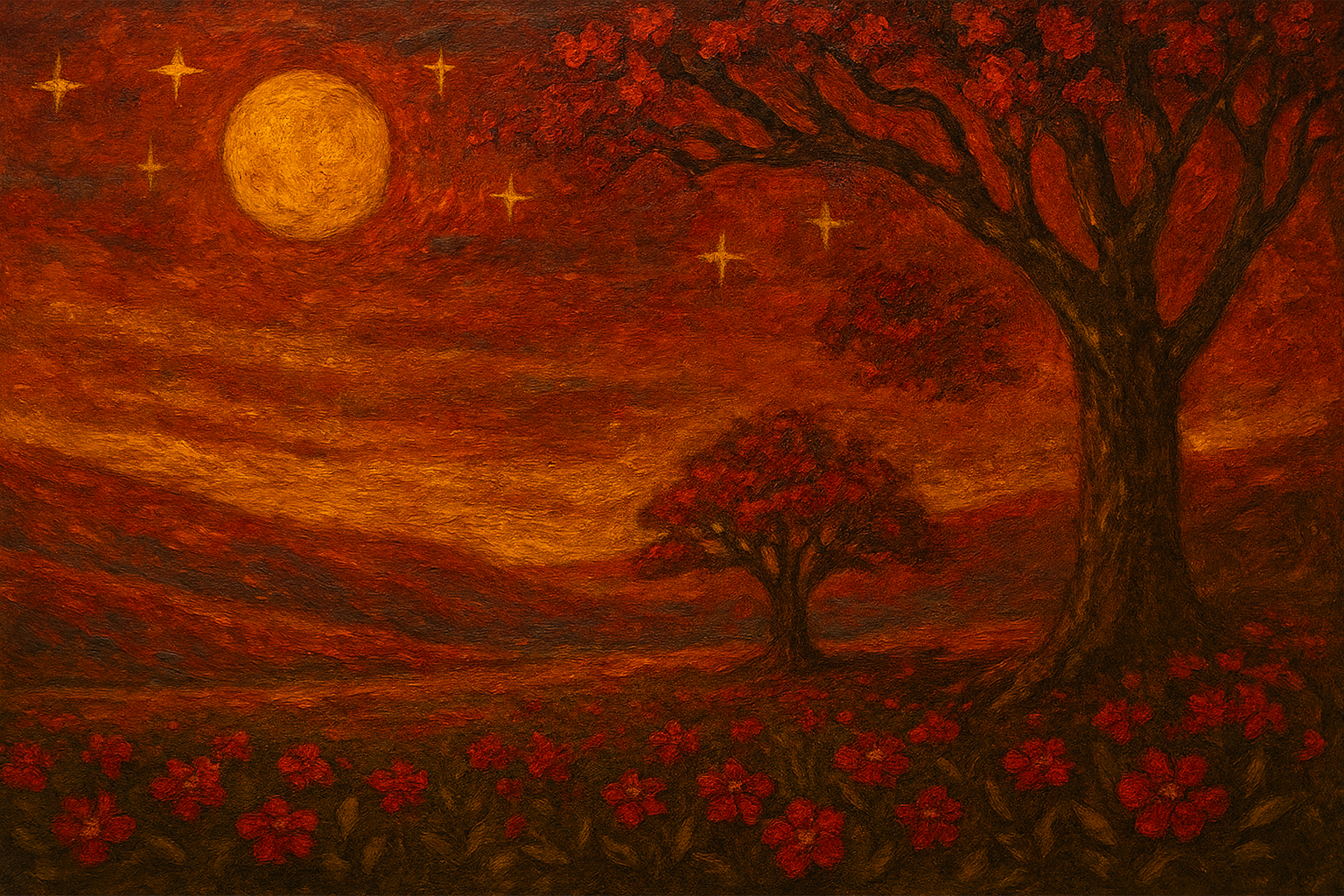
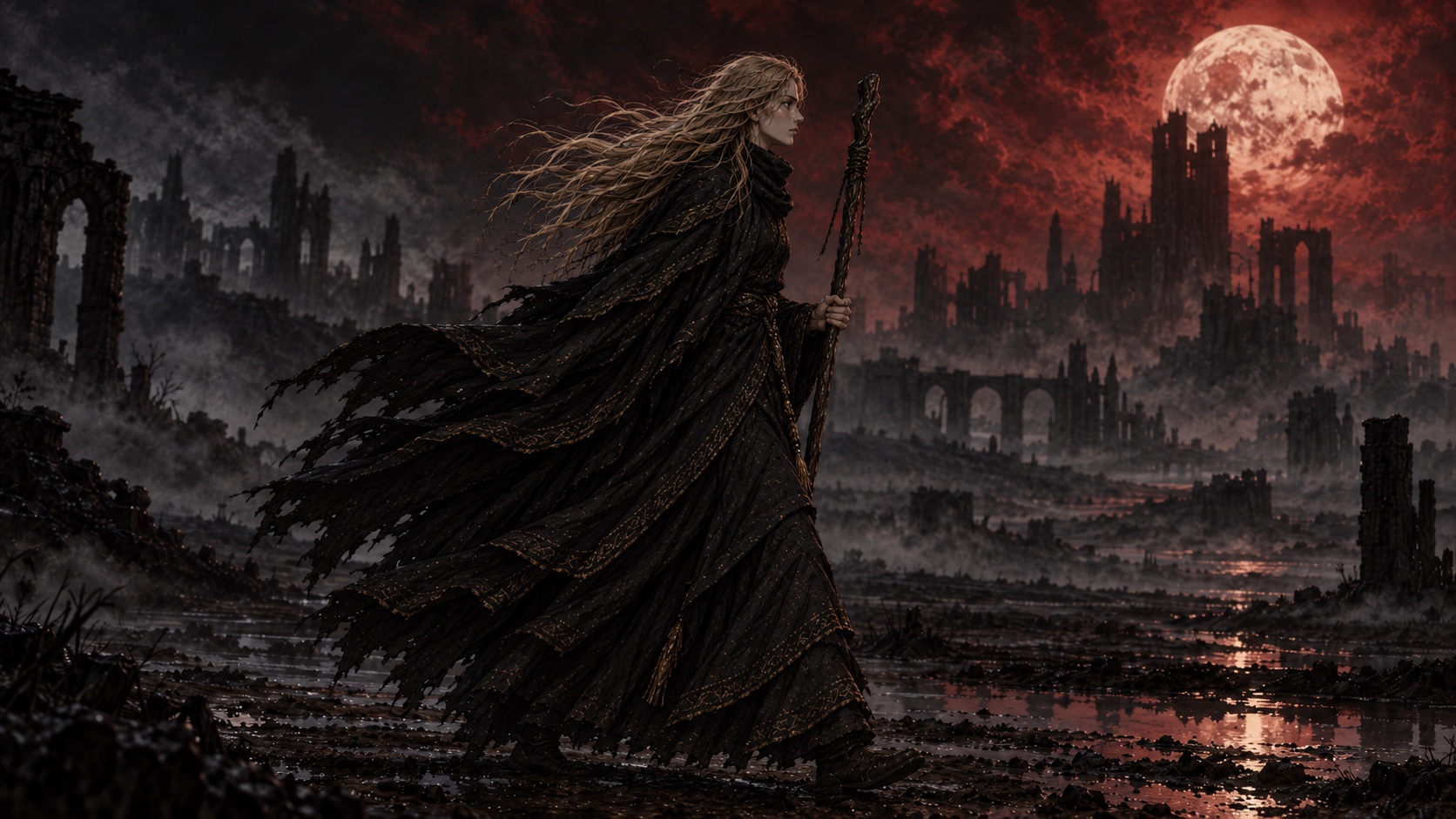
Azil lies in a binary star system. The world orbits Solaris Primaris, while Solaris Secundus is the red star farther away. The Red Nights of Secundus are the nights when the red star's light turns Azil's sky to blood. Under them, the moon Father hangs in a red heaven.
The lead painting, supplied by the campaign's Game Master on October 11, 2026, shows Melody walking from a ruined city beneath Father on a Red Night. The scene it depicts has not been tied to a recorded session.
Sources
- Game Master direction, October 26, 2026: fixed order, 360-day year and festival rule.
- Calculated astronomical model: numerical assumptions, visibility, stability and timing, with primary scientific references.
Sources and Open Questions
Supplied by the campaign's Game Master on October 11, 2026. Before the October 26 astronomical model, the recurrence and duration had not been recorded; the calculated geometry is given below.